Loong Air Files Shanghai IPO As Hangzhou Carrier Targets A320 Fleet Growth
China’s Loong Air has taken a major step toward a public listing, submitting its application for an initial public offering on the main board of the Shanghai Stock Exchange.
The Hangzhou-based full-service carrier, formally Zhejiang Loong Airlines Co., Ltd., is seeking to raise up to CNY2.0 billion through the sale of new A-shares. The airline plans to use the proceeds to support Airbus A320-family aircraft introductions, acquire spare engines, and strengthen working capital.
The filing is significant for China’s airline sector. If completed, Loong Air would become one of the few privately backed Chinese passenger airlines to access the A-share market and the first domestic passenger airline IPO in years. It would also give investors a closer look at one of China’s more important second-tier carriers, an airline that has built its business around Hangzhou Xiaoshan International Airport (HGH), an all-Airbus narrowbody fleet, and a growing domestic and regional network.
Read our stories in your inbox
Two aviation newsletters. Zero fluff.
The key point is that this is still an application, not a completed listing. Loong Air has filed its prospectus and the Shanghai Stock Exchange has accepted the application, but the airline still faces the normal review and approval process before any shares can trade publicly.
Loong Air Seeks CNY2 Billion From Shanghai Listing
Loong Air’s draft prospectus sets out a plan to issue at least 92.4564 million shares, representing no less than 10% of the company’s post-IPO share capital.
The airline is targeting gross proceeds of up to CNY2.0 billion. Huatai United Securities is serving as the sponsor and sole lead underwriter for the listing.
The use of proceeds is tightly linked to Loong Air’s aviation business. The largest portion, CNY1.01 billion, is allocated to spare engine purchases. Another CNY860 million is earmarked for Airbus A320-family aircraft introductions, while CNY130 million is set aside to supplement working capital.
That funding mix says a lot about the airline’s priorities. Loong Air is not raising money for a speculative side business. It is raising capital to support fleet growth, reliability, and day-to-day operating flexibility.
For an airline built around a single aircraft family, spare engine availability is not a minor issue. It directly affects dispatch reliability, maintenance planning, aircraft utilization, and the ability to keep the schedule intact during engine shop visits or unexpected technical events.
An All-Airbus A320 Family Airline
Loong Air’s fleet strategy is one of the clearest parts of the investment case.
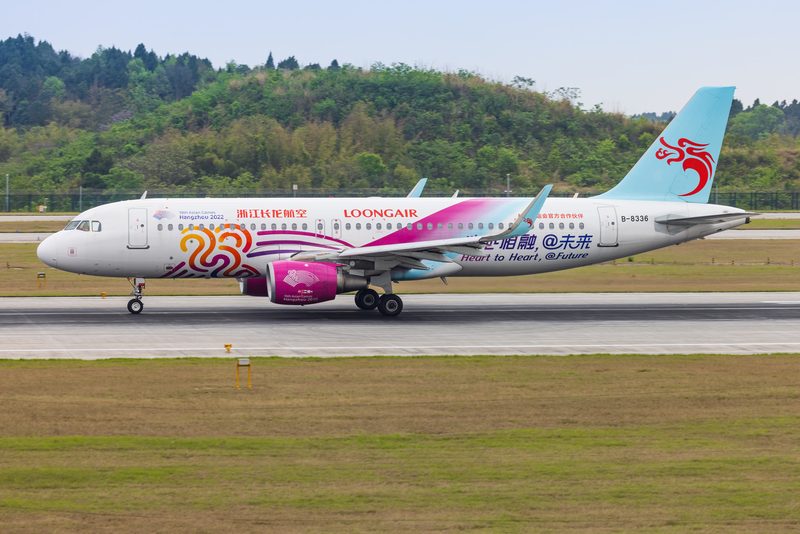
The airline operates an all-Airbus A320-family fleet, including A319, A320, A320neo, and A321neo aircraft. Current public fleet data and Chinese securities reporting place the operating fleet at 77 aircraft, with the company’s prospectus and local media noting an average fleet age of 6.41 years as of the end of 2025.
That is a relatively young fleet by global airline standards. It also gives Loong Air a degree of operating commonality that many larger carriers would welcome. A single narrowbody family simplifies pilot training, maintenance, spare parts, scheduling, and operational planning. It also allows the airline to move aircraft more flexibly across domestic trunk routes, secondary city pairs, and regional international services.
The Airbus A320 family is particularly well suited to Loong Air’s network. The A320 and A320neo can handle the bulk of Chinese domestic flying from Hangzhou (HGH), while the A321neo provides additional capacity on higher-demand routes. The smaller A319 gives flexibility where airport performance, demand, or route length favors a lower-capacity aircraft.
This matters because Loong Air is not a long-haul airline. Its model is built around narrowbody flying from a strong regional base. The A320 family is the right tool for that job.
Why Spare Engines Matter
The largest single use of proceeds is spare engines, and that deserves attention.
For passengers, engines are invisible unless something goes wrong. For an airline, spare engine coverage is fundamental. Modern turbofan engines are expensive, maintenance-intensive assets, and an aircraft can quickly become unavailable if an engine is removed and no spare is ready.
This is especially important for airlines operating A320neo-family aircraft. Across the global industry, new-generation narrowbody engines have faced durability and inspection challenges, particularly in hot, dusty, high-utilization, and short-cycle operating environments. Airlines with stronger spare engine pools are better positioned to protect schedules when engines require maintenance.
Loong Air’s decision to allocate more than half of its planned IPO proceeds to spare engines suggests a focus on operational resilience. The airline wants enough engine support to keep a growing A320-family fleet flying reliably.
That is a practical use of capital. An aircraft order may create growth, but spare engines protect the growth already in the schedule.
Hangzhou Is Central To The Story
Loong Air is based at Hangzhou Xiaoshan International Airport (HGH), one of the most important airports in eastern China.
Hangzhou (HGH) gives the airline a strong home market in Zhejiang province, one of China’s most economically important regions. The city sits near the Yangtze River Delta, close to Shanghai but distinct enough to support its own aviation demand. Hangzhou is also a major technology, e-commerce, tourism, manufacturing, and services hub.
That local economic base helps explain why Loong Air has grown quickly. The airline is not trying to build from a weak regional market. It is based in one of China’s strongest provincial economies, with access to both business and leisure demand.
The prospectus also describes a broader base structure. Loong Air uses Hangzhou (HGH) as its main base, with Ningbo Lishe International Airport (NGB) and Wenzhou Longwan International Airport (WNZ) serving as secondary bases. It also has additional operating support from Jiaxing and branch operations in cities including Chengdu, Xi’an, and Guangzhou.
That structure gives Loong Air a Zhejiang-centered network with broader reach across China. It is not a national giant on the scale of Air China, China Eastern, or China Southern, but it has a defined regional platform and a clear role in eastern China’s aviation market.
A Profitable Growth Story
Loong Air’s financial performance is a major reason the IPO will attract attention.
According to financial data from the prospectus cited in Chinese securities reporting, the airline generated revenue of CNY9.014 billion in 2023, CNY10.009 billion in 2024, and CNY10.648 billion in 2025. Net profit rose from CNY171 million in 2023 to CNY631 million in 2024 and CNY692 million in 2025.
That is notable because airline profitability can be volatile, especially in China’s competitive domestic market. Fuel prices, exchange rates, aircraft ownership costs, airport charges, seasonality, and fare competition can all pressure margins.
Loong Air’s reported profit growth suggests it has reached meaningful scale while maintaining operational discipline. The airline also carried more than 14 million passengers in 2025, with a reported load factor of 88.39% and aircraft daily utilization of 9.42 hours.
Those are useful operating indicators. Load factor alone does not prove profitability, because fares and costs matter just as much. But high load factors combined with rising revenue and profits suggest Loong Air has built a reasonably efficient platform.
A Full-Service Carrier In A Competitive Market
Loong Air describes itself as a full-service airline rather than a low-cost carrier.
That positioning matters in China, where the domestic airline market includes the three state-owned giants, large privately backed airlines, regional operators, and low-cost players such as Spring Airlines. Loong Air’s challenge is to differentiate itself while competing in a market where capacity can grow quickly and fares can come under pressure.
The airline’s full-service model allows it to target business, leisure, visiting-friends-and-relatives, student, and tourism demand. It also supports a more flexible product structure than a pure low-cost model.
At the same time, Loong Air benefits from narrowbody fleet simplicity. Its all-A320-family operation gives it some of the cost and efficiency advantages more commonly associated with lower-cost carriers, even while maintaining a full-service positioning.
That combination may be important for investors. Loong Air is not the cheapest operator in the market, but it is not a complex multi-fleet legacy airline either.
A320 Family Growth Fits The Network
The planned investment in A320-family aircraft introductions aligns with Loong Air’s network strategy.
China’s domestic market remains one of the largest aviation markets in the world, and demand continues to grow over the long term despite short-term economic and pricing cycles. A320-family aircraft are well suited to China’s dense domestic city pairs, medium-haul regional flights, and international services within East Asia, Southeast Asia, and Central Asia.
Loong Air already operates routes across China and into nearby international markets. From Hangzhou (HGH), the A320 family can cover a wide range of destinations, including major domestic cities, leisure markets, and regional international points.
The A321neo is particularly useful as Loong Air grows. With more seats than the A320neo and better economics than older-generation aircraft, it can support high-demand domestic trunk routes without requiring the airline to introduce widebodies. For a carrier focused on narrowbody network growth, the A321neo is a natural capacity tool.
The A320neo also brings lower fuel burn and better environmental performance than older A320ceo aircraft. That matters because fuel remains one of the largest airline cost items, and Chinese airlines, like carriers worldwide, are under pressure to improve efficiency.
IPO Comes After Guidance Review
Loong Air’s filing follows completion of China’s IPO guidance process in late May.
In China, companies preparing to list typically undergo a tutoring or guidance process with their sponsor institution before submitting a formal IPO application. That process is designed to prepare the company for public-market requirements, corporate governance standards, disclosure obligations, and regulatory review.
Reports around Loong Air’s guidance process noted that Huatai United Securities was the tutoring institution and is now serving as the sponsor and lead underwriter.
That sequence indicates Loong Air has moved from preparation into the formal review phase. The listing is still not guaranteed, but the application’s acceptance by the Shanghai Stock Exchange is a major step.
Why This Matters For China’s Airline Sector
China has relatively few publicly listed passenger airlines compared with the size of its aviation market.
The largest names, including Air China, China Eastern Airlines, China Southern Airlines, Hainan Airlines, Spring Airlines, Juneyao Air, and China Express Airlines, already give investors exposure to different parts of the sector. But new passenger airline listings have been rare.
If Loong Air completes the IPO, it would add another privately backed airline to the A-share market. That would be notable because China’s airline sector is still heavily shaped by state-linked carriers and large groups.
Loong Air’s listing could also provide a fresh benchmark for how Chinese investors value a profitable, regionally focused, all-Airbus narrowbody airline based in a strong provincial economy.
For the airline itself, the IPO would provide more than capital. It would also improve visibility, strengthen the balance sheet, and potentially support future aircraft financing.
Risks Investors Will Watch
The investment case is not without risk.
Airlines are capital-intensive businesses. Aircraft purchases, engine maintenance, leases, airport costs, fuel, labor, and technology systems all require constant investment. Loong Air’s own prospectus shows that future growth depends on continued fleet expansion, strong maintenance support, and reliable access to capital.
Fuel prices are another major risk. Even with a young A320-family fleet, fuel remains one of the largest variable costs. A sharp increase in fuel prices can pressure margins quickly unless fare revenue rises at the same time.
Competition is also intense. China’s domestic market includes major carriers with deep networks, powerful loyalty programs, and substantial airport slot portfolios. Loong Air must compete for passengers, slots, routes, crews, and aircraft resources.
There is also execution risk. Growing from 77 aircraft toward a larger fleet requires more pilots, maintenance personnel, dispatch capability, airport support, and management depth. Fleet growth can create value, but only if the airline maintains reliability and cost control.
That is why the spare engine investment is so important. Loong Air appears to understand that fleet growth without operational resilience can create problems quickly.
A Zhejiang Aviation Platform
Loong Air’s IPO also has a regional development angle.
Zhejiang province has long wanted a stronger home-based aviation platform. Hangzhou (HGH) has grown into one of China’s important airports, but the region’s aviation market is still influenced by nearby Shanghai Pudong (PVG), Shanghai Hongqiao (SHA), and other Yangtze River Delta airports.
A stronger Loong Air gives Zhejiang a locally headquartered carrier with an expanding network, aircraft base, and maintenance capabilities. The prospectus also references aviation maintenance and broader aviation services as part of the company’s development plan.
That could make Loong Air more than a passenger airline. The carrier is also building out aviation-related support businesses, including maintenance and spare parts activities. If executed well, that could deepen its role in Zhejiang’s aviation ecosystem.
For airports such as Hangzhou (HGH), Ningbo (NGB), and Wenzhou (WNZ), having a growing local carrier can support route development, schedule depth, and regional connectivity.
Bottom Line
Loong Air has filed for a main-board IPO on the Shanghai Stock Exchange, seeking to raise up to CNY2.0 billion to support Airbus A320-family aircraft introductions, spare engine purchases, and working capital.
The Hangzhou-based carrier is a full-service airline built around an all-Airbus A320-family fleet. It operates 77 aircraft, uses Hangzhou Xiaoshan International Airport (HGH) as its main base, and has developed secondary bases at Ningbo (NGB) and Wenzhou (WNZ). In 2025, it carried more than 14 million passengers, reported an 88.39% load factor, and generated CNY10.648 billion in revenue with CNY692 million in net profit.
The IPO is not complete yet. The Shanghai Stock Exchange has accepted the application, but Loong Air must still pass the formal review process before any listing can take place.
Still, the filing is a major moment for China’s airline sector. If successful, Loong Air would become one of the few privately backed Chinese passenger airlines listed on the A-share market and would give investors a new way to participate in the growth of regional Chinese aviation.
For Loong Air, the proceeds would fund exactly what its network needs next: more A320-family capacity, more spare engine support, and a stronger capital base for continued expansion from Hangzhou (HGH) and the broader Zhejiang market.
Keep reading FlyMag
Get the Daily Brief in the morning or the Route Watch weekly recap on Fridays. Or both.