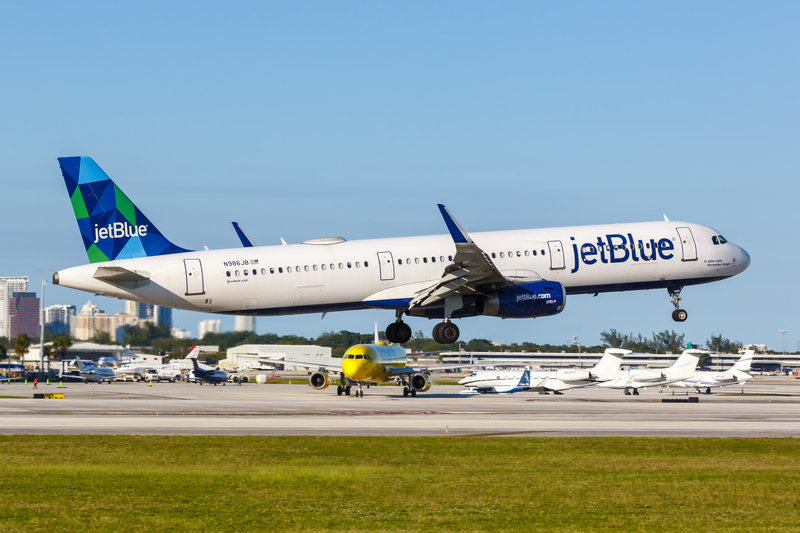
JetBlue has added Barcelona-El Prat Airport (BCN) to its map with a new daily seasonal service from Boston Logan International Airport (BOS), giving the carrier a second destination in Spain and another piece in what is becoming a much more deliberate Boston-centered transatlantic strategy.

On the surface, this is a straightforward summer route launch. In practice, it is more important than that. Barcelona (BCN) gives JetBlue access to one of Europe’s strongest mix markets, where leisure demand, premium traffic, and academic travel all overlap. For an airline still trying to prove that its transatlantic growth can be profitable and sustainable, that kind of city pair matters far more than a simple headline route add.
Boston is clearly the center of the plan
JetBlue has made no secret of wanting Boston Logan (BOS) to function as a primary transatlantic gateway, and Barcelona (BCN) fits that strategy neatly.
Read our stories in your inbox
Two aviation newsletters. Zero fluff.
The flight launched on April 16 and is scheduled to run daily through October 25, 2026. That makes it a summer-season route, but not a tentative one. Daily frequency is a serious commitment, especially for a carrier that is still balancing growth with profitability concerns. It also means JetBlue is trying to make Boston (BOS) more than just a U.S. origin point. The airline wants it to act as a meaningful bridge between New England and Europe, with domestic, Latin American, and Caribbean feed on one side and leisure-heavy European demand on the other.
Barcelona becomes JetBlue’s seventh destination in Europe and its second in Spain after Madrid-Barajas Airport (MAD). With Milan Malpensa Airport (MXP) joining in May, JetBlue says it will operate up to nine daily nonstop flights between Boston (BOS) and Europe this summer. That is no longer a niche experiment. It is a scaled transatlantic proposition.
Barcelona is a smart JetBlue market
There is a reason Barcelona (BCN) makes sense here.
Unlike a pure corporate market, Barcelona offers multiple demand streams at once. Leisure traffic is obvious, but it is not the whole story. Boston (BOS) and Barcelona (BCN) also share strong academic, life sciences, innovation, and business ties, which gives the route a broader base than a summer sun play alone. That matters for JetBlue, because its transatlantic model works best where Mint can attract higher-yield travelers while Core can still stimulate price-sensitive demand.
That balance is especially useful on an Airbus A321LR. JetBlue’s transatlantic A321LR is a long-range narrowbody with only 114 seats, including 24 Mint suites. For airline readers, that is the key aircraft detail in this story. The A321LR gives JetBlue a much smaller-capacity platform than the widebodies used by many legacy competitors, which lowers the bar for daily profitability while still preserving a real premium cabin.
In other words, JetBlue is not trying to outmuscle bigger airlines with gauge. It is trying to out-position them with cabin economics.

The Mint proposition is part of the point
JetBlue’s Barcelona service is also another reminder that the airline’s transatlantic story is not built around low fares alone.
Yes, the launch was supported by introductory one-way pricing starting at $349 in Core from the U.S. point of sale and €399 from the European side. But the more meaningful product story is Mint. On these A321LR flights, JetBlue is selling lie-flat private suites at the front of a narrowbody aircraft, with the kind of boutique premium feel that has become central to how the airline tries to differentiate itself across the Atlantic.
That matters because Barcelona (BCN) is the kind of market where a strong premium proposition can carry disproportionate weight. JetBlue does not need to dominate volume to make the route useful. It needs to capture enough high-yield traffic while keeping the aircraft small enough to make the back cabin manageable. The A321LR lets it do exactly that.
This is also a Boston network play
One of the strengths of the route is that it is not just a Barcelona story. It is a Boston story too.
JetBlue remains strongest where it can combine local demand with connecting relevance, and Boston Logan (BOS) gives it that. The airline can sell Barcelona (BCN) not only to New England-origin passengers, but also to customers connecting through Boston from across its broader U.S., Caribbean, and Latin American network. That adds more depth to the route than a pure point-to-point operation would have on its own.
That is why Boston matters so much in JetBlue’s current strategy. The carrier is still a much smaller transatlantic player than the large global joint ventures, so it needs airports where it can control more of the passenger journey. Boston is one of the few places where it can realistically do that.
Bottom Line
JetBlue’s new Boston Logan (BOS) to Barcelona-El Prat (BCN) service is not just another summer route. It is another step in building Boston into a real transatlantic platform.
Barcelona is a smart addition because it gives the airline a city pair with strong leisure demand, meaningful academic and business ties, and a market profile that suits the Airbus A321LR particularly well. That aircraft, with its low seat count and 24 Mint suites, remains central to JetBlue’s Atlantic strategy: keep the capacity disciplined, sell a real premium product, and grow where Boston gives the airline the best structural advantage.
With Barcelona now launched and Milan close behind, JetBlue is not just expanding in Europe. It is continuing to define what kind of transatlantic airline it wants to be.