Emirates (EK) and Nigeria’s Air Peace (P4) have activated a bilateral interline agreement that materially changes how passengers can stitch together journeys across West and Central Africa, Dubai International (DXB), and London’s airport system—Heathrow (LHR), Gatwick (LGW), and Stansted (STN). This isn’t a flashy new route announcement. It’s the kind of behind-the-scenes commercial plumbing that, when done properly, can unlock new city pairs overnight with far less operational risk than launching metal.

At its core, the agreement enables single-ticket itineraries with through-checked baggage on select routings. For travelers, that’s fewer touchpoints and less uncertainty at transfer points. For network teams, it’s a way to extend “virtual” reach beyond the endpoints each airline can realistically serve with its own aircraft.
What an interline actually changes—and why airline pros care
Interline agreements are often misunderstood as “soft codeshares.” They’re not. A bilateral interline is primarily about ticketing, baggage, and settlement, allowing two carriers to sell a combined itinerary where each airline operates its own segment. The practical advantages are significant:
Read our stories in your inbox
Two aviation newsletters. Zero fluff.
-
Single PNR / single ticket instead of piecing together separate bookings
-
Through-checked baggage where applicable, reducing reclaim/recheck friction
-
Better disruption handling than self-connecting, since the itinerary is issued as one journey
For corporate travel managers and agencies moving passengers through Lagos (LOS), Abidjan (ABJ), or Accra (ACC), this is the difference between a connection that behaves like an integrated network and one that behaves like a gamble.
Beyond Nigeria: Emirates passengers get new West Africa “spokes” via ABJ and ACC
The standout upgrade is that Emirates customers can now access additional West African gateways on Air Peace beyond the Nigeria domestic portfolio that was already available via Lagos Murtala Muhammed International Airport (LOS).
Newly enabled connection points include:
-
Banjul International (BJL) and Dakar Blaise Diagne International (DSS), both via Abidjan Félix-Houphouët-Boigny (ABJ)
-
Freetown Lungi International (FNA) and Monrovia Roberts International (ROB), both via Accra Kotoka International (ACC)
That routing detail matters. ABJ and ACC are established regional gateways with dependable international handling standards, which makes them sensible “bridge nodes” for a product that relies on predictable transfers. It also diversifies connectivity away from a single choke point—useful in a region where irregular operations can be driven by everything from weather to infrastructure constraints.
The Nigeria backbone remains a key piece of the puzzle
The existing arrangement—Emirates long-haul into Lagos (LOS), with onward Air Peace feed—remains central, and it’s still the most intuitive flow for large volumes of traffic.
Those 13 Nigerian destinations available to Emirates customers via Lagos (LOS) are:
Asaba (ABB), Abuja (ABV), Akure (AKR), Benin City (BNI), Calabar (CBQ), Enugu (ENU), Ilorin (ILR), Kaduna (KAD), Kano (KAN), Port Harcourt (PHC), Owerri (QOW), Warri (QRW), and Uyo (QUO).
From a hub strategy perspective, this reinforces Lagos (LOS) as a practical consolidation point: strong origin-and-destination demand, a large domestic catchment, and the kind of short-stage domestic flying that can efficiently feed long-haul departures without requiring widebody capacity domestically.
Air Peace plugs into DXB—and London becomes easier to sell in one line item
For Air Peace, the value is clear: its regional network can connect into Emirates’ hub at Dubai (DXB), opening one-stop access to London Heathrow (LHR), London Gatwick (LGW), and London Stansted (STN) on a single ticket.
Nigeria–UK demand is consistently strong—VFR, education, business, and diaspora flows—and the booking behavior is often price-sensitive but reliability-conscious. An interline itinerary can be sold cleanly through travel agencies and managed corporate channels, with fewer of the pain points associated with self-transfer journeys (baggage, misconnections, and re-issuance hassles).
For passengers, the itinerary becomes easy to understand: regional West Africa → Lagos (LOS) or Accra (ACC)/Abidjan (ABJ) → Dubai (DXB) → London (LHR/LGW/STN).
The metal matters: Emirates leans on the 777-300ER into Lagos
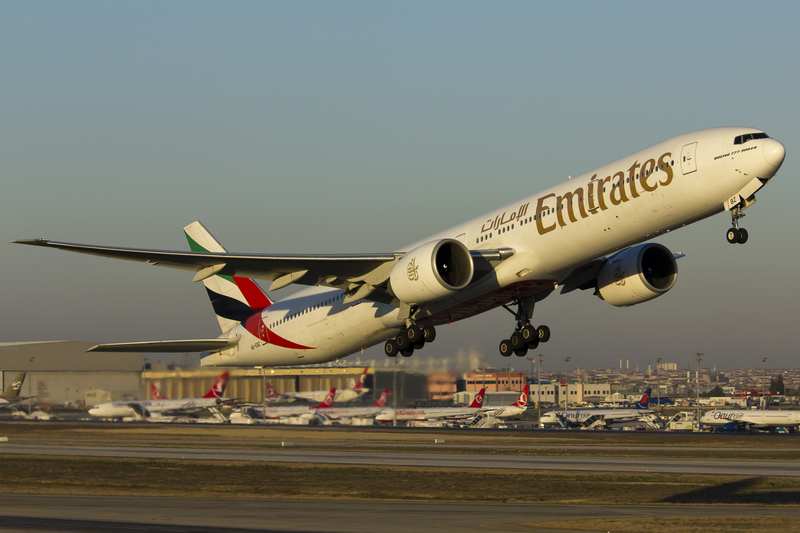
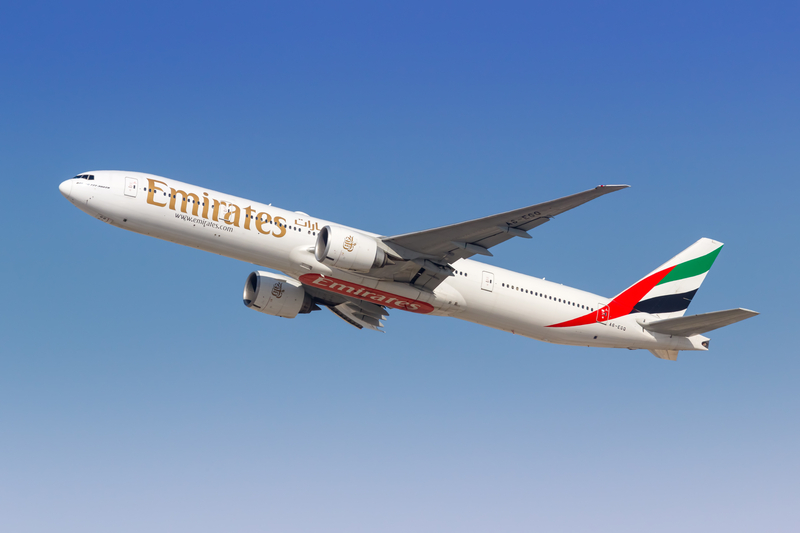
Emirates continues to operate its Dubai (DXB) – Lagos (LOS) route with the Boeing 777-300ER, an aircraft built for long-haul trunk markets where payload, cargo, and premium segmentation all matter. In Emirates’ own published configurations, the 777-300ER seats roughly 358–364 passengers in three classes, depending on the specific layout, with First Class included on select aircraft.
That’s a meaningful point in Nigeria: Emirates positions itself as one of the limited number of carriers offering First Class into the market, and it’s using a true flagship widebody rather than a down-gauged long-range narrowbody. For high-yield passengers and premium-focused corporates, the aircraft type and cabin availability can heavily influence buying behavior—especially when the alternative is a multi-carrier, multi-connection journey with inconsistent onboard standards.
Air Peace fleet: right-sized feed, with enough range for regional lift
Air Peace’s strength here is fleet flexibility. The airline operates a mixed fleet anchored by Boeing 737 variants for dense domestic and near-regional flying, alongside Embraer regional jets that are well suited to thinner intra-Africa sectors where frequency and unit costs matter more than gauge. Air Peace also has Boeing 777 widebodies in its broader fleet mix, though the interline structure here is clearly designed around regional feed rather than widebody substitution.
That combination is exactly what an interline relationship needs: enough aircraft diversity to serve smaller city pairs reliably, while still presenting a consistent product into the long-haul gateway flights.
What to watch next: where this agreement can realistically expand
If this interline performs, the next steps tend to be predictable:
-
More city-pair eligibility as the carriers expand the list of “valid” combinations for sale and baggage through-check
-
Tighter schedule coordination around key long-haul banks at Lagos (LOS) and Dubai (DXB)
-
Commercial refinement: better fare combinability, smoother re-accommodation rules, and clearer minimum-connection logic at ABJ/ACC/LOS
The largest determinant of customer satisfaction won’t be the press release language—it’ll be how consistently the product behaves when something goes wrong: late inbound regional sectors, missed connections, or baggage transfer delays. Strong interline partnerships are built in the disruption playbook, not in the happy-path schedule.
Bottom Line
Emirates (EK) and Air Peace (P4) have turned an interline enhancement into a real network lever: more West Africa access for Emirates customers via Abidjan (ABJ) and Accra (ACC), and broader global reach for Air Peace passengers through Dubai (DXB) to London Heathrow (LHR), Gatwick (LGW), and Stansted (STN). With Emirates deploying the Boeing 777-300ER into Lagos (LOS) and Air Peace providing regional feed across Nigeria and key West African gateways, this is a practical connectivity upgrade that can deliver immediate value—provided it holds up under real-world disruption.
Keep reading FlyMag
Get the Daily Brief in the morning or the Route Watch weekly recap on Fridays. Or both.