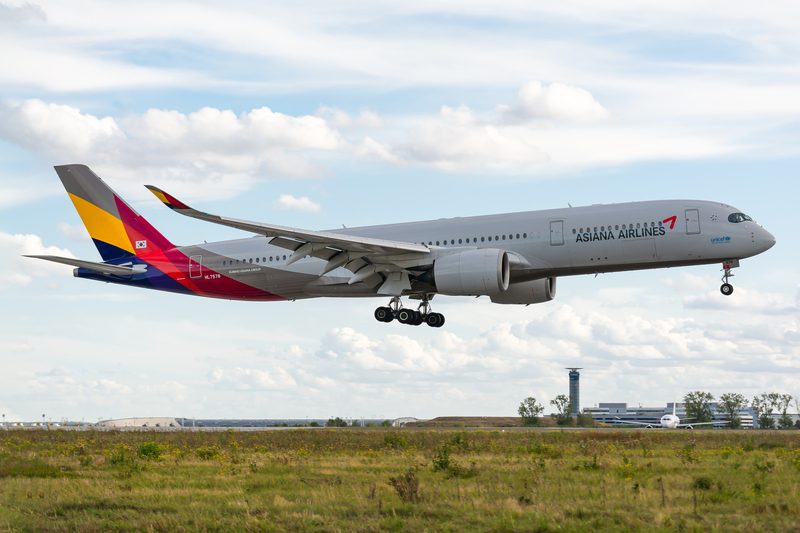
Budapest Ferenc Liszt International Airport (BUD) has added a new long-haul operator with the arrival of Asiana Airlines, which began nonstop service to Seoul Incheon International Airport (ICN) on April 3, 2026.
That matters because this is not simply another route launch into Asia. It deepens one of Budapest’s more strategically important long-haul markets at a time when the airport is working to broaden its intercontinental profile beyond a handful of marquee links. South Korea has already become one of Budapest’s most important Asian markets, and Asiana’s arrival gives that demand base more scale, more schedule choice, and a stronger competitive foundation.
For Budapest, this is the kind of route that does more than fill seats. It strengthens the airport’s role as a Central European gateway with meaningful East Asian relevance.
Read our stories in your inbox
Two aviation newsletters. Zero fluff.
The A350-900 Is the Right Aircraft for the Job
Asiana is operating the route with the Airbus A350-900, which is a strong match for a market like ICN-BUD.
The A350-900 gives the airline the range and cargo capability needed for an 8,134-kilometer sector, while also offering the lower fuel burn and operating efficiency that matter on long-haul routes that are still developing commercially. For an airline adding a new Central European destination, that is exactly the kind of aircraft you want: large enough to matter, efficient enough to be sustainable, and premium enough to support a serious long-haul proposition.

That aircraft choice also says something about Asiana’s view of the route. This is not a tentative narrowbody-style experiment or a marginal seasonal play. It is a proper long-haul commitment with a next-generation widebody.
This Is a Capacity Story as Much as a New-Route Story
The real strategic shift comes from what Asiana adds to the market alongside Korean Air.
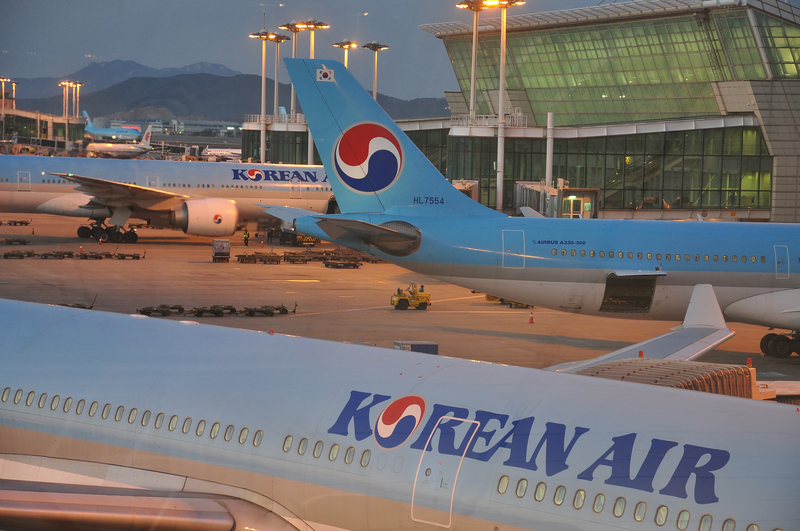
Budapest Airport says the new service, combined with Korean Air’s existing operation, lifts the city pair to more than 2,000 weekly seats and effectively creates daily nonstop access between the Hungarian and South Korean capitals. That is a meaningful threshold. A route served only a few times a week can still be important, but once a market reaches near-daily or daily utility across competing carriers, it starts to behave more like an established long-haul corridor than an opportunistic niche link.
That is why this launch matters beyond the initial frequency. It makes Seoul a deeper, more usable market from Budapest.
Budapest’s Korea Market Is Built on More Than Tourism
One of the more telling points from Budapest Airport is that South Korea is now its third-largest long-haul market. That is a significant statement because it shows the demand is not being driven by novelty alone.
The underlying traffic base is broader than leisure. South Korea has become increasingly important to Hungary through business links, investment, manufacturing, and broader economic ties, all of which help support long-haul demand. Add in visiting-friends-and-relatives traffic, inbound tourism, and onward connections, and the Budapest-Seoul market starts to look much more durable than a simple city-break route.
For airports, those are exactly the markets that matter most: routes with enough leisure appeal to remain visible, but enough business and structural demand to remain resilient.
Asiana Strengthens Its European Footprint
For Asiana Airlines, Budapest becomes its ninth European destination, which is another sign that the carrier continues to value Europe as a core long-haul region even as the wider Korean airline market evolves.
Budapest is not the largest city in Asiana’s European system, but that is part of the appeal. Secondary and mid-sized European capitals can offer strong economics when they sit at the intersection of growing trade, rising tourism, and limited nonstop competition. Budapest fits that profile well.
In that sense, the route is not just about adding one more point on the map. It is about identifying a Central European market that is increasingly strong enough to support another Korean long-haul operator.
Asia Is Becoming a More Important Part of Budapest’s Identity
The Seoul growth also fits into a larger trend at Budapest.
The airport now serves eight Asian destinations, and that widening footprint is gradually reshaping how BUD is positioned in the region. For years, Budapest’s long-haul identity was relatively narrow. Today, it is becoming a more diversified intercontinental airport, with Asia playing a larger role in that evolution.
That matters because long-haul identity is cumulative. One new route is useful. Multiple Asian links begin to change how airlines, investors, and passengers view an airport’s strategic potential.
Asiana’s arrival therefore adds more than seats. It adds credibility to Budapest’s wider Far East network story.
Bottom Line
Asiana Airlines’ launch of Budapest (BUD) to Seoul Incheon (ICN) is a meaningful addition to both the airport’s long-haul portfolio and the wider Hungary–South Korea market.
The Airbus A350-900 gives the route the right long-haul platform, while the combination of Asiana and Korean Air turns Seoul into a much more substantial nonstop market from Budapest. For Asiana, the route strengthens a growing European network. For Budapest, it confirms that South Korea is no longer a marginal long-haul niche, but one of the airport’s more important intercontinental markets.
Keep reading FlyMag
Get the Daily Brief in the morning or the Route Watch weekly recap on Fridays. Or both.