Turkish Airlines Shifts Sydney Stop From Kuala Lumpur to Singapore
Turkish Airlines will reroute its Sydney service through Singapore Changi Airport (SIN) during the Northern Winter 2026/27 season, replacing the route’s existing intermediate stop at Kuala Lumpur International Airport (KUL).
From October 26, 2026, through March 27, 2027, the airline plans to operate five weekly Airbus A350-900 flights from Istanbul Airport (IST) to Sydney Kingsford Smith Airport (SYD) through Singapore Airport (SIN). The change is contained in Turkish Airlines’ latest winter schedule filing.
The move will place both of Turkish Airlines’ Australian routes through Singapore. The carrier will continue operating three weekly Airbus A350-900 flights between Istanbul Airport (IST), Singapore Airport (SIN), and Melbourne Airport (MEL).
Read our stories in your inbox
Two aviation newsletters. Zero fluff.
Istanbul–Singapore–Sydney Schedule
Turkish Airlines has filed the following schedule, with all times local:
TK22: Istanbul Airport (IST) 3:20 p.m. – Singapore Changi Airport (SIN) 6:50 a.m. the following day
TK22: Singapore Changi Airport (SIN) 8:30 a.m. – Sydney Kingsford Smith Airport (SYD) 7:25 p.m.
Flight TK22 will leave Istanbul Airport (IST) every Monday, Wednesday, Thursday, Friday, and Saturday. The corresponding arrivals in Sydney Airport (SYD) will occur on Tuesdays, Thursdays, Fridays, Saturdays, and Sundays.
The return schedule will be:
TK23: Sydney Kingsford Smith Airport (SYD) 9:35 p.m. – Singapore Changi Airport (SIN) 2:50 a.m. the following day
TK23: Singapore Changi Airport (SIN) 4:35 a.m. – Istanbul Airport (IST) 11:10 a.m.
Flight TK23 will depart Sydney Airport (SYD) every Tuesday, Thursday, Friday, Saturday, and Sunday. The aircraft will have a scheduled stop of one hour and 45 minutes at Singapore Airport (SIN) before continuing to Istanbul.
The complete Istanbul-to-Sydney journey is scheduled to take approximately 20 hours and five minutes, including a one-hour-and-40-minute stop in Singapore. The return journey is scheduled for approximately 21 hours and 35 minutes, including the Singapore stop.
Passengers will remain on a through Turkish Airlines service, but the stop at Singapore Airport (SIN) is necessary because the airline’s current A350-900 cannot operate Istanbul–Sydney nonstop with the required commercial payload and operating margins.
Sydney Reservations Appear to Be Returning
When the schedule change was first published, reservations for TK22 and TK23 were not available during the winter operating period. Sydney temporarily disappeared from sale, creating uncertainty over whether Turkish Airlines had finalized the revised routing.
That situation appears to have changed. Turkish Airlines’ Istanbul–Sydney booking page now displays economy fares for travel beginning October 26 and continuing through November, December, and January. Business-class fares are also displayed for selected winter dates.
The appearance of fares indicates that Turkish Airlines is restoring inventory following the routing change. Passengers should still check individual flights carefully because reservation displays, operating days, and stopover airports can be adjusted while an airline finalizes a new seasonal schedule.
Singapore Gains Five Additional Weekly Flights
Moving the Sydney stop from Kuala Lumpur Airport (KUL) to Singapore Airport (SIN) will produce a notable change in Turkish Airlines’ Southeast Asian schedule.
The airline’s total operation touching Singapore will rise from 17 to 22 weekly flights. That figure includes the carrier’s regular Istanbul–Singapore services, three weekly flights continuing to Melbourne Airport (MEL), and the five new Sydney Airport (SYD) sectors.
Kuala Lumpur Airport (KUL), meanwhile, will fall from 19 to 14 weekly Turkish Airlines flights once the Sydney continuation is removed.
The change does not necessarily mean Turkish Airlines is reducing its core Istanbul–Kuala Lumpur market. Instead, the five weekly aircraft that currently continue from Kuala Lumpur to Sydney will be transferred to Singapore.
Concentrating both Australian routes at Singapore Airport (SIN) could simplify some aspects of Turkish Airlines’ operation. The airline may be able to consolidate ground handling, passenger transfers, technical support, and disruption recovery for Sydney and Melbourne at a single Southeast Asian stopover airport. That is an operational inference, as Turkish Airlines has not publicly explained why it selected Singapore over Kuala Lumpur.
Turkish Airlines Continues Melbourne Service
Turkish Airlines will retain three weekly Airbus A350-900 flights between Istanbul Airport (IST), Singapore Airport (SIN), and Melbourne Airport (MEL).
The airline sells tickets between Singapore and Melbourne, allowing the tag flight to carry passengers traveling only between the two cities as well as customers continuing to or from Istanbul. Turkish Airlines’ booking website currently lists Singapore–Melbourne fares for dates extending into November 2026.
Whether the airline will immediately offer the same local ticketing rights between Singapore Airport (SIN) and Sydney Airport (SYD) was not clear when the schedule was first filed. The initial absence of TK22 and TK23 from the reservation system prevented confirmation of standalone Singapore–Sydney availability.
If Turkish Airlines sells the Singapore–Sydney segment separately, it would create another fifth-freedom option in a major international market. Fifth-freedom rights allow an airline to carry passengers between two foreign countries when the flight begins or ends in the airline’s home country.
Sydney Route Originally Operated Through Kuala Lumpur
Turkish Airlines launched service to Sydney Airport (SYD) on December 4, 2024, initially operating four weekly flights through Kuala Lumpur Airport (KUL).
The route became the airline’s second Australian destination after Melbourne and was described by Turkish Airlines as the longest flight in its network. The carrier selected the Airbus A350-900 for the operation, with the initial schedule taking approximately 19 hours from Istanbul to Sydney, including the intermediate stop.
Sydney service later increased to five weekly flights. The winter 2026/27 filing maintains that frequency but replaces Kuala Lumpur with Singapore as the intermediate point.
The adjustment gives Turkish Airlines a consistent Australian gateway structure. Both Sydney Airport (SYD) and Melbourne Airport (MEL) will be linked to Istanbul Airport (IST) through Singapore Airport (SIN), although they will retain separate flight numbers and operating schedules.
Airbus A350-900 Remains on the Route
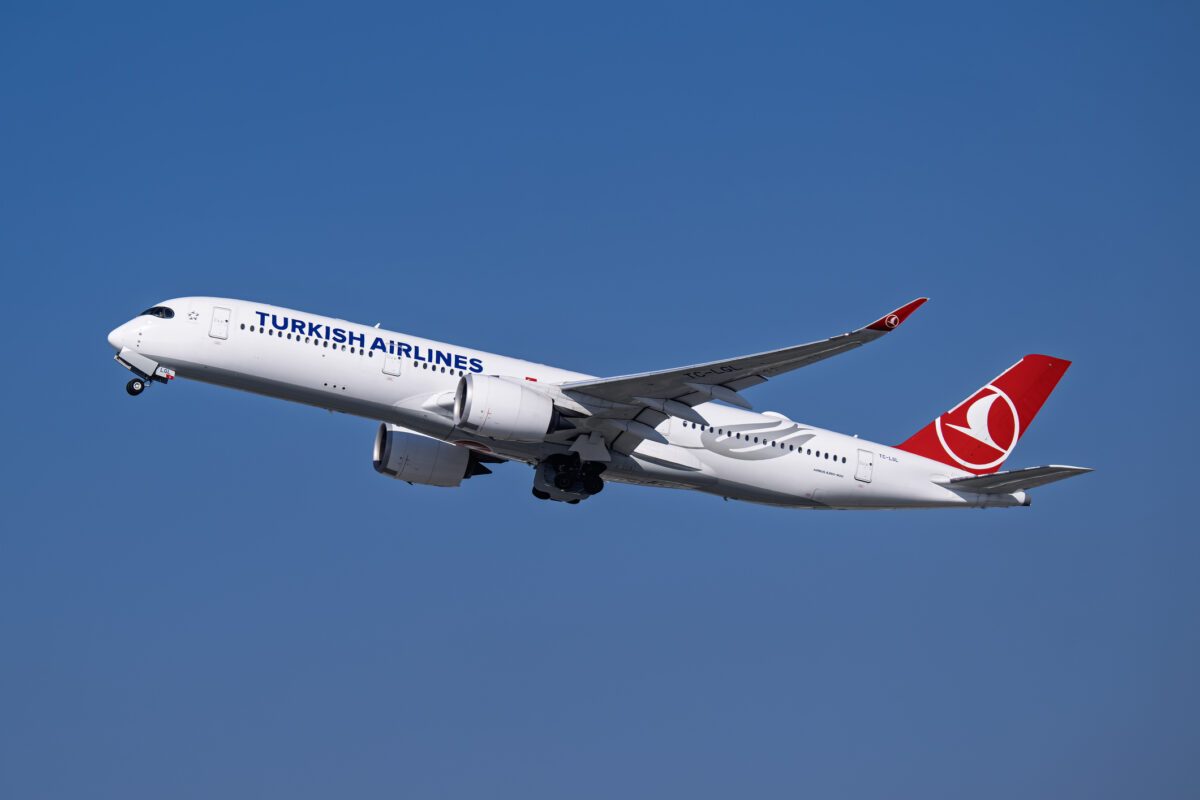
Turkish Airlines will continue using the Airbus A350-900 throughout the Istanbul–Singapore–Sydney operation.
When the Sydney route launched, the airline described the assigned A350 as having 329 seats: 32 fully flat business-class seats and 297 economy seats. If the same configuration operates all five weekly flights, Turkish Airlines will offer up to 1,645 seats in each direction every week. Aircraft substitutions and alternative A350 configurations remain possible.
The A350-900 is powered by two Rolls-Royce Trent XWB engines and uses carbon-fiber-reinforced materials throughout much of its structure. Turkish Airlines publishes a maximum range of approximately 9,553 miles for the aircraft, although usable range varies according to passenger loads, cargo, winds, fuel reserves, and routing.
The aircraft is particularly well suited to a one-stop Australia operation because both sectors are substantial long-haul flights. The Istanbul–Singapore portion is scheduled for approximately 10 hours and 30 minutes, while Singapore–Sydney will take just under eight hours.
Passengers receive a modern twin-aisle cabin, larger windows, high ceilings, updated cabin-pressure systems, inflight entertainment, and Wi-Fi availability. Turkish Airlines does not currently offer a premium-economy cabin on the standard A350 configuration used for its Sydney launch.
Singapore Becomes Central to Turkish Airlines’ Australia Strategy
The winter change strengthens Singapore Airport’s role as Turkish Airlines’ primary stopping point for Australia.
Using Singapore for both destinations gives the airline access to a major connecting airport with extensive passenger facilities and established long-haul handling capabilities. It could also create opportunities to carry local passengers between Singapore and Australia if the required inventory and traffic rights are made available.
For passengers traveling between Istanbul Airport (IST) and Sydney Airport (SYD), the practical difference will primarily be the stopover airport. Travelers will connect through Singapore Airport (SIN) rather than Kuala Lumpur Airport (KUL), while the route will continue using the Airbus A350-900 and operating five times per week.
The change also creates more Turkish Airlines capacity at Singapore while removing an equivalent number of flights from Kuala Lumpur. Singapore will receive 22 weekly Turkish Airlines services during the winter, compared with 14 at Kuala Lumpur.
Bottom Line
Turkish Airlines will reroute its five weekly Istanbul Airport (IST)–Sydney Kingsford Smith Airport (SYD) flights through Singapore Changi Airport (SIN) from October 26, 2026, through March 27, 2027.
The Airbus A350-900 service currently operates through Kuala Lumpur International Airport (KUL), which will lose five weekly Turkish Airlines flights when the change takes effect.
Singapore will become the intermediate stop for both of Turkish Airlines’ Australian destinations. Sydney will receive five weekly flights, while three weekly Istanbul–Singapore–Melbourne services will continue unchanged.
The carrier’s overall Singapore schedule will increase from 17 to 22 weekly flights, while Kuala Lumpur will decrease from 19 to 14. The shift effectively consolidates Turkish Airlines’ one-stop Australian operation at Singapore Airport (SIN).
Although TK22 and TK23 were initially unavailable for booking after the schedule filing, Turkish Airlines now displays fares for winter travel to and from Sydney. That suggests the temporary reservation gap is being resolved as the airline loads the revised Singapore routing into its sales systems.
Keep reading FlyMag
Get the Daily Brief in the morning or the Route Watch weekly recap on Fridays. Or both.