Luxair’s 11-Destination Expansion Puts the E195-E2 at the Center of Its 2026 Growth
Luxair is undertaking one of the largest network expansions in its history, adding service from Luxembourg Airport (LUX) to 11 destination airports during 2026.

The growth spans everything from short regional routes to Edinburgh Airport (EDI) and Bilbao Airport (BIO) to a considerably longer nonstop service linking Luxembourg Airport (LUX) with Abu Dhabi’s Zayed International Airport (AUH). Mediterranean leisure markets remain central to the strategy, but the schedule also shows Luxair becoming more willing to test thinner business, city-break and long-range markets.
The headline figure requires some context. Luxair’s official Summer 2026 schedule identified nine additional destinations. Abu Dhabi Airport (AUH) and Salerno Costa d’Amalfi Airport (QSR), which are scheduled to join the network later in the year, bring the total to 11.
Read our stories in your inbox
Two aviation newsletters. Zero fluff.
However, not every route represents an entirely new market. Alicante Airport (ALC), Bilbao Airport (BIO) and Tunis-Carthage International Airport (TUN) are returning destinations, while Zakynthos Airport (ZTH) and Araxos Airport (PTH) are being served through a single triangular operation.
Luxair’s 11 Route Additions for 2026
| Destination | Airport | Launch date | Planned service |
|---|---|---|---|
| Porto Santo, Portugal | PXO | March 31 | Weekly |
| Alicante, Spain | ALC | April 1 | Twice weekly |
| Zakynthos, Greece | ZTH | May 20 | Weekly triangular service |
| Araxos, Greece | PTH | May 20 | Weekly triangular service |
| Girona, Spain | GRO | June 2 | Twice weekly during peak summer |
| Helsinki, Finland | HEL | July 2 | Twice weekly |
| Edinburgh, Scotland | EDI | July 3 | Twice weekly |
| Tunis, Tunisia | TUN | July 4 | Twice weekly |
| Bilbao, Spain | BIO | July 16 | Twice weekly |
| Abu Dhabi, United Arab Emirates | AUH | October 26 | Weekly winter-seasonal service |
| Salerno, Italy | QSR | November 1 | Three scheduled round trips |
The official schedule differs slightly from some previously published reports. Luxair began its returning Tunis Airport (TUN) route on July 4 rather than July 7, while service to Bilbao Airport (BIO) launched on July 16.
The E195-E2 Is Becoming Luxair’s Network-Development Aircraft
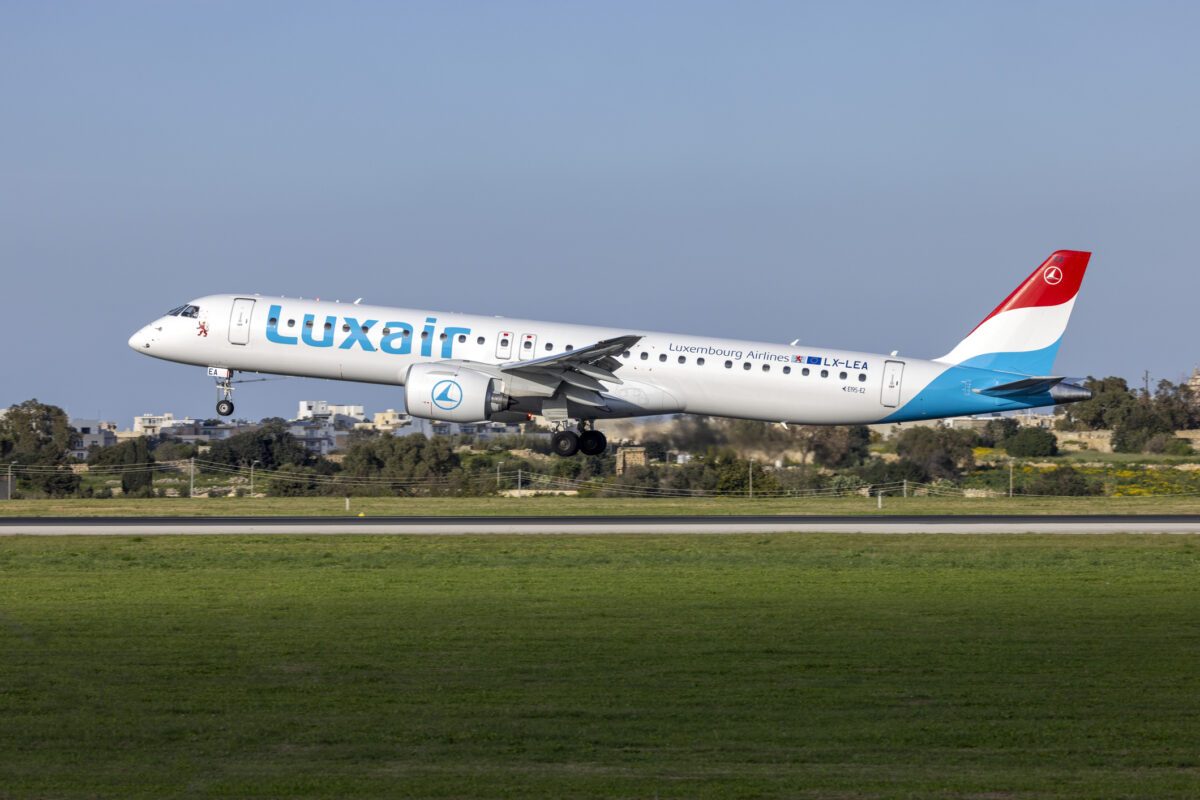
Luxair’s expanding fleet of Embraer E195-E2 regional jets is playing a central role in the airline’s 2026 growth.
The type is being used extensively on the new routes from Luxembourg Airport (LUX) to Helsinki Airport (HEL) and Edinburgh Airport (EDI). It is also appearing on services to Alicante Airport (ALC) and Tunis Airport (TUN), although Boeing 737-family aircraft can be substituted where demand or operational requirements justify additional capacity.
Luxair configures the E195-E2 with 136 seats in a two-by-two layout. Every passenger receives either a window or aisle seat, making the aircraft particularly attractive on business-oriented and higher-yield regional routes.
With a published range of up to approximately 3,000 nautical miles, or 5,556 kilometers, the E195-E2 gives Luxair considerably more flexibility than a conventional regional jet. It can operate relatively long, thin routes without requiring the capacity of a Boeing 737-800 or 737 MAX 8.
That places the aircraft in an important position within Luxair’s fleet. The E195-E2 sits between the airline’s 76-seat De Havilland Canada DHC-8-400 turboprops and its larger Boeing narrowbodies, allowing planners to open new markets without immediately committing 180 or more seats per departure.
Embraer and Luxair have confirmed six firm E195-E2 orders, consisting of an initial four aircraft and two subsequently exercised options. The airline also retains purchase rights for additional aircraft, giving it room to expand the fleet if the new routes perform well.
ID 42081062 © Richair | Dreamstime.com
Bilbao Demonstrates Why the Q400 Still Matters
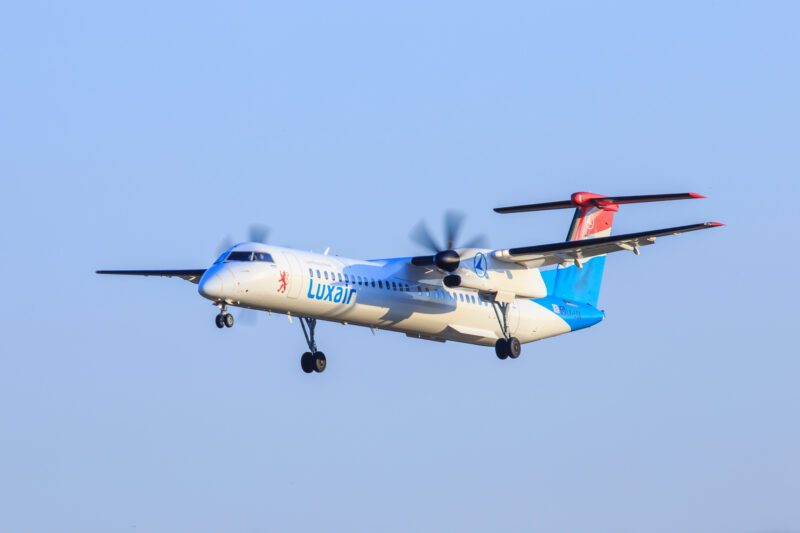
Luxair is using the De Havilland Canada DHC-8-400, commonly known as the Q400, on its twice-weekly service between Luxembourg Airport (LUX) and Bilbao Airport (BIO).
Although turboprops are disappearing from many European flag-carrier fleets, the Q400 remains an effective network-development tool for Luxair. Its 76-seat capacity substantially reduces the number of passengers needed to make a flight commercially viable, particularly during the first season of a new or returning route.
The aircraft is slower than the E195-E2 or Boeing 737, but that disadvantage is relatively limited on a regional sector such as Luxembourg Airport (LUX) to Bilbao Airport (BIO). Lower capacity may be more valuable than reducing the block time by a few minutes, especially on a route initially operating only twice a week.
Using the Q400 also enables Luxair to preserve its larger jets for longer sectors and higher-volume leisure destinations.
Mediterranean Leisure Markets Remain a Priority
Several of the additions reinforce Luxair’s established position in the European leisure market.
Weekly service to Porto Santo Airport (PXO), part of Portugal’s Madeira archipelago, began on March 31 using Boeing 737-family aircraft. The route complements Luxair’s existing presence in Portugal while giving passengers access to an island market that has far less nonstop service than nearby Madeira Airport (FNC).
Alicante Airport (ALC) returned on April 1 with Wednesday and Saturday departures, while Girona-Costa Brava Airport (GRO) joined the network on June 2. Girona Airport (GRO) is being served on Tuesdays and Saturdays during the peak summer period through late August.
Luxair’s Greek expansion is slightly more complex. The airline operates a weekly Luxembourg Airport (LUX)-Zakynthos Airport (ZTH)-Araxos Airport (PTH)-Luxembourg Airport (LUX) triangle. Combining the two destinations allows Luxair to serve separate Greek leisure markets without operating an independent round trip to each airport.
From a network-planning perspective, triangular routes can make lower-volume seasonal destinations viable by distributing the operating cost across two markets. The tradeoff is a longer journey for passengers traveling on the sector that includes the intermediate stop.
Edinburgh and Helsinki Broaden the Network Northward
The introduction of Edinburgh Airport (EDI) and Helsinki Airport (HEL) gives the expansion a more balanced profile than a schedule focused exclusively on Mediterranean vacations.
Twice-weekly flights to Helsinki Airport (HEL) began on July 2, followed by Edinburgh Airport (EDI) on July 3. Both are primarily operated by the Embraer E195-E2.
Helsinki Airport (HEL) gives Luxair access to an important Nordic business and connecting market, although a twice-weekly schedule is more naturally suited to leisure travel and longer business stays than traditional same-day corporate demand.
Edinburgh Airport (EDI) combines city-break traffic, tourism, financial-sector demand and connections between Luxembourg’s international workforce and the United Kingdom. The E195-E2’s capacity makes it possible to develop that traffic gradually without the higher load requirement associated with a Boeing 737.
Luxair has scheduled 52 round trips on each route during 2026, reflecting a measured introduction rather than an immediate attempt to establish daily service.
Abu Dhabi Is the Most Ambitious Addition
The longest and most strategically significant route in Luxair’s expansion will connect Luxembourg Airport (LUX) with Zayed International Airport (AUH).
Luxair plans to inaugurate the service on October 26, operating weekly during the winter season through May 4, 2027. The outbound flight will leave Luxembourg Airport (LUX) on Mondays, with the return departing Abu Dhabi Airport (AUH) on Tuesdays.
The airline will use the Boeing 737 MAX 8, whose published maximum range of approximately 3,500 nautical miles makes the aircraft suitable for long, relatively thin routes that would not support a widebody. Luxair plans to offer 12 dedicated Business Class seats and enhanced onboard catering similar to the product used on its Dubai International Airport (DXB) service.
Luxair will not have the market to itself.
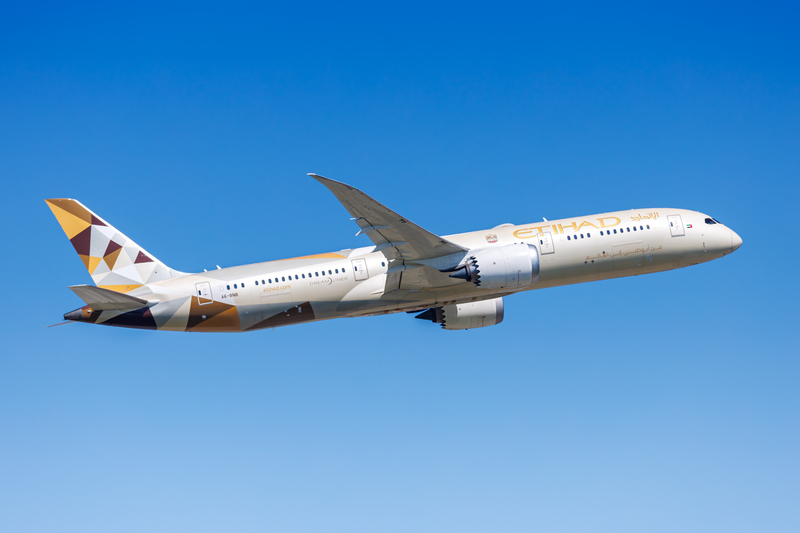
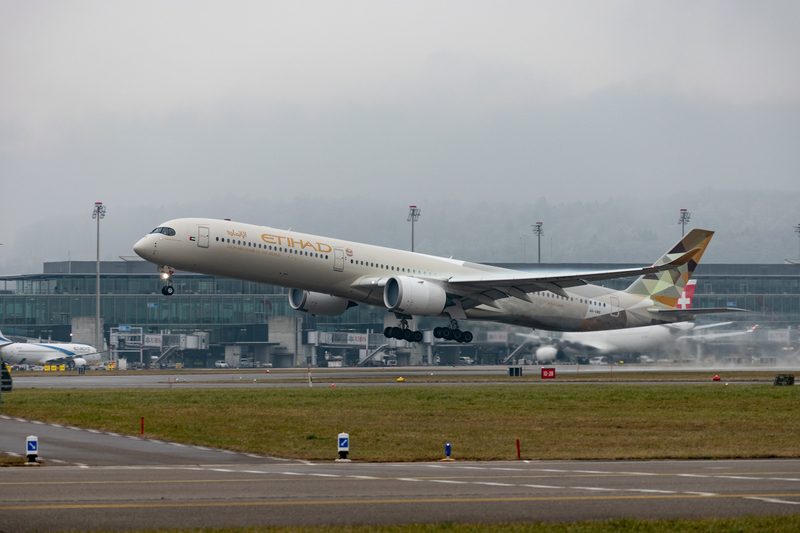
Etihad Airways is scheduled to begin its own service between Abu Dhabi Airport (AUH) and Luxembourg Airport (LUX) on October 29, just three days after Luxair’s inaugural flight. Etihad plans to operate three times weekly using an Airbus A321LR.
The A321LR is configured with Etihad’s new three-class interior, including First Class suites and lie-flat Business Class seats. That will give Etihad a considerable premium-product advantage, while its three weekly frequencies will provide greater scheduling flexibility than Luxair’s single weekly departure.
Assuming both schedules operate as announced, Luxembourg Airport (LUX) and Abu Dhabi Airport (AUH) will have four weekly nonstop flights. Whether the two airlines can stimulate enough local, connecting and premium demand to support that capacity will be one of the more interesting European route-development stories of the 2026-27 winter season.
Salerno Is More of a Market Test Than a Full Route
Salerno Costa d’Amalfi Airport (QSR) is also joining Luxair’s network, but only on a highly limited basis.
Three round trips are scheduled for November 1, 5 and 8 using the airline’s 141-seat Boeing 737-700. The approximately two-hour flight will provide direct access to the Salerno and Amalfi Coast region without requiring passengers to fly through Naples International Airport (NAP).
With only three rotations initially planned, Salerno Airport (QSR) should be viewed as a short operating series or market test rather than an established scheduled route. Luxair can use the flights to evaluate demand before deciding whether QSR warrants a longer seasonal program in future years.
A Diverse Fleet Gives Luxair More Options
Few European airlines of Luxair’s size operate such a varied short- and medium-haul fleet.
Its current fleet includes the DHC-8-400, Embraer E195-E2, Boeing 737-700, Boeing 737-800 and Boeing 737 MAX 8. Luxair has also used wet-leased Airbus A320-family capacity to supplement its own aircraft during periods of high demand.
That diversity creates additional training, maintenance and scheduling complexity. However, it also gives Luxair an unusually broad capacity range.
The airline can deploy a 76-seat Q400 to Bilbao Airport (BIO), a 136-seat E195-E2 to Edinburgh Airport (EDI) or Helsinki Airport (HEL), and a 737 MAX 8 to Abu Dhabi Airport (AUH). That capacity flexibility reduces the financial risk of launching routes from a relatively small home market.
Luxair’s strategy is not simply to add the maximum possible number of destinations. It is matching each market with an aircraft that gives it a realistic chance of reaching sustainable load factors.
Luxembourg Airport Continues to Outgrow Its Home Market
Luxembourg Airport (LUX) handled approximately 5.3 million passengers in 2025, setting a new annual record. The airport now offers more than 120 direct destinations despite serving a country with a population of well under one million.
That performance is possible because Luxembourg Airport (LUX) serves a much larger cross-border catchment area covering parts of France, Belgium and Germany. It also benefits from Luxembourg’s financial sector, European institutions, multinational workforce and high level of outbound leisure demand.
Luxair’s 2026 expansion is designed around those characteristics. Routes such as Edinburgh Airport (EDI) and Helsinki Airport (HEL) target business and city-break demand, while Porto Santo Airport (PXO), Alicante Airport (ALC), Zakynthos Airport (ZTH) and Araxos Airport (PTH) reinforce the airline’s leisure portfolio.
Abu Dhabi Airport (AUH), meanwhile, represents an attempt to capture both local traffic and passengers seeking connections beyond the United Arab Emirates.
Bottom Line
Luxair’s 2026 expansion is more nuanced than the headline figure of 11 new routes suggests. Three destinations are returning to the network, two are combined into a triangular Greek service, and Salerno Airport (QSR) is initially limited to just three round trips.
Even so, the program represents a significant step for the Luxembourg flag carrier.
The Embraer E195-E2 is allowing Luxair to pursue thinner European markets that may be too large for the Q400 but too risky for a Boeing 737. At the same time, the 737 MAX 8 is enabling the airline to reach considerably farther from Luxembourg Airport (LUX), most notably with the launch of Abu Dhabi Airport (AUH).
The expansion’s success will not be determined by the number of destinations announced. It will depend on whether Luxair can convert low-frequency experiments into sustainable year-round or recurring seasonal routes while managing an increasingly diverse fleet and growing competition at Luxembourg Airport (LUX).
Keep reading FlyMag
Get the Daily Brief in the morning or the Route Watch weekly recap on Fridays. Or both.