Air China Group Commits to 55 Airbus Jets in Major Fleet Renewal Through 2032
Air China and its controlled subsidiary Shenzhen Airlines have signed agreements for 55 Airbus aircraft, securing new long-haul and narrowbody capacity for delivery through 2032.


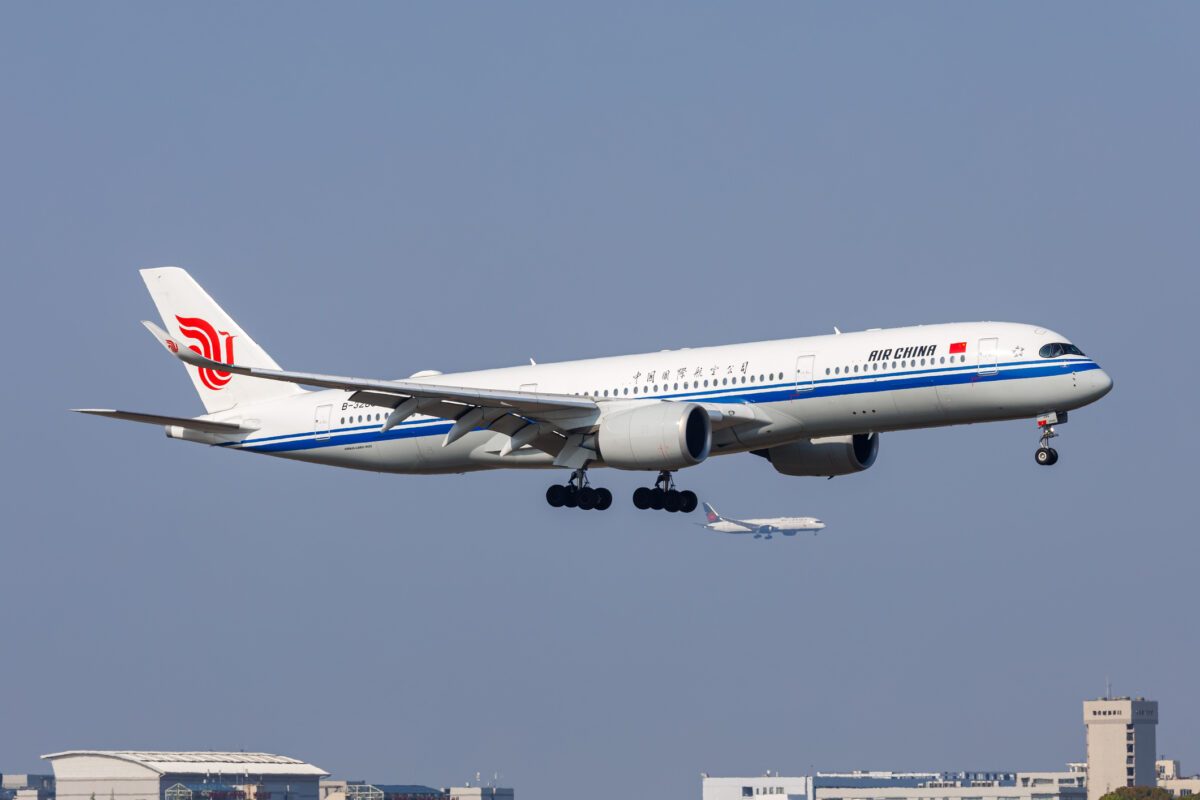
Air China will acquire 15 Airbus A350-900 widebody aircraft, while Shenzhen Airlines has ordered 40 A320neo-family aircraft.
The state-owned airline group disclosed the agreements in a July 17 filing with the Shanghai Stock Exchange. Air China’s A350-900s are scheduled to arrive between 2030 and 2032, while Shenzhen Airlines will receive its new narrowbodies between 2029 and 2032.
Read our stories in your inbox
Two aviation newsletters. Zero fluff.
The transactions have a combined catalog value of approximately $12.44 billion. However, Air China said Airbus granted substantial commercial discounts, meaning the actual acquisition cost will be significantly lower than the published reference value.
Air China plans to fund the aircraft through its existing financial resources, bank borrowing, and other financing channels. The airline said it does not intend to conduct a separate equity raise specifically to pay for the order.
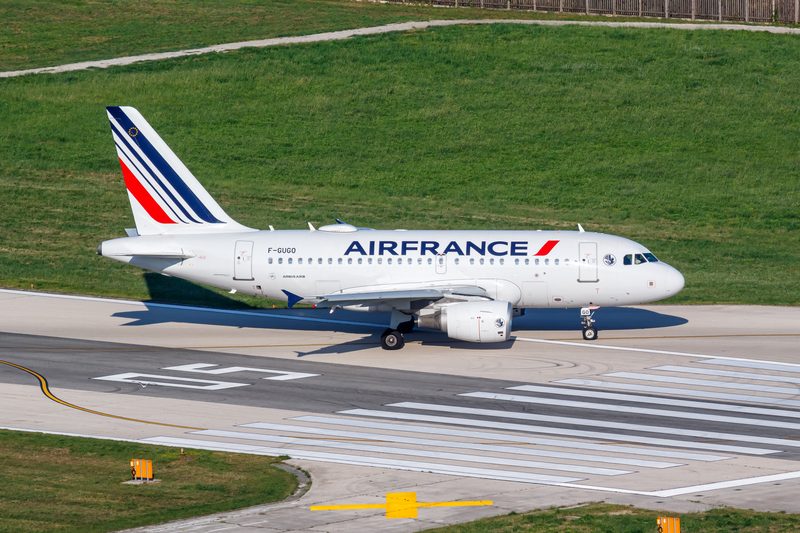
The agreement strengthens Air China’s established A350 operation while giving Shenzhen Airlines a large block of next-generation narrowbodies for domestic and regional flying from airports including Shenzhen Bao’an International Airport (SZX).
Air China and Shenzhen Airlines’ New Airbus Orders
| Airline | Aircraft | Quantity | Delivery Period | Published Reference Value |
|---|---|---|---|---|
| Air China | Airbus A350-900 | 15 | 2030–2032 | Approximately $6.09 billion |
| Shenzhen Airlines | Airbus A320neo family | 40 | 2029–2032 | Approximately $6.35 billion |
| Combined | 55 | 2029–2032 | Approximately $12.44 billion |
The order was reported by Reuters following Air China’s stock-exchange disclosure.
Air China’s board approved the purchases before the airline and Shenzhen Airlines signed their respective agreements with Airbus. Air China Import & Export Corporation will act as the import agent for the 15 widebody aircraft.
The airline group said part of the new fleet will replace existing aircraft rather than provide purely additional capacity. As a result, the eventual net increase in fleet size will be smaller than the headline total of 55 airplanes.
The $12.44 Billion Figure Is Not the Final Purchase Price
The combined $12.44 billion valuation is based on aircraft reference prices used in the regulatory filing. It does not represent the amount Air China and Shenzhen Airlines will ultimately pay.
Large airline customers generally receive substantial discounts when ordering dozens of aircraft, particularly when deliveries are spread across several years.
Air China confirmed that Airbus provided significant price concessions. The final terms may also include credit arrangements that can be applied to aircraft payments, spare parts, training, maintenance support, or other Airbus products and services.
The published valuation places the 15 A350-900s at an average reference price of approximately $406 million each. The 40 A320neo-family aircraft have an average stated value of nearly $159 million each.
Those figures should not be interpreted as realistic estimates of the airlines’ actual unit costs.
Payments will also be distributed over the years preceding delivery. Air China will not pay the complete aircraft value immediately, reducing the near-term financial effect of an acquisition program extending through 2032.
Shenzhen Airlines Ordered A320neo-Family Aircraft
Some reports have described Shenzhen Airlines’ agreement as an order for 40 A320-200neos. The disclosure itself is broader, identifying the purchase as 40 A320neo-family aircraft.
The distinction is important because the A320neo family includes several variants:
- Airbus A319neo
- Airbus A320neo
- Airbus A321neo
- Airbus A321XLR
Shenzhen Airlines already operates both the A320neo and the larger A321neo. According to ch-aviation’s fleet reporting, its fleet includes approximately 35 A320neos and eight A321neos, with another 22 A321neos already on confirmed order.
The additional 40 aircraft could therefore include more than one variant.
Standard A320neos would be suitable for replacing older A320ceos and Boeing 737-800s across high-frequency domestic routes. A321neos could provide additional capacity at airports where takeoff and landing slots are limited.
The larger A321neo could also support longer regional services from Shenzhen Bao’an International Airport (SZX) to destinations across East and Southeast Asia.
Airbus and Shenzhen Airlines have not disclosed the final variant breakdown, cabin configurations, or annual delivery quantities.
Until those details are published, describing the entire purchase as 40 standard A320neos would be more specific than the available evidence supports.
No Engine Selection Has Been Announced
The A320neo family is available with two principal engine options:
- CFM International LEAP-1A
- Pratt & Whitney PW1100G geared turbofan
Shenzhen Airlines has not publicly identified an engine supplier for the newly ordered aircraft.
The selection will have long-term implications for maintenance facilities, spare-engine availability, technician training, component inventories, and fleet commonality.
An airline with an established engine type may favor retaining the same powerplant across future deliveries. However, pricing, production availability, performance guarantees, maintenance agreements, and technical reliability can all influence the final decision.
Because deliveries do not begin until 2029, Shenzhen Airlines has time to determine the precise aircraft and engine combination that best supports its fleet-retirement and network plans.
Airbus says the A320neo family can deliver approximately 20% lower fuel consumption and carbon emissions per seat compared with earlier-generation narrowbodies under comparable conditions.
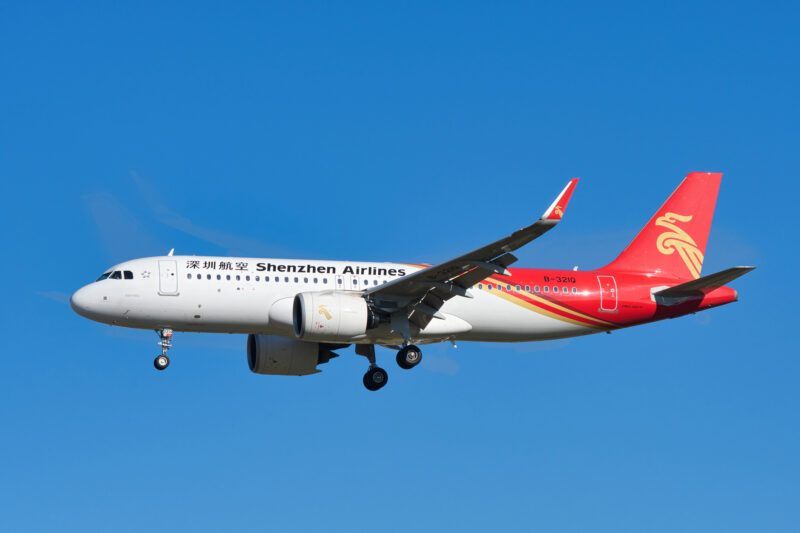
Photo By: ZapperSiR | Dreamstime.com
Shenzhen Airlines Gains Both Replacement and Growth Capacity
Shenzhen Airlines operates a broad network centered on Shenzhen Bao’an International Airport (SZX), one of the principal aviation gateways serving China’s Greater Bay Area.
Its fleet supports short domestic sectors, high-volume business routes, and international services across Asia.
The delivery period between 2029 and 2032 will allow Shenzhen Airlines to replace older aircraft as they approach expensive maintenance events or lease expirations. The new jets can also provide controlled growth if passenger demand continues to increase.
Shenzhen Airlines’ current cabin information shows a typical A320 configuration carrying 152 passengers:
| Cabin | Seats |
| Business Class | 8 |
| Premium Class | 18 |
| Economy Class | 126 |
| Total | 152 |
The airline has not confirmed that the incoming aircraft will use the same layout.
A denser cabin could lower unit costs on leisure routes, while a larger premium section might be more appropriate for business-heavy services between Shenzhen and major Chinese commercial centers.
The aircraft order gives Shenzhen Airlines flexibility to create different configurations for different parts of its network.
Air China Deepens an Established A350 Operation
The 15 A350-900s will not introduce a new aircraft type to Air China.
Air China received its first A350-900 in August 2018 and has since developed the aircraft into an important part of its long-haul fleet.
Current fleet data indicate that Air China already operates approximately 28 A350-900s. Minor differences between databases may reflect maintenance status, recent deliveries, or the timing of fleet updates.
If its existing aircraft remain in service, the latest order could eventually take Air China’s A350 fleet beyond 40 airplanes.
Expanding an established subfleet offers major operational advantages. Air China already has:
- A350-qualified pilots
- Trained cabin crews
- Maintenance and engineering experience
- Spare parts and tooling
- Flight simulators
- Approved operating procedures
- Long-haul dispatch experience
The new aircraft can enter an existing support system instead of requiring Air China to create an entirely new training, maintenance, and operational organization.
A larger A350 fleet should also improve recovery options when an aircraft becomes unavailable because of maintenance or an unexpected technical problem.
Air China’s Current A350 Carries 312 Passengers
Air China’s existing Airbus A350-900 cabin accommodates 312 passengers across three classes.
| Cabin | Seats |
| Business Class | 32 |
| Premium Economy | 24 |
| Economy Class | 256 |
| Total | 312 |
The Business Class cabin provides direct aisle access, while Premium Economy gives Air China a distinct product between lie-flat Business Class and standard Economy.
Air China has not disclosed the seating configuration planned for the 15 aircraft arriving between 2030 and 2032.
That leaves the airline with several options.
It could retain the existing 312-seat layout to maximize fleet interchangeability. Air China could also introduce a new Business Class product, increase the size of Premium Economy, install updated inflight entertainment, or create different configurations for specific route categories.
Passenger expectations and long-haul cabin technology will continue to develop before the first aircraft arrives in 2030, making a future interior update likely even if the basic seat count remains similar.
The A350 Can Serve Nearly Any Air China Long-Haul Market
The Airbus A350-900 is a twin-engine widebody constructed extensively from carbon-fiber-reinforced polymer and other advanced materials.
Airbus lists the aircraft with typical three-class capacity for approximately 300 to 350 passengers and a maximum range of around 8,600 nautical miles, depending on configuration, weight variant, payload, and operating conditions.
The A350-900 is powered exclusively by Rolls-Royce Trent XWB engines.
That performance gives Air China considerable flexibility to operate from hubs such as Beijing Capital International Airport (PEK) and Chengdu Tianfu International Airport (TFU) to destinations throughout:
- Europe
- North America
- Australia
- Africa
- The Middle East
- South and Southeast Asia
Air China has not assigned the newly ordered aircraft to individual routes.
Specific deployment decisions would be premature because international demand, bilateral agreements, airspace availability, airport slots, and competitive conditions could change considerably before 2030.
The A350s could be used to add frequencies on established routes, replace older aircraft, or open markets that do not require the capacity of a Boeing 747-8 or Boeing 777-300ER.
Older Airbus A330s Are Logical Replacement Candidates
Air China said part of the aircraft order would replace existing fleet capacity, but it did not identify which aircraft would be retired.
The carrier’s older Airbus A330-200s and A330-300s are logical potential replacement candidates based on their age and the types of routes they operate.
That remains an informed fleet-planning inference rather than a retirement plan confirmed by Air China.
The A350-900 can perform many of the same medium- and long-haul missions as the A330 while providing newer engines, improved aerodynamics, greater range, a wider cabin, and a composite-intensive structure.
By 2030, some existing A330s may require expensive heavy-maintenance work, cabin refurbishment, or lease-renewal decisions.
Air China will need to determine whether investing further in those aircraft provides a better financial return than replacing them with new A350s.
Replacement may also occur indirectly. A new A350 could take over a Boeing 777 or Boeing 787 route, allowing that aircraft to replace an A330 elsewhere in the network.
Fleet renewal rarely occurs as a simple one-for-one exchange on the same route.
The Order Does Not Mean 55 Aircraft of Pure Growth
Air China emphasized that only part of the acquisition will provide net fleet expansion.
Some aircraft will replace existing jets, ensuring that total fleet growth remains within what the airline described as a controllable range.
The group’s filing also evaluated the purchase using available tonne-kilometers, or ATKs. The metric combines payload capacity with distance and incorporates both passenger and cargo capability.
On a gross basis, the 15 A350-900s represent approximately 7.1% of the Air China Group’s ATK capacity as of December 31, 2025. Shenzhen Airlines’ 40 A320neo-family aircraft represent approximately 4.3% under the same capacity comparison.
Those percentages do not represent guaranteed schedule growth.
The ultimate effect will depend on:
- Aircraft retirements
- Cabin configurations
- Average daily utilization
- Route distances
- Maintenance requirements
- Passenger demand
- Cargo deployment
- Lease returns
- Transfers within the airline group
A 312-seat A350 operating a daily 12-hour sector adds substantially more ATKs than the same airplane flying shorter routes or fewer frequencies.
The same uncertainty applies to Shenzhen Airlines because a standard A320neo and an A321neo provide different numbers of seats and different payload capacity.
The Order Is a Long-Term Decision Despite Current Losses
Air China recently warned that it expects to report a first-half 2026 net loss of as much as CNY2.6 billion, approximately $360 million.
The carrier said higher fuel prices had reduced its profit margins.
That near-term financial pressure does not necessarily conflict with an aircraft order covering deliveries beginning in 2029 and 2030.
Airlines plan their fleets many years in advance. By the time the new aircraft arrive, some jets operating today will be approaching retirement, heavy maintenance, or lease expiration.
Failing to reserve production positions could leave Air China and Shenzhen Airlines without replacement aircraft when they are needed.
Airbus and Boeing delivery slots are often allocated years in advance, particularly for popular aircraft such as the A350 and A320neo family.
This order is therefore best viewed as a long-term fleet-renewal program rather than a decision based solely on Air China’s financial performance during 2026.
Airbus Continues to Gain Major Chinese Orders
Air China and Shenzhen Airlines were not the only Chinese carriers announcing Airbus purchases on July 17.
Hainan Airlines separately agreed to acquire 40 A320neo-family aircraft for delivery between 2028 and 2032. That agreement has a stated catalog value of as much as $5.4 billion.
Together, the Air China, Shenzhen Airlines, and Hainan Airlines transactions cover 95 Airbus aircraft with combined reference values of approximately $17.8 billion.
The latest purchases follow several other major Airbus commitments from Chinese airlines.
China Eastern Airlines announced agreements covering 101 A320neo-family aircraft and 25 A330neos. China Southern Airlines and Xiamen Airlines disclosed a combined order for 137 A320neo-family jets.
The number of aircraft scheduled for delivery between 2028 and 2033 illustrates the scale of fleet renewal expected across China’s airline industry.
Airbus also operates an A320-family final assembly line in Tianjin, although Air China and Shenzhen Airlines have not said where their aircraft will be assembled.
The Political Timing Should Not Be Overstated
The original report linked the aircraft announcement with political remarks made in the United States one day earlier.
Neither Air China’s stock-exchange filing nor statements from Airbus connected the aircraft purchase with those political developments.
Large aircraft transactions typically require months or years of fleet analysis, technical evaluations, pricing negotiations, financing discussions, production planning, and board approval.
A 55-aircraft transaction would not ordinarily be negotiated and finalized in response to comments made the previous day.
The agreement has broader relevance to competition between Airbus and Boeing in China, but presenting it as a direct political response would require supporting evidence from the airlines, manufacturers, or government officials.
No such evidence has been released.
Several Important Details Remain Undisclosed
Air China has not identified the routes, operating bases, or cabin interiors planned for its 15 A350-900s.
Shenzhen Airlines has not disclosed the precise mix of A320neo-family variants or announced an engine supplier.
The airlines have also not published:
- Annual aircraft quantities within the delivery periods
- Final negotiated purchase prices
- Specific fleet-retirement schedules
- Financing institutions
- Ownership or leasing plans for individual aircraft
- Maintenance-support agreements
- Purchase rights or options accompanying the order
- New cabin products
- Route assignments
Additional information may emerge through later stock-exchange filings, manufacturer order reports, engine announcements, or fleet-planning presentations.
Bottom Line
Air China and Shenzhen Airlines have signed agreements for 55 Airbus aircraft with a combined catalog value of approximately $12.44 billion.
Air China will receive 15 Airbus A350-900s between 2030 and 2032. Shenzhen Airlines will take 40 A320neo-family aircraft between 2029 and 2032.
The final purchase price will be substantially lower than the published reference value. Air China plans to finance the aircraft through existing resources, bank borrowing, and other funding channels rather than a dedicated equity raise.
For Air China, the order expands an established A350 operation and provides future replacement capacity for older widebody aircraft while supporting long-haul flying from hubs such as Beijing Capital International Airport (PEK) and Chengdu Tianfu International Airport (TFU).
For Shenzhen Airlines, the 40 narrowbodies will support fleet renewal and controlled growth from Shenzhen Bao’an International Airport (SZX).
The filing does not establish that all 40 aircraft will be standard A320neos. The final package could include other members of the A320neo family, while the engine selection and cabin configurations remain undisclosed.
The political reference included in the original report has no demonstrated connection to the transaction.
The real significance of the order lies not in its $12.44 billion headline value, but in the production positions, fleet commonality, replacement flexibility, and network capacity that the Air China Group has secured through the beginning of the next decade.
Keep reading FlyMag
Get the Daily Brief in the morning or the Route Watch weekly recap on Fridays. Or both.