AJet Opens Germany’s Only Nonstop Route to Sivas With Seasonal Cologne Service
AJet has launched a new nonstop route between Cologne Bonn Airport (CGN) and Sivas Nuri Demirağ Airport (VAS), giving Germany its only direct scheduled air link with the Central Anatolian city.
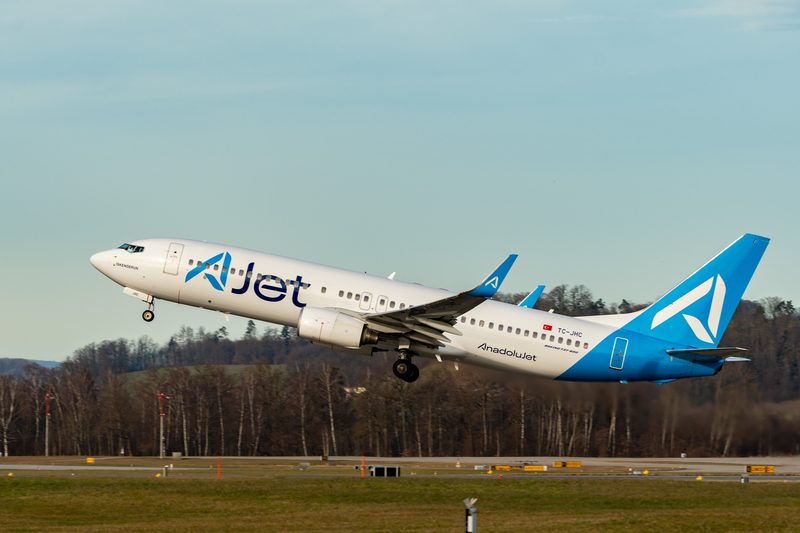
The Turkish Airlines-owned low-cost carrier inaugurated the route on July 8, 2026. Flights operate once weekly on Wednesdays using a Boeing 737-800, with the initial seasonal schedule running through September 9.
Cologne Bonn Airport describes the service as both the only current nonstop connection between Germany and Sivas and the only scheduled international route operating from Sivas Airport (VAS). The flight is expected to appeal primarily to passengers visiting friends and relatives, although it also provides new tourism and business links between North Rhine-Westphalia and Central Anatolia.
Full AJet Cologne–Sivas Schedule
The route operates under flight numbers VF1071 and VF1072. The weekly aircraft rotation begins in Sivas before returning from Cologne later the same evening.

All times are local.
| Flight | Route | Departure | Arrival | Operating day | Aircraft |
|---|---|---|---|---|---|
| VF1071 | Sivas (VAS)–Cologne/Bonn (CGN) | 5:55 p.m. | 9:10 p.m. | Wednesday | Boeing 737-800 |
| VF1072 | Cologne/Bonn (CGN)–Sivas (VAS) | 10:10 p.m. | 3:10 a.m. +1 | Wednesday | Boeing 737-800 |
The westbound flight from Sivas (VAS) has a scheduled block time of four hours and 15 minutes. The return from Cologne/Bonn (CGN) is scheduled for four hours, arriving in Sivas early Thursday morning.
Germany is one hour behind Türkiye during the northern summer, which explains why the local departure and arrival times make the westbound flight appear longer than the eastbound sector.
The schedule currently runs from July 8 through September 9, producing 10 planned round trips. AJet has not announced whether the route will return for summer 2027 or operate beyond the initial seasonal period.
The Route Is Seasonal, Not Yet a Year-Round Commitment
The limited operating window is an important detail missing from the original announcement.
AJet is not initially committing to permanent year-round service between Cologne (CGN) and Sivas (VAS). The airline has scheduled the route for approximately two months during the peak summer travel season, when demand between Germany and Türkiye is particularly strong.
A weekly schedule allows AJet to test the market with relatively little commercial exposure. If every flight uses a 189-seat Boeing 737-800, the airline will provide approximately 1,890 seats in each direction during the initial season.
That is enough capacity to measure demand, fares, baggage volumes and customer behavior without tying up an aircraft on a daily or even several-times-weekly basis.
The Wednesday schedule may work particularly well for passengers making extended visits to family. It is less convenient for short vacations or business travelers, since customers must remain for one or more full weeks unless they return through another airport or use a connecting itinerary.
The first season will show whether the market can support a longer operating period, additional weekly frequencies or a return during future summer peaks.
Why Cologne Is a Logical German Gateway
Cologne Bonn Airport sits within North Rhine-Westphalia and the densely populated Rhine-Ruhr region, giving AJet access to travelers from Cologne, Bonn, Düsseldorf, Dortmund, Essen, Duisburg and surrounding communities.
Germany is home to nearly three million people with Turkish roots, with a substantial share living in North Rhine-Westphalia and other parts of the former West Germany. That creates consistent demand for flights to Turkish cities that extends well beyond conventional tourism.
Most airline service between Germany and Türkiye is concentrated on Istanbul, Antalya, İzmir and several larger Anatolian markets. Passengers traveling to smaller inland cities often have to connect at Istanbul Airport (IST), Istanbul Sabiha Gökçen Airport (SAW), Ankara Esenboğa Airport (ESB) or another Turkish gateway.
The direct flight removes that connection.
A passenger beginning in Cologne (CGN) can now reach Sivas (VAS) in approximately four hours rather than transferring in Istanbul and potentially spending most of the day traveling. Checked baggage remains on one aircraft, and passengers avoid the risk of a missed connection caused by a late inbound flight.
The route also provides a practical alternative for travelers who previously flew to another Turkish airport and completed the journey to Sivas by road or domestic air service.
Cologne Bonn Airport Chairman Thilo Schmid said the flight strengthens links with an important Central Anatolian region while offering a more convenient option for passengers visiting friends and relatives.
AJet Is Using the Boeing 737-800
AJet has assigned the Boeing 737-800 to VF1071 and VF1072.
The aircraft belongs to Boeing’s 737 Next Generation family, which also includes the 737-600, 737-700 and 737-900. It is separate from the newer Boeing 737 MAX series.
The 737-800 measures approximately 129 feet, 6 inches long and has a maximum certified passenger capacity of 189. Boeing lists a range of up to approximately 2,800 nautical miles, placing the roughly 1,400-nautical-mile Cologne–Sivas route comfortably within the aircraft’s capabilities.
AJet’s 737-800s are generally configured with 189 Economy Class seats in a high-density, single-class cabin. That layout gives the airline a low cost per available seat, which is particularly important on routes driven by price-sensitive leisure and visiting-friends-and-relatives traffic.
The aircraft is powered by two CFM International CFM56-7B turbofan engines. The CFM56-7B is the exclusive engine family for the Boeing 737 Next Generation series and is used by hundreds of airlines worldwide.
The 737-800 is an appropriate choice for the route because it combines enough capacity for peak summer demand with lower total operating costs than a widebody. AJet does not need to fill an Airbus A330 or Boeing 787 to provide a nonstop connection lasting approximately four hours.
The Route Uses One of AJet’s Largest Subfleets
The Boeing 737-800 remains an important part of AJet’s rapidly expanding operation.
AJet currently lists a fleet of 118 aircraft, including 44 Boeing 737-800s. Its wider fleet also includes Airbus A320-family jets and Boeing 737 MAX 8s, allowing the carrier to serve domestic Turkish routes and international destinations across Europe, North Africa, the Middle East and Central Asia.
AJet emerged from Turkish Airlines’ former AnadoluJet operation and began flying under its current identity in March 2024. It remains wholly owned by Turkish Airlines but operates with a lower-cost commercial model and its own branding.
That structure allows the Turkish Airlines group to address different market segments.
Turkish Airlines can concentrate on full-service traffic, global connections and premium passengers through Istanbul Airport (IST). AJet can operate high-density narrowbodies on price-sensitive domestic and regional routes, particularly from Sabiha Gökçen Airport (SAW), Ankara (ESB) and secondary Turkish cities.
Cologne–Sivas fits the AJet model particularly well. It is a direct, seasonal route with strong family and community traffic that does not require a premium-heavy cabin or extensive connecting network.
Sivas Airport Has More Runway Than the Route Requires
Sivas Nuri Demirağ Airport (VAS) is located northwest of the city at an elevation of approximately 5,222 feet above sea level.
Its single Runway 01/19 measures approximately 12,500 feet, or 3,810 meters, making it unusually long for an airport serving a relatively modest scheduled passenger market. The runway provides substantial performance margin for narrowbody aircraft operating during warm weather at the airport’s high elevation.
Elevation matters because aircraft engines and wings produce less performance as air density decreases. Higher temperatures further reduce density, potentially increasing the runway distance required for takeoff.
The long runway gives AJet flexibility to operate a fully loaded Boeing 737-800 with passengers, baggage and sufficient fuel for the nonstop flight to Cologne (CGN). The route is not especially demanding for the aircraft’s range, but strong summer temperatures and Sivas’ elevation must still be included in each flight’s performance calculations.
Airline dispatchers will determine the allowable takeoff weight using temperature, wind, runway conditions, aircraft configuration and other operational factors before every departure.
The airport’s elevation also means that passengers arriving from Cologne will land at an airport more than 5,000 feet above sea level, despite Sivas being located on a broad inland plateau rather than in a mountainous resort area.
Cologne Is Currently Sivas’ Only International Scheduled Route
Cologne Bonn Airport states that the new AJet service is the only international flight currently offered from Sivas Airport (VAS).
The wording should be understood as referring to the airport’s present scheduled network. Sivas has handled international passengers and seasonal foreign services in previous years, so the Cologne route is not necessarily the first international operation in the airport’s history.
Its current significance is that it gives Sivas a direct international scheduled link without requiring passengers to connect through Istanbul, Ankara or another Turkish airport.
The remainder of Sivas’ regular passenger network is primarily domestic. AJet and other Turkish carriers connect the city with major national gateways, where customers can transfer to wider domestic and international networks.
International service can be difficult for a regional airport to sustain because demand is often highly seasonal and concentrated around a limited number of overseas communities. A weekly summer route is therefore a logical entry point.
AJet can increase frequency if demand consistently exceeds the available seats. If demand weakens outside July and August, the airline can end the operation after September without supporting lightly booked winter flights.
Visiting-Friends-and-Relatives Traffic Will Drive the Route
The commercial foundation of Cologne–Sivas is likely to be visiting-friends-and-relatives traffic, commonly abbreviated as VFR within airline network planning.
VFR routes behave differently from conventional vacation markets.
Passengers may remain at their destination for several weeks, carry larger quantities of checked baggage and travel during school holidays or major family events. Demand is often strongest during summer and around religious or national holidays.
Customers may also be more willing to travel on a weekly flight when the nonstop service eliminates a complicated connection.
The late-night Cologne departure is less problematic for this market than it might be for business travelers. Passengers leave Germany at 10:10 p.m. and arrive in Sivas at 3:10 a.m., allowing the aircraft to fit into AJet’s wider weekly schedule while still providing a direct journey.
The arrival time is inconvenient, but family travelers may prefer an early-morning pickup in Sivas to transferring through Istanbul and arriving several hours later.
The flight in the opposite direction reaches Cologne at 9:10 p.m., enabling passengers to complete the journey to homes throughout North Rhine-Westphalia before midnight in many cases.
One Weekly Flight Limits the Market’s Flexibility
The greatest weakness is frequency.
Passengers must travel on Wednesday in both directions. A traveler who misses the flight because of illness, a delayed ground journey or a documentation issue cannot simply take another nonstop departure the following day.
The next AJet nonstop will not operate for another week.
Customers requiring greater flexibility may continue choosing one-stop itineraries through Istanbul or Ankara, where multiple daily flights create far more scheduling options.
The weekly operation can also complicate disruption recovery. If a flight is canceled because of weather, maintenance or crew availability, AJet may not have another Cologne–Sivas departure available for seven days.
The airline could reroute passengers through its domestic network, place customers on another Turkish Airlines group service or arrange an additional replacement flight. Each option would be more complicated than reaccommodating passengers on a route operating daily.
That operational risk is another reason a weekly seasonal service should be treated as a market test rather than evidence of a fully established year-round route.
Sivas Has More Than 4,000 Years of Recorded History
The airport announcement describes Sivas as a city with more than 4,000 years of history and a population exceeding 630,000.
The population figure is better understood as referring to the wider Sivas Province. Recent population data places the province at approximately 637,000 residents, while the urban center itself is considerably smaller.
Sivas was an important center during the Anatolian Seljuk period and remains known for a concentration of 13th-century religious and educational architecture.
The Buruciye Madrasa, Double Minaret Madrasa and Gök Madrasa were all constructed during the 13th century. Their monumental stone portals, decorative tile work and prominent minarets remain among the city’s most recognizable architectural features.
The wider province is also home to the Great Mosque and Hospital of Divriği, a 13th-century complex added to the UNESCO World Heritage List in 1985. The site is particularly known for its elaborate stone carvings and distinctive combination of mosque and medical architecture.
The direct flight may therefore generate a small amount of cultural and heritage tourism in addition to family traffic. However, a once-weekly seasonal schedule and the absence of a large international tourism profile mean VFR demand will almost certainly remain the primary commercial driver.
The Route Could Support More Than Passenger Travel
A direct air connection can also support small-scale business, educational and institutional travel between Central Anatolia and Germany.
Sivas has economic activity in agriculture, manufacturing, mining, education and public administration, while Germany remains one of Türkiye’s most important commercial partners.
The Boeing 737-800’s lower cargo holds can carry passenger baggage and limited commercial freight. Available capacity will depend heavily on checked-baggage volumes, which can be substantial on VFR flights.
Time-sensitive documents, spare parts, personal shipments and lower-volume commercial goods may still benefit from a direct service that avoids handling at an intermediate hub.
The weekly frequency prevents the route from becoming a major cargo link, but belly freight can provide useful incremental revenue and improve the economics of individual flights.
AJet Can Evaluate Several Markets With One Route
The initial operation will provide AJet with information extending beyond the performance of Cologne–Sivas itself.
The airline can measure how much demand originates around Cologne compared with the wider Rhine-Ruhr region. It can identify how many passengers travel from Sivas city and how many come from surrounding districts across the province.
Booking data will show whether passengers purchase basic fares or add checked baggage, seat assignments and other optional services. The carrier can also examine how early customers book, how fares perform close to departure and whether demand remains strong after the peak July and August travel period.
Those findings may influence future routes from Sivas to other German cities.
AJet’s booking platform already sells connecting itineraries between Sivas and airports including Düsseldorf (DUS), Frankfurt (FRA), Stuttgart (STR), Munich (MUC), Hamburg (HAM), Berlin (BER) and Hanover (HAJ). That does not mean nonstop flights from those cities are planned, but it gives the airline visibility into where German demand is originating.
If Cologne performs strongly, AJet could increase frequency, extend the season or consider another German gateway. If the route struggles despite being the only nonstop option, the airline may conclude that the market is better served through connections.
A Summer Route Can Succeed Without Operating All Year
Seasonal operation should not automatically be interpreted as weakness.
Many routes between Germany and secondary Turkish cities are shaped by school holidays, family visits and summer travel. Demand can be strong enough to fill aircraft during July and August but insufficient to support the same capacity during November or February.
AJet can earn attractive revenue during the strongest weeks and use the Boeing 737-800 elsewhere after September.
That flexibility is a central advantage of an airline operating more than 100 narrowbody aircraft. The same airplane can fly Cologne–Sivas during summer and be redeployed to domestic Turkish, Gulf, North African or other European routes when seasonal demand changes.
A year-round route may be more convenient for passengers, but it is not necessarily more profitable.
The first season’s average fares and load factors will determine whether AJet sees value in extending the flight beyond its current September 9 end date.
Bottom Line
AJet launched its new nonstop route between Sivas Nuri Demirağ Airport (VAS) and Cologne Bonn Airport (CGN) on July 8, 2026.
Flights VF1071 and VF1072 operate once weekly on Wednesdays using a Boeing 737-800. The aircraft leaves Sivas at 5:55 p.m., arrives in Cologne at 9:10 p.m., and departs Germany at 10:10 p.m. before reaching Sivas at 3:10 a.m. Thursday.
The service is currently Germany’s only scheduled nonstop connection with Sivas and the only international scheduled route operating from Sivas Airport.
It is not yet a year-round addition. AJet has filed the route only through September 9, creating an initial season of 10 round trips.
The 189-seat Boeing 737-800 is well suited to the approximately four-hour flight. Its CFM56-powered narrowbody economics allow AJet to serve the market without the capacity risk associated with a larger aircraft.
The route’s primary purpose is to serve visiting-friends-and-relatives demand between Central Anatolia and Germany’s large Turkish-origin community, particularly across North Rhine-Westphalia and the Rhine-Ruhr region.
For passengers, the principal benefit is convenience. Travelers can avoid connections through Istanbul or Ankara, reduce total journey time and reach Sivas on one aircraft.
The limitation is frequency. One weekly flight provides little flexibility and makes disruption recovery more difficult. It also shows that AJet is testing the market rather than making a permanent commitment.
If the first summer produces strong load factors and acceptable fares, Cologne–Sivas could return for a longer 2027 season or gain additional frequencies. Until AJet publishes a future schedule, however, the route should be described as a seasonal experiment with significant VFR potential—not a confirmed year-round expansion.