Vietnam Airlines 18-Hour Caracas-Hanoi A350 Flight Was More Than a Record Run
Vietnam Airlines has quietly entered the Airbus A350 record books with an extraordinary nonstop flight from Venezuela to Vietnam, operating one of the longest A350 sectors ever flown.

The flight, operated as VN69, departed Simón Bolívar International Airport (CCS) near Caracas and flew nonstop to Noi Bai International Airport (HAN) in Hanoi. The sector covered approximately 16,398 km, or 10,190 miles, and took 18 hours and 22 minutes, according to flight-tracking data.
That makes the flight remarkable for two reasons. First, it was not a normal scheduled passenger service. It was the return leg of a government-backed humanitarian mission to Venezuela following a major earthquake. Second, it pushed the Vietnam Airlines Airbus A350-900 far beyond the type of mission it normally flies in the carrier’s scheduled network.
For airline professionals, this was not just a long flight. It was a real-world demonstration of what a modern widebody can do when payload, routing, crew planning, government coordination, and mission urgency align.
A Relief Mission Created an Unusual Long-Haul Operation
The record-setting flight began with Vietnam’s response to earthquake damage in Venezuela. Vietnam Airlines first operated VN66 from Hanoi (HAN) to Caracas (CCS), using an Airbus A350 with a technical stop at Paris Charles de Gaulle Airport (CDG).
That first mission carried 124 rescue personnel from Vietnam’s Ministry of National Defense and Ministry of Public Security, 10 search-and-rescue dogs, and approximately 25 metric tonnes of humanitarian supplies, specialized equipment, and rescue gear.
Less than 24 hours later, Vietnam Airlines dispatched a second special flight, VN68, also using an Airbus A350. That flight departed Hanoi (HAN) late on June 29, stopped at Paris (CDG), and continued to Caracas (CCS) with 46.8 metric tonnes of relief cargo and equipment.
Those outbound flights were long and complex, but they were not the record-setting sectors. Because they carried substantial payload and operated with a planned technical stop in Paris, they followed a more conventional mission structure for a heavy humanitarian deployment.
The unusual flight came afterward, when the aircraft returned nonstop from Caracas (CCS) to Hanoi (HAN).
VN69 Was the Record Flight
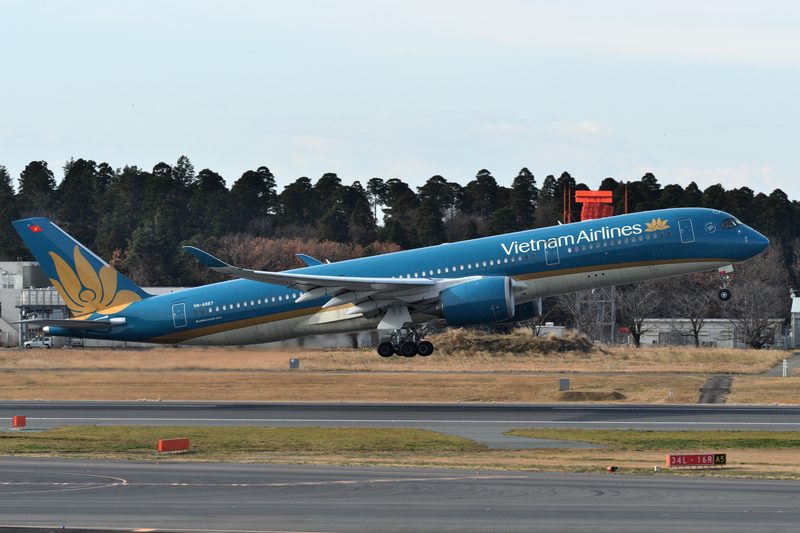
Flight-tracking data shows the return flight operated as VN69 using Airbus A350-941 VN-A896. The aircraft departed Caracas (CCS) and flew directly to Hanoi (HAN), with an actual flight time of 18 hours and 22 minutes.
That is longer than many scheduled ultra-long-haul passenger flights and places the sector in rare territory for the A350 family. Flightradar24 described the 16,398 km flight as the second-longest A350 flight ever operated, behind a German Air Force A350 mission that flew roughly 17,000 km nonstop from Cologne, Germany, to Canberra, Australia, in 2020.
The distinction is important. Singapore Airlines still operates the world’s longest scheduled nonstop commercial passenger services with the Airbus A350-900ULR between Singapore and New York. But Vietnam Airlines’ Caracas-Hanoi flight was a special mission, not a scheduled commercial route. It belongs in the category of extraordinary A350 operations rather than regular airline service.

That does not make it any less impressive. In some ways, it makes it more interesting.
Why the Flight Could Go Nonstop
The obvious question is how a standard A350-900 could fly such a long sector when Vietnam Airlines’ own A350 fleet page lists a maximum distance of 14,350 km, and Airbus lists the general A350-900 range at up to 8,500 nautical miles, or about 15,740 km.
The answer is that published range figures are not hard walls. They are based on assumptions about payload, configuration, reserves, weather, routing, and operating conditions. A lightly loaded return flight can perform very differently from a full scheduled passenger flight with passengers, bags, cargo, catering, and commercial payload.
On a humanitarian mission, the outbound aircraft carries the heavy load. After delivering personnel and relief supplies, the return sector may be much lighter. That changes the fuel equation dramatically. Lower payload means lower fuel burn, which means more range. Favorable winds and carefully planned routing can also extend practical operating capability.
This is why the Caracas (CCS)-Hanoi (HAN) return flight should be viewed less like a normal commercial service and more like a long-distance positioning or special mission flight. The aircraft was not being asked to carry a full commercial passenger load across the world. It was being used as a strategic transport asset.
That is exactly the kind of scenario where modern long-haul aircraft show their full flexibility.
The Aircraft: Vietnam Airlines’ Airbus A350-900
Vietnam Airlines operates the Airbus A350-900, one of the most capable long-haul aircraft in commercial service. The A350-900 is built around a carbon-fiber-reinforced fuselage and wing, Rolls-Royce Trent XWB engines, advanced aerodynamics, and a cabin designed for long-duration flying.
Vietnam Airlines lists its A350 with 305 or 323 seats depending on configuration. The aircraft type is central to the airline’s long-haul network, serving major Asian, European, Australian, and North American markets from Vietnam.
In normal commercial service, Vietnam Airlines’ A350 is used for routes such as Hanoi (HAN) or Ho Chi Minh City (SGN) to Paris (CDG), Melbourne (MEL), Sydney (SYD), Tokyo (NRT/HND), Seoul (ICN), and San Francisco (SFO). Those are demanding long-haul missions, but they are still very different from a near-global Caracas-Hanoi return.
The A350 is particularly well suited to this kind of special operation because of its efficiency and range. Compared with previous-generation widebodies, the A350 offers lower fuel burn, a quieter cabin, strong payload-range performance, and modern long-haul reliability. For a national carrier called upon to support a government relief mission, those characteristics matter.
Why Paris Was Used on the Outbound Flights
Both outbound relief missions used Paris Charles de Gaulle (CDG) as a technical stop between Hanoi (HAN) and Caracas (CCS). That routing makes operational sense.
A heavy humanitarian flight carrying rescue personnel, dogs, equipment, and tonnes of cargo has a very different performance profile from a lightly loaded return flight. A technical stop allows the airline to refuel, manage payload-range limitations, adjust crew planning, and continue safely to Venezuela.
Paris (CDG) is also a logical stopover point because Vietnam Airlines already serves the airport and has operational familiarity there. For a complex mission requiring short-notice coordination, using an established European station reduces operational risk.
The return flight had different conditions. With the relief payload delivered and the aircraft needing to return to Vietnam, the economics and performance calculation changed. That is what made the nonstop Caracas-Hanoi sector possible.
A Mission Outside Vietnam Airlines’ Normal Network
Vietnam Airlines does not normally operate to South America. Its scheduled long-haul network is concentrated around Northeast Asia, Southeast Asia, Australia, Europe, and North America.
That made the Venezuela deployment highly unusual. Operating to Caracas (CCS) required coordination beyond normal scheduled-airline planning, including overflight permissions, airport handling, technical support, crew arrangements, ground logistics, cargo loading, and government mission requirements.
The airline also warned that using widebody aircraft and operational resources for the relief flights could affect scheduled services during the summer peak, including possible aircraft substitutions or flight-time adjustments.
That is a real tradeoff. For an airline, pulling two A350s and specialized crews into a humanitarian operation is not a simple matter. Widebody fleets are tightly scheduled, especially during high-demand travel periods. A single aircraft rotation can affect long-haul schedules several days forward.
But national carriers often play this role. During crises, they become more than commercial airlines. They become strategic transport platforms.
How It Compares With Singapore Airlines and the German Air Force
The current A350 benchmark remains the German Air Force’s 2020 nonstop A350 flight from Cologne to Canberra. That flight covered approximately 17,000 km and lasted about 19 hours. It was operated by an Airbus ACJ350-900, a government version of the A350 configured for VIP and state transport rather than normal airline service.
Vietnam Airlines’ Caracas-Hanoi flight sits below that German Air Force mission but above most airline-operated A350 sectors by distance.
The comparison with Singapore Airlines’ Singapore-New York service requires some care. Singapore Airlines operates scheduled A350-900ULR flights between Singapore (SIN) and New York, including JFK and Newark (EWR), and those remain the world’s longest scheduled nonstop passenger services. The ULR variant was specifically developed for those missions and is configured with only Business Class and Premium Economy seating to reduce weight and support ultra-long-haul performance.
Vietnam Airlines’ flight was different. It used a standard A350-900, not the A350-900ULR, and it was not a revenue passenger service. That is why the Vietnam Airlines mission is so notable. It was not an aircraft doing what it was specifically optimized to do in daily commercial service. It was a standard long-haul airline A350 being pushed into an extraordinary operating envelope.
Project Sunrise Will Eventually Reset the A350 Record Book
The A350 distance conversation will change again when Qantas Project Sunrise enters service. Qantas has selected the Airbus A350-1000ULR for nonstop flights from Sydney (SYD) to London Heathrow (LHR) and New York (JFK), with Sydney-London planned from October 2027.
Those flights are expected to become the world’s longest scheduled commercial passenger services. Qantas has ordered specially configured A350-1000ULR aircraft with fewer seats, additional range capability, a premium-heavy cabin, and a dedicated Wellbeing Zone for passengers on ultra-long-duration flights.
That future operation will be very different from Vietnam Airlines’ humanitarian mission. Qantas is building an entire commercial product around ultra-long-haul flying. Vietnam Airlines operated a special mission to meet an urgent national and humanitarian need.
Both cases show the same broader point: the A350 family has become one of the defining aircraft platforms of the ultra-long-haul era.
The Humanitarian Value Was Bigger Than the Record
The record is aviation-interesting, but it should not overshadow the purpose of the flights.
Vietnam Airlines was carrying rescue personnel, dogs, equipment, and relief supplies to support earthquake recovery in Venezuela. The flights required rapid coordination between government agencies, airport authorities, flight operations, engineering, cargo teams, and ground handlers.
That matters because aircraft capability only becomes useful when an airline can mobilize it quickly. The A350’s range is one part of the story. The operational system behind it is the other.
A long-haul aircraft can move people and cargo across continents, but only if the airline can assemble crews, prepare cargo, obtain clearances, plan alternates, coordinate handling, and support the aircraft far outside its normal network. Vietnam Airlines did all of that on short notice.
That is why this mission deserves attention beyond the distance number.
What This Says About Modern Widebody Operations
The Caracas-Hanoi flight is a reminder that modern widebodies are not limited to scheduled route maps. Airlines use them for evacuations, repatriation flights, disaster relief, government missions, medical transport, military support, and urgent cargo movements.
The A350 is especially valuable in those roles because it combines range, efficiency, cabin capacity, and cargo volume. It is also a twin-engine aircraft certified for long overwater and remote operations, which is critical when routing across oceanic and sparsely served regions.
For network planners, the flight is an outlier. For operations teams, it is a case study. It required payload management, fuel planning, long-haul crew logistics, overflight coordination, and aircraft utilization discipline. For aviation enthusiasts, it was a rare chance to see an airline A350 operate a sector closer to a government or ferry mission than a normal passenger flight.
For Vietnam Airlines, it was also a reputational moment. The airline demonstrated that its widebody fleet can support national-level missions far beyond its scheduled network.
Bottom Line
Vietnam Airlines’ nonstop Caracas (CCS)-Hanoi (HAN) flight was one of the most remarkable Airbus A350 operations ever recorded. Operated as VN69 by Airbus A350-941 VN-A896, the flight lasted 18 hours and 22 minutes and covered approximately 16,398 km, placing it behind only the German Air Force’s 17,000 km A350 mission in reported A350 distance rankings.
The flight was not a scheduled passenger route and should not be compared directly with commercial services such as Singapore Airlines’ A350-900ULR flights between Singapore and New York. It was a special humanitarian return mission after Vietnam Airlines delivered rescue personnel, search dogs, equipment, and relief supplies to Venezuela.
That is what makes the flight so compelling. It was not a marketing exercise or a route launch. It was a national-carrier mission that happened to showcase the extraordinary capability of the Airbus A350-900. For Vietnam Airlines, it was a demonstration of operational reach. For the wider industry, it was another reminder that modern long-haul aircraft can become critical humanitarian tools when distance, urgency, and payload all matter.