Lufthansa’s Denver A380 Returns With A Leaner Summer Playbook
Lufthansa’s Airbus A380 is back at Denver International Airport, but its second summer in Colorado is being managed with far more discipline than its debut season.

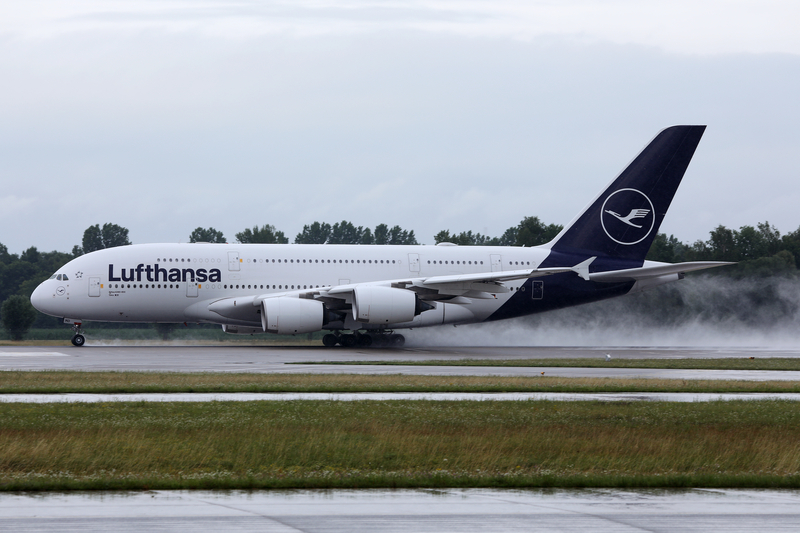
The first Lufthansa A380 of the 2026 Denver season arrived from Munich International Airport (MUC) at Denver International Airport (DEN) on July 2, operating as LH480 with aircraft D-AIMA. The double-deck aircraft had originally been expected earlier in the summer, but the first scheduled A380 operation did not materialize as initially planned, pushing the effective start of the 2026 superjumbo season into early July.
For aircraft enthusiasts, the arrival was still a major moment. Denver (DEN) remains one of the rare U.S. airports to see scheduled Airbus A380 service, and Lufthansa is the only airline scheduled to bring the type to the Rocky Mountain region this year.
For network planners, however, the more interesting story is not the aircraft’s return. It is the fact that Lufthansa has cut the total A380 flying on the Munich (MUC)–Denver (DEN) route by nearly half compared with last year.
Lufthansa Brings The A380 Back To Denver
The A380 is operating between Munich (MUC) and Denver (DEN), one of Lufthansa’s most important U.S. long-haul routes from Bavaria.
The route normally operates as LH480 westbound from Munich to Denver and LH481 eastbound from Denver to Munich. Munich Airport’s published A380 schedule lists LH480 departing MUC at 11:15 and arriving at DEN at 13:45 local time, while LH481 departs DEN at 16:15 and arrives back in Munich at 10:50 the following morning. Actual times can vary by date, aircraft rotation, and operational conditions.
The first 2026 A380 arrival, D-AIMA, is one of Lufthansa’s Airbus A380-841 aircraft. The type is powered by four Rolls-Royce Trent 900-series engines and remains the largest passenger aircraft in the world. Lufthansa’s A380 seats 509 passengers in a four-class layout: First Class, Business Class, Premium Economy, and Economy.
That makes the A380 a very different proposition from the Airbus A350-900 or Boeing 787-9. It is not simply a larger aircraft. It is a capacity statement.
At Denver (DEN), that statement carries extra weight because the airport has the runway length, terminal capability, and international growth profile to handle the aircraft, but not many airlines have a commercial reason to send an A380 there.
A Shorter A380 Season Than 2025
Lufthansa’s 2025 A380 season at Denver was a major airport milestone.
Denver Airport said the A380 operated nearly 350 total arrivals and departures between Munich (MUC) and Denver (DEN) from April 30 through October 24, 2025. That was the first time DEN had scheduled service with the world’s largest passenger aircraft.
The 2026 season is much shorter. Instead of running from spring deep into October, the A380 is effectively concentrated into the core summer travel window, with scheduled operations focused between early July and late September.
That is the source of the roughly 47% cut in scheduled A380 flights. The aircraft is still back, and Lufthansa is still committed to Denver, but it is no longer giving the route the same long superjumbo season it had in 2025.
This is best understood as right-sizing, not retreat. Lufthansa tested a long A380 season last year. The market responded with strong passenger volume, but the seat count was enormous. For 2026, the airline is keeping the A380 during the highest-demand months while reducing the risk of carrying too much capacity during weaker shoulder periods.
Why The A380 Is Hard To Fill Profitably
The Airbus A380 is loved by passengers, crews, and aviation fans, but it is not an easy aircraft to schedule.
Lufthansa’s A380 has 509 seats. That includes 8 First Class seats, 78 Business Class seats, 52 Premium Economy seats, and 371 Economy seats. Compared with a Lufthansa Airbus A350-900, which can seat 293 passengers in one common layout, the A380 adds more than 200 seats on a single departure.
That is a massive capacity increase. It can work beautifully in peak periods when demand is strong, premium cabins are selling, and connecting traffic is flowing in both directions. It can become a margin problem when too many seats are left empty.
The challenge is especially sharp on a long-haul route such as Munich (MUC)–Denver (DEN). The A380 is a four-engine aircraft, and while it is highly capable, it has a higher trip cost than modern twin-engine widebodies. The economics only work if the airline can fill the aircraft at acceptable fares across all cabins.
A full A380 can be a revenue machine. A three-quarters-full A380 can be much harder to justify when an A350-900 or Boeing 787-9 could perform the same mission with lower total trip cost and less empty-seat risk.
Denver Is A Strong Market, But Not A Pure Local Market
The Munich (MUC)–Denver (DEN) route is not driven only by passengers traveling between Bavaria and Colorado.
It is a Star Alliance corridor. Lufthansa and United Airlines use Munich and Denver as connecting platforms, moving passengers across both networks. Denver (DEN) gives Lufthansa access to United’s large Rocky Mountain and western U.S. network, while Munich (MUC) gives United and Denver-originating travelers access to Lufthansa’s European, Middle Eastern, African, and Asian connections.
That is the real logic behind the route. Local Denver–Munich demand matters, but the aircraft is also carrying passengers traveling between places such as Austin, Las Vegas, Phoenix, Salt Lake City, San Diego, Prague, Athens, Delhi, Bengaluru, and beyond.
This is why the A380 can make sense at Denver despite the route not being a classic global megacity pair like London–Dubai or New York–Frankfurt. Denver is a major United hub, Munich is a major Lufthansa hub, and the two networks can feed each other.
But connecting traffic can be lower-yield than local premium demand. If too much of the aircraft is filled with lower-fare connecting passengers, the A380’s size becomes less attractive. Lufthansa’s 2026 schedule cut suggests the airline wants the route to perform better on yield, not just passenger count.
The 2025 Lesson: More Passengers, Lower Loads
Lufthansa’s first Denver A380 season did exactly what a superjumbo deployment often does: it increased total passenger volume.
The aircraft gave the market a large seat boost, and Denver Airport said the A380 helped contribute to a rise in international passenger traffic. That is good for the airport, good for visibility, and good for route prestige.
The airline’s problem is more nuanced. Industry schedule and traffic analysis indicated that the A380 pushed total passenger numbers higher in 2025, but average seat occupancy fell compared with the earlier, smaller-aircraft operation. That is not surprising. When an airline adds hundreds of seats per departure, load factor can fall even if more people are traveling.
The question is whether the additional passengers paid enough to justify the additional aircraft cost.
Lufthansa’s 2026 adjustment suggests the answer was mixed. The airline did not abandon the A380 at Denver. It simply shortened the season, keeping the aircraft when demand should be strongest and using smaller widebodies elsewhere in the schedule.
That is disciplined network planning.
The Aircraft: Lufthansa’s Airbus A380-800
The Airbus A380 remains one of the most impressive aircraft ever built.
Lufthansa’s A380-800 is 72.73 meters long, has a wingspan of 79.80 meters, and has a maximum takeoff weight of 560 metric tons. Its range is listed at 12,400 kilometers, more than enough for Munich (MUC)–Denver (DEN), a sector of roughly 5,200 miles depending on routing.
The aircraft’s appeal is not only capacity. The A380 is unusually spacious, especially in premium cabins and on the upper deck. Lufthansa’s version offers First Class at the front of the upper deck, a large Business Class cabin, Premium Economy, and a substantial Economy cabin across the main deck and rear upper-deck sections.
For passengers, the A380 is still special. It is quiet, stable, and spacious, and it carries a sense of occasion that newer twin-engine aircraft do not always match. For airports, it is an attention-grabber. For airlines, however, it is a tool that must be used carefully.
Lufthansa knows this well. After parking the A380 fleet during the pandemic, the airline brought the type back because long-haul demand recovered faster than expected and new aircraft deliveries were delayed. The A380 now gives Lufthansa high-capacity relief at Munich, but it has to be placed only where the revenue case is strong.
Denver’s A380 Capability Is Part Of The Story
Denver International Airport (DEN) is well suited to large widebody operations.
The airport has long runways, high-capacity international facilities, and a large United hub. Its elevation makes aircraft performance more complex than at sea-level airports, but DEN was built with long-haul operations in mind. The A380’s presence shows that the airport can handle the largest passenger aircraft in scheduled service.
That is valuable for Denver’s airport profile. A380 service is not just about one Lufthansa route. It signals that DEN can support top-tier international aircraft and complex long-haul operations. That matters as the airport continues to grow its transatlantic, transpacific, and Latin America ambitions.
Still, being able to handle the A380 is different from needing it every day for months. Lufthansa’s 2026 plan recognizes both truths. Denver can support the A380, but the market may not need a long A380 season every year.
The Frankfurt A350 Adds A Second Lufthansa Layer
Lufthansa’s Denver operation is not only about Munich.
The airline also serves Denver from Frankfurt Airport (FRA), and Lufthansa has deployed the Airbus A350-900 from Frankfurt on routes including Denver. The A350-900 gives Lufthansa a very different aircraft profile from the A380: long range, strong fuel efficiency, modern cabin systems, and much lower trip cost.
In Lufthansa’s standard A350-900 layout, the aircraft seats 293 passengers: 48 in Business Class, 21 in Premium Economy, and 224 in Economy. Other Allegris-equipped variants have different layouts, but the key point is the same. The A350 is a more efficient twin-engine aircraft with far less capacity risk than the A380.
That gives Lufthansa flexibility. The airline can use the A380 from Munich (MUC) during the strongest peak-summer window and rely on A350 flying from Frankfurt (FRA) to support Denver demand over a longer period.
For Denver passengers, that means Lufthansa still has a strong Germany network. For Lufthansa planners, it means the airline can balance capacity between two German hubs without overexposing the A380.
Could The A380 Leave Denver Again?
It is possible.
If the 2026 A380 season performs well, Lufthansa may keep Denver in the superjumbo rotation for future summers. If load factors and yields remain weak, the airline could move the route back to the Airbus A350-900, Boeing 787-9, Airbus A340-600, or another long-haul type depending on future fleet availability.
The Boeing 777X is another future variable. Lufthansa has been waiting for the next-generation Boeing widebody, and when it finally enters service, it could eventually reshape the airline’s long-haul fleet planning. But it is too early to write the 777X into Denver’s schedule with confidence.
For now, the realistic comparison is between the A380 and the A350. The A380 offers 509 seats and unmatched airport spectacle. The A350 offers a much leaner capacity profile and far better fuel efficiency. If Denver can support the A380 at strong yields during July, August, and September, the superjumbo can stay. If not, the A350 is the cleaner long-term answer.
Why Lufthansa Still Values Denver
The reduced A380 schedule should not be mistaken for Lufthansa losing interest in Denver.
Denver (DEN) has become one of the most important interior U.S. gateways for transatlantic travel. The airport benefits from a large local market, a fast-growing metro area, strong premium leisure demand, corporate traffic, ski and mountain tourism, and United’s massive connecting network.
For Lufthansa, Denver connects well with Munich (MUC) and Frankfurt (FRA). It supports both local and connecting traffic, and it gives the Lufthansa Group a strong presence in the Rocky Mountain region. The market also has close business, tourism, and cultural links with Germany and Central Europe.
The decision to bring the A380 back at all shows that Lufthansa still sees high peak-season value in the route. The decision to shorten the season shows that the airline is now more focused on profitability than prestige.
That is exactly how mature long-haul network planning should work.
The Passenger Experience: A Rare Treat From Denver
For passengers booked on the A380, the 2026 season is a rare opportunity.
Very few U.S. airports see scheduled A380 service anymore, and Denver is not an obvious superjumbo market in the way Los Angeles (LAX), New York JFK (JFK), or Miami (MIA) might be. That makes the Lufthansa flight especially attractive for aviation enthusiasts and travelers who want to experience the aircraft before the global A380 fleet becomes even smaller.
The aircraft also offers a large premium cabin. With First Class, Business Class, and Premium Economy onboard, Lufthansa can cater to high-value travelers as well as families and economy passengers connecting between the U.S. and Europe.
The onboard experience will not be the same as Lufthansa’s newest Allegris-equipped aircraft, but the A380 still delivers something the A350 and 787 cannot: size, space, and the feeling of flying on a true double-deck flagship.
For many passengers, that is still part of the appeal.
A380 Economics Are Less Forgiving Than A350 Economics
The core issue is simple: the A380 has to be full enough, at the right fares, to justify itself.
A modern twin-engine widebody such as the Airbus A350-900 can operate a route with fewer seats and lower fuel burn. If demand softens, the A350 gives an airline more protection. If demand surges, the A380 offers enormous upside.
That makes the A380 a seasonal weapon rather than a default aircraft.
Denver’s summer travel peak is exactly the kind of period where the A380 can work. Europe-bound leisure traffic is strong, inbound U.S. travel is active, school holidays support family trips, and United connections help fill the aircraft at DEN. But once the peak starts to fade, the A380 becomes harder to defend.
Lufthansa’s 2026 plan reflects that reality. The airline is not walking away from Denver. It is concentrating the A380 where it has the best chance of making money.
Bottom Line
Lufthansa’s Airbus A380 return to Denver is both a celebration and a correction.
The aircraft’s arrival at Denver International Airport (DEN) from Munich (MUC) brings back one of the most impressive sights in commercial aviation: a 509-seat, four-engine, double-deck Airbus A380 operating scheduled service to the Rocky Mountain region. For passengers and aviation enthusiasts, it is a major highlight of the summer.
But the 2026 A380 season is much leaner than 2025. Lufthansa has effectively cut the total A380 flying to Denver by nearly half, mostly by shortening the operating window and concentrating the aircraft into the strongest summer months.
That is the right move. The A380 can produce huge passenger volumes, but it also carries major capacity and cost risk. Denver is a strong Lufthansa and United market, but it has to support the aircraft with the right mix of local demand, connecting traffic, premium revenue, and load factor.
If the 2026 season performs well, the A380 could remain a summer fixture at DEN. If not, Lufthansa has more efficient alternatives, especially the Airbus A350-900, already active in the airline’s Denver network from Frankfurt (FRA).
For now, Denver gets the superjumbo back. The long-term question is whether the route can make the A380 work as more than an aviation spectacle