Air Arabia Adds Daily Sharjah-Aleppo Flights As UAE-Syria Connectivity Rebuilds
Air Arabia will launch daily nonstop flights between Sharjah and Aleppo on July 4, 2026, adding another important Syria route to the carrier’s growing regional network.
The new service will connect Sharjah International Airport (SHJ) with Aleppo International Airport (ALP). It will operate seven times per week using Air Arabia’s Airbus A320-family fleet.
For Air Arabia, the launch strengthens its position between the United Arab Emirates and Syria. It also gives passengers a direct link between the airline’s main Sharjah (SHJ) hub and Syria’s second-largest city.
The route is especially relevant for visiting-friends-and-relatives traffic, business travel and the gradual rebuilding of regional air links to Syria.
Daily Flights Start July 4
The new Sharjah (SHJ)–Aleppo (ALP) route will operate daily.
Flight G9 351 will depart Sharjah (SHJ) at 8:00 a.m. and arrive in Aleppo (ALP) at 10:35 a.m.
The return flight, G9 352, will leave Aleppo (ALP) at 11:35 a.m. and arrive back in Sharjah (SHJ) at 3:55 p.m.
All times are local.
The schedule gives Air Arabia a morning departure from the UAE and a same-day return from Syria. That is useful for aircraft utilization, especially on a route that sits well within narrowbody range.
The outbound sector is blocked at 2 hours and 35 minutes. The return sector is longer, at 3 hours and 20 minutes. That makes the route a natural fit for Air Arabia’s single-aisle fleet.
Aleppo Joins Air Arabia’s Syria Network
Aleppo (ALP) will become Air Arabia’s second Syrian destination from Sharjah.
The airline already operates 21 weekly flights between Sharjah (SHJ) and Damascus International Airport (DAM). It also operates three weekly flights between Zayed International Airport (AUH) in Abu Dhabi and Damascus (DAM) through Air Arabia Abu Dhabi.
That gives the Air Arabia group direct UAE links to Syria’s two most important cities.
Damascus remains the country’s political and administrative center. Aleppo, meanwhile, is a major northern city with deep commercial, industrial and community ties.
Adding Aleppo (ALP) gives Air Arabia a broader Syria footprint. It also gives passengers outside Damascus another direct route to the UAE.
Why Aleppo Matters
Aleppo is not a secondary market in the usual sense.
Before years of conflict severely damaged Syria’s economy and transport system, Aleppo was one of the country’s most important business and industrial centers. It had strong links in trade, manufacturing, textiles and regional commerce.
Air service to Aleppo (ALP) therefore has more than symbolic value.
It can support family travel, small business movement, aid-related travel, cargo demand and regional commercial links. It can also help reconnect the Syrian diaspora with northern Syria through a direct UAE gateway.
The route may be especially useful for passengers who would otherwise travel overland from Damascus or connect through another regional airport.
A direct Sharjah (SHJ)–Aleppo (ALP) flight removes that extra step.
Sharjah Remains The Core Of Air Arabia’s Model
Sharjah (SHJ) is Air Arabia’s original and most important hub.
The airline has built a large low-cost network from the airport, connecting the UAE with the Middle East, North Africa, Europe, Central Asia, South Asia and parts of Africa.
That hub structure is important for the Aleppo route.
Passengers traveling from Aleppo (ALP) will not only be able to reach Sharjah. They will also have access to Air Arabia’s wider network through SHJ.
That includes destinations across the Gulf, India, Pakistan, Central Asia and other parts of the airline’s system.
For a market such as Aleppo, this is valuable. The route is not only a point-to-point service. It can also feed onward travel through a low-cost hub.
The Aircraft: Airbus A320-Family Narrowbodies
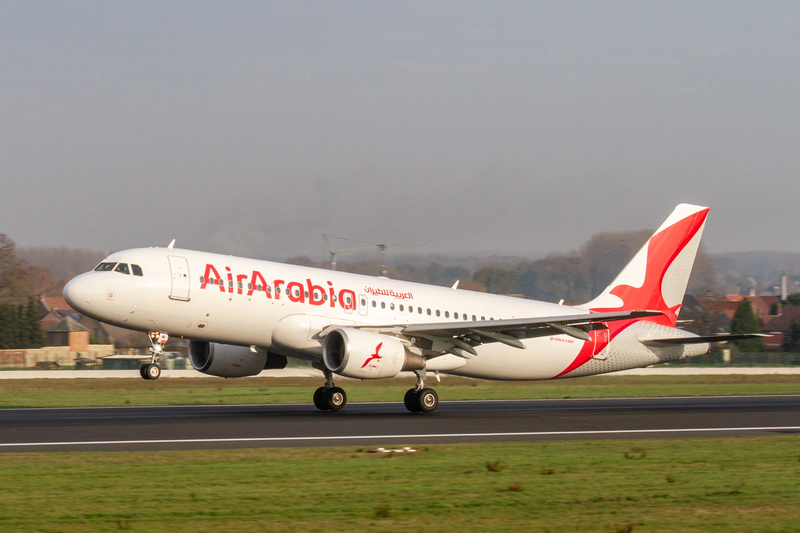
Air Arabia will operate the Aleppo service with its Airbus A320-family fleet.
The airline’s fleet is built around the Airbus A320 and Airbus A321 family. These aircraft are the backbone of its low-cost operation.
That is the right type of aircraft for Sharjah (SHJ)–Aleppo (ALP).
The route is long enough to need efficient narrowbody economics, but not long enough to require a widebody. The A320 family gives Air Arabia the right balance of range, seat capacity and operating cost.
Air Arabia also uses the A321neo LR on some longer routes. The airline says the A321neo LR can accommodate 215 passengers and includes its SkyTime wireless entertainment system.
However, Air Arabia has not specified which exact A320-family variant will operate every Aleppo flight.
A Low-Cost Product On A Rebuilding Route
Air Arabia’s product is built around affordable fares and optional extras.
Passengers can buy meals through SkyCafe, use the airline’s SkyTime streaming entertainment service where available, and earn points through Air Rewards.
That model works well on a route like Aleppo.
VFR passengers are often price-sensitive. Families may also value direct flights more than full-service extras. A daily low-cost service gives them more schedule choice and fewer connection complications.
The route also helps business travelers who need a practical link between northern Syria and the UAE.
Frequency matters here. A once- or twice-weekly service can be useful, but daily flights make the route much easier to plan around.
UAE–Syria Air Links Continue To Grow
The launch comes as airlines gradually rebuild service to Syria.
That process has been uneven. The Syrian market remains complex, and airline decisions depend on regulatory approvals, security assessments, demand, insurance and airport readiness.
Still, the direction is clear.
More regional carriers are returning or increasing flights. Air Arabia’s Aleppo launch fits that broader pattern.
The airline is also expanding from more than one UAE airport. Sharjah (SHJ) remains the main hub, while Air Arabia Abu Dhabi gives the group a presence at Abu Dhabi (AUH).
That two-hub UAE strategy gives the company more flexibility. It can serve different passenger bases and build broader coverage into markets such as Syria.
A Route With Strong VFR Potential
The strongest demand driver is likely visiting-friends-and-relatives traffic.
Large Syrian communities live and work across the Gulf, including in the UAE. For those travelers, direct flights to both Damascus (DAM) and Aleppo (ALP) are valuable.
Aleppo is especially important for travelers with family ties in northern Syria.
Without a direct flight, many passengers need to land in Damascus, connect through another country, or travel overland for several hours. A nonstop Sharjah–Aleppo service reduces that friction.
That should make the route attractive from the start.
It may also support inbound UAE travel from Syria, especially for passengers connecting onward through Sharjah.
Economic And Tourism Links Are Part Of The Story
Air Arabia Group CEO Adel Al Ali said Syria remains a key destination in the airline’s network.
He said the Aleppo launch supports accessibility and convenience while contributing to economic and tourism ties between the UAE and Syria.
That language matters.
Airlines are often early indicators of rebuilding regional relationships. When direct flights return, business travel becomes easier. Family travel becomes easier. Trade contacts become easier.
Tourism may take longer to rebuild, especially in a market with Syria’s recent history. However, air connectivity is a necessary first step.
Without flights, recovery is much harder.
Air Arabia Strengthens Its Regional Advantage
Air Arabia has a clear advantage in this type of market.
It operates a simple single-aisle fleet. It has a large Sharjah hub. It understands price-sensitive regional demand. It also has experience serving markets that larger full-service airlines may approach more cautiously.
That makes Aleppo a logical addition.
The route does not need a complex long-haul product. It needs reliable narrowbody capacity, good fares and daily frequency.
Air Arabia can provide that.
The carrier’s scale also helps. Because it already operates 21 weekly Sharjah–Damascus flights, it has an established Syria sales base. Adding Aleppo builds on that existing demand rather than starting from zero.
Bottom Line
Air Arabia’s new daily Sharjah (SHJ)–Aleppo (ALP) service is a meaningful expansion of UAE–Syria connectivity.
The route begins on July 4, 2026, with daily Airbus A320-family flights. It will complement Air Arabia’s existing Syria network, which already includes 21 weekly Sharjah (SHJ)–Damascus (DAM) flights and three weekly Abu Dhabi (AUH)–Damascus (DAM) flights.
For passengers, the biggest benefit is convenience. Aleppo gains a direct UAE link, while travelers from northern Syria gain access to Air Arabia’s broader Sharjah network.
For Air Arabia, the route deepens its role in the Syrian market and strengthens its position as one of the region’s most important low-cost carriers.
The launch is also a sign of how regional air links to Syria are slowly rebuilding. Daily service to Aleppo is not just another route addition. It is a practical step in reconnecting one of Syria’s most important cities with the wider Middle East.