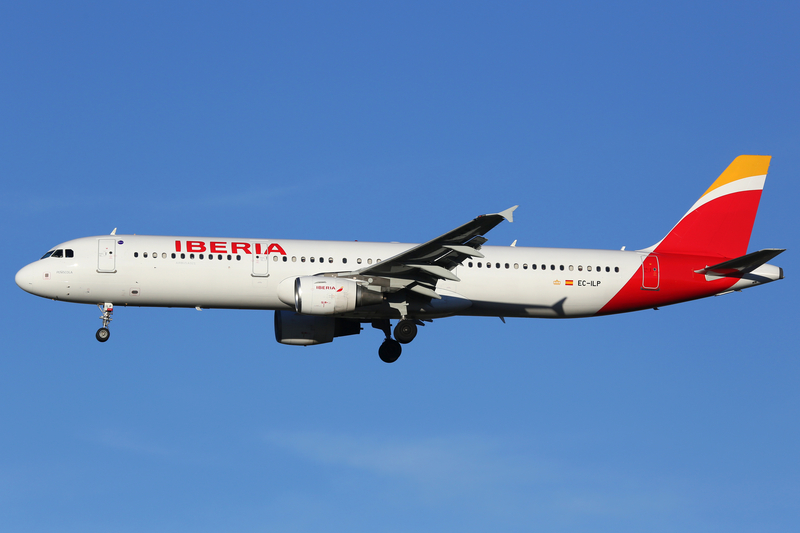
Iberia Launches Madrid-Toronto As A321XLR Opens A New Canada Link
Iberia has launched its new nonstop route between Madrid-Barajas Airport (MAD) and Toronto Pearson International Airport (YYZ).

The first flight arrived in Toronto (YYZ) with a load factor above 95%.
That is a strong start for Iberia’s newest North American route. It also shows clear demand for nonstop travel between Spain and Canada.
Read our stories in your inbox
Two aviation newsletters. Zero fluff.
The service will operate five times per week during the summer season. Flights run on Mondays, Wednesdays, Fridays, Saturdays, and Sundays.
Iberia says the route will offer more than 37,000 seats this summer.
Toronto Becomes Iberia’s New Canadian Gateway
The new Madrid (MAD)–Toronto (YYZ) service gives Iberia a direct link to Canada’s largest city.
Toronto is one of North America’s most important business, tourism, education, and immigrant-community markets. It also has strong demand to Europe.
For Iberia, the route adds another point to its growing North American network.
It also gives Canadian travelers a new one-stop option beyond Madrid. Through MAD, Iberia passengers can connect to 46 destinations across Spain and more than 60 across Europe.

That makes the route more than a simple Spain–Canada city pair.
It turns Madrid into a useful gateway for Toronto passengers heading to Spain, Portugal, Italy, France, North Africa, and other parts of Europe.
The First Flight Arrived Nearly Full
The inaugural Madrid–Toronto flight performed strongly.
Iberia said the first flight arrived at Toronto Pearson (YYZ) with a load factor above 95%.
That does not guarantee long-term success. First flights often benefit from launch attention, trade interest, and early booking demand.
Still, a near-full inaugural service is a positive signal.
It suggests the market had been waiting for a direct Iberia link. It also supports the airline’s decision to use a smaller long-range aircraft instead of a widebody.
The A321XLR Is The Key Aircraft
The route is operated by the Airbus A321XLR.
That matters.
The A321XLR gives Iberia long-haul range with narrowbody economics. It can operate transatlantic routes that may not need a larger aircraft such as an Airbus A330 or A350.
For Madrid (MAD)–Toronto (YYZ), that is useful.
The market is large enough for nonstop service. But it may not need a widebody every day during the summer season.
The A321XLR gives Iberia a better way to match capacity with demand.
Iberia Was The A321XLR Launch Airline
Iberia has become one of the most important early operators of the A321XLR.
The airline became the first carrier in the world to operate the type commercially in November 2024.
Since then, the aircraft has become central to its transatlantic growth.
Iberia has used the A321XLR to strengthen routes such as Boston (BOS), Washington Dulles (IAD), and San Juan (SJU). It is also using the aircraft to open new opportunities in the Americas.
Toronto (YYZ) fits that strategy.
It is a long-haul market that benefits from nonstop service, but the aircraft size keeps the commercial risk under control.
A Narrowbody With A Long-Haul Cabin
Iberia’s A321XLR has 182 seats.
The aircraft has two cabins: Business and Economy.
The Business cabin has 14 individual seats with direct aisle access. These seats convert into full-flat beds, giving premium passengers a true long-haul-style product on a single-aisle aircraft.
Economy has 168 seats.
The aircraft also includes Airbus’ Airspace cabin, larger overhead bins, LED lighting, Bluetooth audio connectivity, USB-A and USB-C charging, and improved onboard connectivity.
That makes the aircraft different from a standard short-haul A321.
Passengers are still flying on a single-aisle jet. But the cabin is designed for long-haul missions.
Why The A321XLR Works For Toronto
Madrid (MAD)–Toronto (YYZ) is exactly the type of route the A321XLR was built to serve.
It is long enough to need a true long-haul aircraft. But it does not necessarily require a large widebody.
That gives Iberia flexibility.
A widebody can be efficient if demand is strong every day. But it also adds more seats to fill. The A321XLR lets Iberia operate more targeted long-haul services with fewer seats.
It also allows the airline to open new markets faster.
Instead of waiting for demand to justify an A330 or A350, Iberia can launch a route with a smaller aircraft and build from there.
Madrid Gains Another North American Link
The new Toronto route also strengthens Madrid’s role as a transatlantic hub.
Iberia is using Madrid-Barajas (MAD) as its main bridge between Europe and the Americas.
That is especially important as the airline grows in North America.
Toronto joins a wider Iberia plan that includes new or planned routes such as Philadelphia (PHL), Monterrey (MTY), Orlando (MCO), Recife (REC), and Fortaleza (FOR).
The strategy is clear.
Iberia wants to use smaller, efficient aircraft to grow beyond the largest traditional gateways.
Toronto is part of that next phase.
Canadian Demand To Madrid Is Growing
The launch also comes as Madrid sees stronger demand from Canada.
Madrid tourism officials said Canadian demand to the region increased sharply in early 2026. City officials also described Canada as one of Madrid’s fastest-growing visitor markets this year.
That matters for the route.
The success of MAD–YYZ will not depend only on Spanish outbound demand. It also needs Canadians traveling to Madrid, Spain, and wider Europe.
Toronto has a large catchment area. It also has strong premium and leisure traffic.
That gives Iberia a good base for the service.
The Stopover Programme Adds Value
Iberia is also promoting its Stopover Hola Madrid programme.
The programme allows passengers connecting through Madrid to stop in the Spanish capital for up to nine nights without paying additional airfare.
That can help the new Toronto route.
A passenger flying from Toronto to another European city may choose Iberia if they can add a Madrid stopover at no extra airfare.
For Madrid, the benefit is also clear.
The programme can turn connecting passengers into visitors. That means more hotel stays, restaurant spending, museum visits, and local tourism revenue.
Part Of Flight Plan 2030
The Toronto launch is part of Iberia’s Flight Plan 2030.
The plan includes €6 billion of investment.
Iberia wants to expand its long-haul fleet from 45 aircraft to about 70. It also plans to renew short- and medium-haul aircraft, improve digital services, upgrade the customer experience, and open new destinations.
The A321XLR is a major part of that plan.
It gives Iberia a lower-risk way to add long-haul routes. It also helps the airline grow in North America and Latin America without relying only on widebody aircraft.
A Different Kind Of Transatlantic Growth
The route shows how transatlantic flying is changing.
For years, new long-haul routes usually required widebody aircraft. That limited what airlines could try.
The A321XLR changes that.
Airlines can now launch thinner transatlantic markets with fewer seats and lower trip costs. That does not mean the widebody is disappearing. Iberia will still need A330s and A350s for larger markets.
But the A321XLR gives the airline another tool.
It can connect cities that may not have supported daily widebody service in the past.
Toronto is a good example of that approach.
Bottom Line
Iberia has launched its new nonstop Madrid (MAD)–Toronto (YYZ) route.
The first flight arrived at Toronto Pearson with a load factor above 95%. The route will operate five times per week during the summer season and offer more than 37,000 seats.
The service is operated by the Airbus A321XLR, configured with 182 seats across Business and Economy.
For Iberia, the aircraft is central to its transatlantic expansion strategy. It allows the airline to open long-haul routes with fewer seats than a widebody while still offering a premium cabin.
For Toronto passengers, the route adds direct access to Madrid and one-stop connections across Spain and Europe.
For Madrid, it brings another North American market into Iberia’s growing hub strategy.
The route is small compared with Iberia’s largest long-haul markets, but it is strategically important. It shows how the A321XLR is helping airlines build new transatlantic links that once may have been too risky for larger aircraft.
Keep reading FlyMag
Get the Daily Brief in the morning or the Route Watch weekly recap on Fridays. Or both.