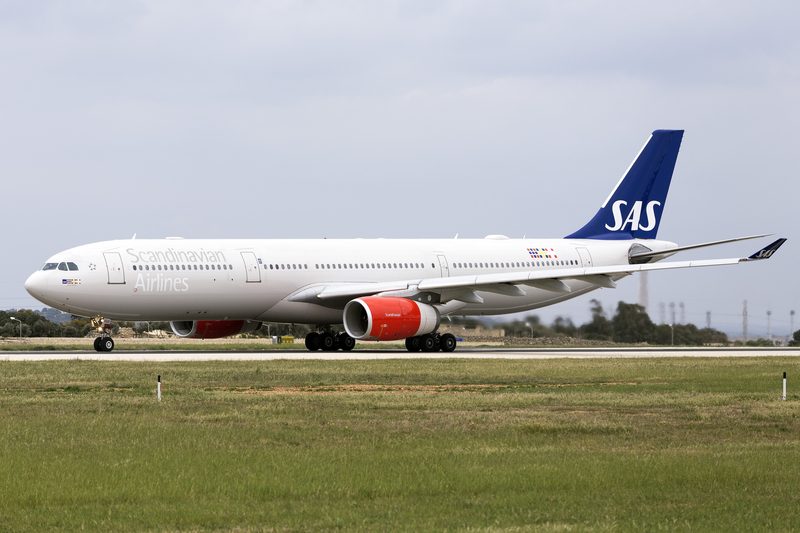
A Scandinavian Airlines Airbus A330-300 operating from Newark Liberty International Airport (EWR) to Stockholm Arlanda Airport (ARN) diverted to Bangor International Airport (BGR) after smoke was reportedly detected in the cabin during the transatlantic crossing.

The aircraft, registered LN-RKM, was operating as SK904 on May 25, 2026. The crew elected to divert as a precaution, and the aircraft landed safely in Bangor roughly 75 minutes after the decision to head for Maine. No injuries were reported.
For aviation readers, the key point is simple: smoke or smoke-like odors in flight are treated as one of the clearest triggers for an immediate diversion, even when the source is not yet known and even if the aircraft itself appears otherwise fully controllable.
Read our stories in your inbox
Two aviation newsletters. Zero fluff.
Smoke In The Cabin Is Always Taken Seriously
The crew’s decision to divert was entirely consistent with standard airline practice.
Any report of smoke in the cabin can point to several possible issues, including electrical faults, overheating equipment, ventilation system malfunctions, or other technical failures that cannot be fully diagnosed in the air. The exact cause may later prove minor, but the operating assumption during the flight is always the opposite: treat it as potentially serious until proven otherwise.
That is why these diversions happen quickly and usually to the nearest suitable airport.
Bangor Remains A Natural Transatlantic Diversion Airport
Bangor was the logical place to end the flight.
It sits in exactly the kind of position that makes it useful for North Atlantic diversions, offering a long runway, emergency-response capability, and the ability to receive a widebody aircraft at short notice. For crews facing possible smoke in the cabin, the priority is not keeping the schedule intact. It is getting the airplane on the ground at a suitable airport with support available.
That is one reason Bangor continues to matter even if it is not a major international hub in the commercial sense.
The Aircraft Landed Safely And Stayed On The Ground
One important detail is that the A330 remained on the ground in Bangor after landing.
That suggests the issue required technical inspection before the aircraft could be cleared to continue. Even if smoke is no longer visible or the smell dissipates, airlines do not simply send the aircraft back into service without maintenance review. Smoke events are treated as potentially significant until a clear source is identified and the aircraft is determined safe.
For passengers, that usually means a longer disruption than the diversion itself.
The Cause Had Not Yet Been Confirmed Publicly
At the time of the initial reporting, SAS had not publicly explained what caused the reported smoke.
That is important because smoke-related diversions often look more dramatic to passengers than the eventual technical cause may justify. But it is just as important not to minimize them prematurely. Until engineers inspect the aircraft, the airline may not know whether the issue came from an electrical source, air-conditioning system, galley equipment, or something else entirely.
So the correct framing here is straightforward: precautionary diversion for a potentially serious onboard technical issue.
Bottom Line
SAS flight SK904 from Newark to Stockholm diverted safely to Bangor after smoke was reportedly detected in the cabin. The Airbus A330-300 LN-RKM landed without incident, emergency services were available, and no injuries were reported.
For the airline, it was a disruption. For the crew, it was exactly the kind of conservative decision commercial aviation is designed to reward. When smoke is reported onboard, the safest flight plan is usually the shortest one to the ground.