Turkish Airlines 777 Hits Radar Mast While Taxiing At Antalya Airport
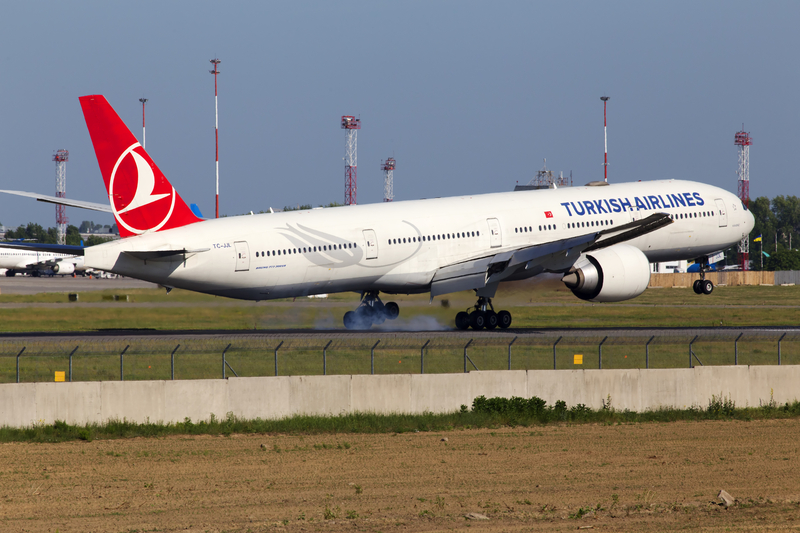
A Turkish Airlines Boeing 777 was damaged at Antalya Airport (AYT) after striking a ground radar antenna mast while taxiing after arrival.
The aircraft was operating flight TK2430 from Istanbul Airport (IST) to Antalya (AYT) on Thursday, June 11.
The aircraft involved was a Boeing 777-300ER registered TC-LKD.
Read our stories in your inbox
Two aviation newsletters. Zero fluff.
Turkish Airlines said the aircraft’s right wing contacted a ground radar antenna mast while the jet was approaching its parking position. The airline confirmed that 267 passengers were safely evacuated.
One passenger was lightly injured. Turkish Airlines said that passenger’s condition was good.
The Incident Happened After Landing
TK2430 had already landed at Antalya (AYT).
The incident happened during taxi, as the widebody moved toward its parking area.
That timing matters. This was not an in-flight event. It was a ground incident after a normal domestic flight from Istanbul (IST).
According to Turkish reports, the aircraft entered the wrong taxi lane while moving toward the apron. It then contacted a mast connected to ground radar equipment.
The impact damaged the aircraft and the mast.
Turkish Airlines said a technical investigation has started.
The Aircraft Was A Boeing 777-300ER
The aircraft involved was TC-LKD, a Boeing 777-300ER.
The Boeing 777-300ER is one of the largest twin-engine widebody aircraft in passenger service. Boeing lists the type with a wingspan of 64.8 meters, or 212 feet 7 inches.
That is a major factor in ground handling.
A 777-300ER does not need much forward speed to create serious damage during taxi. Its wingtips extend far from the cockpit, and pilots cannot directly see the outer wingtip position with precision from the flight deck.
As a result, widebody taxi operations depend heavily on correct routing, airport markings, air traffic instructions, wingtip clearance, and ground layout.
Why Taxiway Clearance Matters
Taxiing a 777 is not like taxiing a narrowbody.
The aircraft is 73.9 meters long and has a wide span. It needs taxiways and apron lanes that are approved for its aircraft category.
If a large aircraft enters a taxi route designed for smaller aircraft, the margin can disappear quickly.
Early reporting from the Aviation Safety Network indicated that the distance between the taxiway centerline and the mast base may have been less than half the 777-300ER’s full wingspan.
If confirmed, that would explain why the aircraft could not clear the structure from that path.
However, the full cause is not yet known. Investigators will need to review airport markings, taxi instructions, surface movement data, crew actions, and ground-control communications.
Passengers Were Evacuated
After the impact, the aircraft stopped and passengers were evacuated.
Turkish Airlines said all 267 passengers were taken off safely.
Reports from Turkey say one passenger suffered a minor injury. The airline said the passenger’s health condition was good.
There were no reports of life-threatening injuries.
For passengers, the incident would have been alarming. Ground collisions can create loud noise, sudden movement, cabin damage, and visible emergency response activity.
However, the aircraft was already on the ground. That gave crews and airport emergency teams more control over the response.
Reports Mention Cabin Damage
Several early reports and images suggested the mast or related structure damaged areas beyond the wing, including the fuselage and cabin area.
Those details should still be treated carefully.
Turkish Airlines’ public statement confirmed contact between the right wing and the ground radar antenna mast. It also confirmed the evacuation and one minor injury.
Until the technical investigation is complete, it is better to avoid stating the full damage pattern as final.
What is clear is that TC-LKD sustained enough damage to be removed from service for inspection and repair.
TC-LKD Had Recently Returned To Turkish
Flight-tracking data from Flightradar24 identifies TC-LKD as a Boeing 777-3Q8ER operated by Turkish Airlines.
The aircraft had previously spent time away from Turkish Airlines on lease. It had recently returned to Turkish service and was still flying in a modified livery rather than a full standard Turkish Airlines paint scheme.
The aircraft’s recent lease history is not known to be connected to the Antalya incident.
This was a ground-handling event during taxi, not a known airworthiness issue with the aircraft type.
A Domestic Route With A Long-Haul Aircraft
TK2430 is a domestic route from Istanbul (IST) to Antalya (AYT).
The flight is short. But Turkish Airlines sometimes uses widebody aircraft on domestic sectors, especially where demand is high or aircraft positioning is useful.
Antalya is one of Turkey’s busiest leisure gateways. It handles heavy seasonal traffic and a mix of domestic, European, Russian, Middle Eastern, and charter operations.
Using a Boeing 777 on IST–AYT is unusual compared with a narrowbody flight, but not impossible for Turkish Airlines.
The aircraft gives the airline a large number of seats on a short, high-demand route. It can also help position a widebody for later operations.
Ground Incidents Can Be Expensive
The repair bill could be significant.
A ground radar mast contacting a widebody wing is not a simple paint scrape. Engineers will need to inspect the right wing, leading-edge or tip structure, skin panels, internal components, and any systems affected by the impact.
If the fuselage or cabin area was also damaged, repairs become more complex.
A pressurized aircraft fuselage must meet strict structural standards. Any puncture or tear has to be repaired properly before the aircraft can return to passenger service.
The cabin may also need work if overhead bins, oxygen-mask panels, wiring, or interior trim were affected.
The aircraft will likely remain grounded until Turkish Airlines and maintenance teams complete inspections and repairs.
Investigators Will Focus On The Taxi Route
The central question is simple: why was a large widebody close enough to hit the mast?
Investigators will likely examine several areas.
They will look at the taxi clearance given to the crew. They will also review whether the aircraft followed the assigned path.
They will check airport markings, charts, lighting, and signage. They may also review whether the taxiway or apron lane was approved for a Boeing 777-300ER.
Surface radar and ground movement recordings could also be important.
At large airports, taxi incidents can involve a chain of small factors. A missed turn, unclear marking, wrong clearance, airport works, poor visibility, or an incorrect assumption can all reduce safety margins.
At this stage, the cause remains under investigation.
Antalya Airport Operations Continued
The incident happened at Antalya (AYT), one of Turkey’s most important airports for tourism.
The airport serves the Mediterranean resort region and handles major seasonal traffic flows.
A widebody ground incident can disrupt apron operations. It can close a taxi lane, delay other aircraft, and require emergency and maintenance teams to secure the area.
Still, the aircraft was not on the runway at the time of the collision. That limited the wider operational impact compared with a runway incident.
The main effect was on the damaged aircraft, its passengers, and local ground operations near the apron.
A Reminder About Widebody Ground Risk
This incident is a reminder that taxiing is still a safety-critical phase of flight.
Large aircraft are vulnerable on the ground because their dimensions leave little margin in tight apron areas.
The cockpit sits far ahead of the wings. The crew must judge turns and clearances from a position that is not directly above the wingtip.
That is why ground movement procedures matter so much.
Airports must protect aircraft with proper markings, approved taxi routes, wingtip-clearance rules, and clear controller instructions. Airlines must also ensure crews follow taxi charts and stop if there is any doubt.
A slow-speed ground collision can still damage an aircraft badly and injure passengers.
Bottom Line
A Turkish Airlines Boeing 777-300ER operating flight TK2430 from Istanbul (IST) to Antalya (AYT) struck a ground radar antenna mast while taxiing after landing.
The aircraft, registered TC-LKD, was moving toward its parking position when its right wing contacted the mast. Turkish Airlines said 267 passengers were safely evacuated and one passenger suffered a minor injury.
The incident is now under technical investigation.
The key question is why a large widebody aircraft ended up close enough to hit ground radar equipment. Investigators will focus on the taxi route, airport markings, ground-control instructions, crew actions, and aircraft clearance.
For Turkish Airlines, TC-LKD is likely to be out of service while engineers assess and repair the damage. For the industry, the incident is another reminder that ground operations can be just as unforgiving as flight operations when large aircraft and tight airport infrastructure meet.
Keep reading FlyMag
Get the Daily Brief in the morning or the Route Watch weekly recap on Fridays. Or both.