Allegiant Reworks Its Florida Map As 34 Routes Disappear From The Schedule
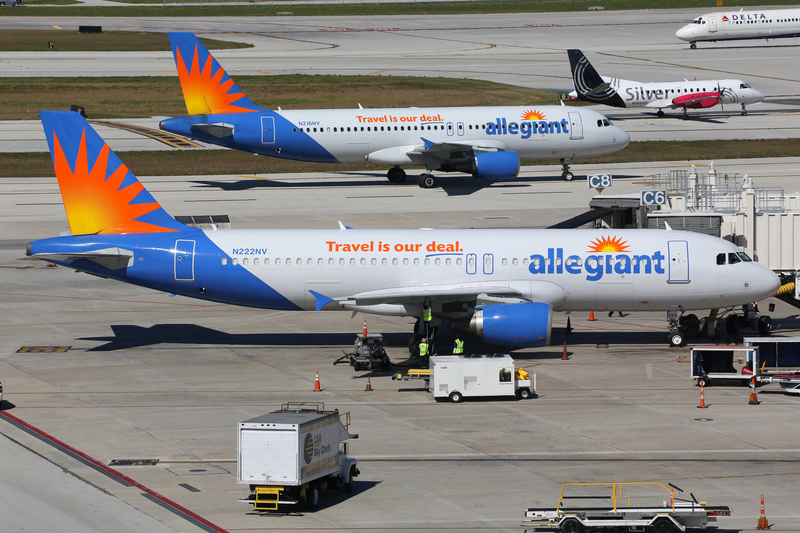
Allegiant Air is reshaping its Florida network, removing 34 domestic routes that operated at some point between January 2025 and May 2026 but are not scheduled to continue from June 2026 onward.
For a carrier as dependent on Florida as Allegiant, that number immediately gets attention. The Sunshine State remains the center of the airline’s leisure-focused business model, with flights to airports such as Orlando Sanford (SFB), St. Pete-Clearwater (PIE), Punta Gorda (PGD), Fort Lauderdale (FLL), Sarasota/Bradenton (SRQ), Destin-Fort Walton Beach (VPS), Fort Myers (RSW), Jacksonville (JAX), Key West (EYW), Melbourne (MLB), Palm Beach (PBI), and Orlando International (MCO).
But Allegiant’s network has always been fluid. The airline is built around low-frequency, point-to-point routes that connect small and mid-sized cities with leisure destinations. Some routes work extremely well. Others fill aircraft only during narrow seasonal peaks or fail to generate enough fare revenue to justify the flying.
Read our stories in your inbox
Two aviation newsletters. Zero fluff.
That is the story behind the latest Florida cuts.
This is not a broad exit from Florida. Allegiant still plans more Florida flights from June through December 2026 than it operated in the same period last year. The carrier is not leaving the state. It is pruning weaker routes and shifting capacity toward markets where it believes the aircraft can earn better returns.

34 Florida Routes Removed From The Schedule
The route removals touch eight Florida airports and cover a wide range of markets, from small Upper Midwest cities to Northeast leisure flows and longer thin routes that appear to have struggled with yield or load factor.
The largest group of cuts involves Fort Lauderdale (FLL) and Orlando Sanford (SFB), which together account for 15 of the 34 removed routes.
| Ended | Route | Current Competitive Context |
|---|---|---|
| April 2025 | Orlando Sanford (SFB) – Grand Forks (GFK) | No nonstop service from SFB or Orlando (MCO) |
| April 2025 | Orlando Sanford (SFB) – Minot (MOT) | No nonstop service from SFB or Orlando (MCO) |
| May 2025 | Fort Lauderdale (FLL) – Peoria (PIA) | No nonstop service from FLL or Miami (MIA) |
| May 2025 | Orlando Sanford (SFB) – Greensboro (GSO) | Breeze serves Orlando (MCO) – Greensboro (GSO) |
| August 2025 | Fort Lauderdale (FLL) – Norfolk (ORF) | JetBlue serves FLL–ORF; American serves MIA–ORF |
| August 2025 | Orlando Sanford (SFB) – Norfolk (ORF) | Multiple carriers serve Orlando (MCO) – Norfolk (ORF) |
| April 2026 | Fort Lauderdale (FLL) – Bangor (BGR) | No nonstop service from FLL or Miami (MIA) |
| April 2026 | Fort Lauderdale (FLL) – Flint (FNT) | No nonstop service from FLL or Miami (MIA) |
| April 2026 | Fort Lauderdale (FLL) – Traverse City (TVC) | No nonstop service from FLL or Miami (MIA) |
| April 2026 | Orlando Sanford (SFB) – Bismarck (BIS) | No nonstop Florida service |
| April 2026 | Orlando Sanford (SFB) – Columbia (COU) | Allegiant later adds COU–SFB back from October 2026 |
| May 2026 | Fort Lauderdale (FLL) – Columbia (COU) | No nonstop FLL service |
| May 2026 | Fort Lauderdale (FLL) – Savannah (SAV) | Breeze serves FLL–SAV; American serves MIA–SAV |
| May 2026 | Fort Lauderdale (FLL) – Tri-State/Huntington (HTS) | No nonstop FLL service |
| May 2026 | Orlando Sanford (SFB) – Niagara Falls (IAG) | No nonstop SFB/MCO service, though Buffalo (BUF) has Orlando service |
The remaining 19 cuts are spread across Destin-Fort Walton Beach (VPS), Jacksonville (JAX), Palm Beach (PBI), Punta Gorda (PGD), Sarasota/Bradenton (SRQ), and St. Pete-Clearwater (PIE):
| Florida Airport | Removed Routes |
| Destin-Fort Walton Beach (VPS) | Minneapolis/St. Paul (MSP) |
| Jacksonville (JAX) | Norfolk (ORF) |
| Palm Beach (PBI) | Indianapolis (IND) |
| Punta Gorda (PGD) | Minneapolis/St. Paul (MSP), New Orleans (MSY), Plattsburgh (PBG), Richmond (RIC), Savannah (SAV), Tri-State/Huntington (HTS) |
| Sarasota/Bradenton (SRQ) | Elmira (ELM), Minneapolis/St. Paul (MSP), Moline/Quad Cities (MLI), Plattsburgh (PBG), Portsmouth/Pease (PSM), Roanoke (ROA) |
| St. Pete-Clearwater (PIE) | Bismarck (BIS), McAllen (MFE), Norfolk (ORF), Savannah (SAV) |
Several of these routes were lightly served, highly seasonal, or dependent on very specific leisure traffic flows. That is exactly where Allegiant is most likely to experiment — and also where it is most likely to cut quickly if the numbers do not work.
ID 437898045 | Air © Boarding1now | Dreamstime.com
This Is A Florida Reset, Not A Florida Retreat
The key point is that Allegiant is not walking away from Florida.
Florida still dominates Allegiant’s network. The airline’s business model is built around linking smaller U.S. cities with leisure destinations, and Florida is the single most important leisure destination in the system. Airports such as Orlando Sanford (SFB), St. Pete-Clearwater (PIE), Punta Gorda (PGD), Sarasota/Bradenton (SRQ), and Destin-Fort Walton Beach (VPS) are central to Allegiant’s identity.
What is changing is the mix.
The routes being removed are not necessarily large, daily trunk markets. Many were low-frequency services that operated two or three times weekly, often with strong seasonal dependence. That kind of flying can be profitable when aircraft are full, fares are strong, and utilization fits Allegiant’s schedule model. It can also become unattractive quickly when loads soften, fares fall, or aircraft can earn more elsewhere.
Allegiant is built to make those changes. Unlike network carriers that may keep routes for connectivity, corporate contracts, or alliance relevance, Allegiant has less reason to preserve a weak route. If a city pair does not produce the right return, the aircraft can be shifted to another leisure market.
That is why route churn is not a side effect of Allegiant’s model. It is part of the model.
Why Allegiant Cuts Routes That Look Useful On Paper
Many of these routes make sense at first glance.
Minot (MOT) to Orlando Sanford (SFB) gives North Dakota travelers direct access to Central Florida. Palm Beach (PBI) to Indianapolis (IND) connects the Midwest with South Florida. Sarasota (SRQ) to Plattsburgh (PBG) links a cold-weather Northeast market with the Gulf Coast. Punta Gorda (PGD) to Richmond (RIC) and Savannah (SAV) look like natural leisure routes.
The issue is not whether people travel between these places. The issue is whether enough people travel nonstop, on Allegiant’s operating days, at fares that justify the aircraft.
That is a much harder test.
Allegiant’s model depends on low-frequency service. The airline often flies routes only two or three times weekly, sometimes less during off-peak periods. That keeps costs low and lets the airline match capacity to leisure demand. But it also limits schedule utility. A passenger who needs to travel on Tuesday may not choose Allegiant if the flight only operates on Friday and Monday.
A route can therefore have real demand but still fail as a low-frequency nonstop.
That appears to be the case with several of the removed markets.
Orlando Sanford Loses Several Thin Northern Routes
Orlando Sanford (SFB) is one of Allegiant’s most important Florida airports, but it also saw a meaningful number of route removals.
The most notable are Grand Forks (GFK), Minot (MOT), Bismarck (BIS), Niagara Falls (IAG), Columbia (COU), Greensboro (GSO), and Norfolk (ORF).
SFB is different from Orlando International (MCO). Allegiant uses Sanford as a lower-cost, leisure-oriented alternative to the region’s primary airport. That works well for many passengers visiting Central Florida’s theme parks, beaches, cruise ports, and vacation homes. It can be less compelling when a route is thin, seasonal, or when travelers prefer the broader airline choices available at MCO.
The Minot (MOT) route shows the challenge. It was one of Allegiant’s longest routes from Orlando Sanford and one of the longest scheduled passenger services in Minot’s history. Long, thin routes are difficult for any airline. They tie up aircraft for a long time, burn more fuel, and require stronger fares to make sense.
If the fare is weak, even a decent load factor may not be enough.
That is especially true for Allegiant’s Airbus A320-family aircraft. The A319 has 156 seats, while the A320 typically carries 177 or 180 seats in Allegiant’s current configuration. A long sector needs to fill a meaningful number of those seats at fares that support both trip cost and aircraft time.
Fort Lauderdale Cuts Are More Competitive
Fort Lauderdale (FLL) is a very different case.
Unlike Orlando Sanford (SFB), Fort Lauderdale-Hollywood International Airport (FLL) is a major South Florida airport with substantial competition. JetBlue, Spirit, Southwest, Delta, American, United, and others all operate at FLL or nearby Miami (MIA), and passengers in South Florida often have multiple airport choices.
Allegiant’s FLL cuts include Bangor (BGR), Flint (FNT), Traverse City (TVC), Peoria (PIA), Norfolk (ORF), Columbia (COU), Savannah (SAV), and Tri-State/Huntington (HTS).
These routes are varied, but most fit Allegiant’s traditional small-to-mid-size city playbook. The problem is that Fort Lauderdale is not always the easiest airport for that model. Costs, congestion, local competition, and nearby Miami (MIA) all complicate the economics.
Some routes, such as Fort Lauderdale (FLL) to Norfolk (ORF) and Savannah (SAV), still have competition or nearby alternatives. Others, such as FLL to Peoria (PIA), Bangor (BGR), Flint (FNT), Traverse City (TVC), and Tri-State/Huntington (HTS), now leave those markets without nonstop Fort Lauderdale or Miami access.
That may be frustrating for passengers, but it also suggests the routes were too thin or too low-yielding for Allegiant’s current priorities.
Punta Gorda And Sarasota See Gulf Coast Pruning
Punta Gorda (PGD) and Sarasota/Bradenton (SRQ) are both important Gulf Coast leisure airports for Allegiant, but both saw several routes disappear.
Punta Gorda loses Minneapolis/St. Paul (MSP), New Orleans (MSY), Plattsburgh (PBG), Richmond (RIC), Savannah (SAV), and Tri-State/Huntington (HTS). Sarasota loses Elmira (ELM), Minneapolis/St. Paul (MSP), Moline/Quad Cities (MLI), Plattsburgh (PBG), Portsmouth/Pease (PSM), and Roanoke (ROA).
These are classic Allegiant-style routes: smaller origin cities or secondary airports linked with Florida Gulf Coast leisure markets. Some likely performed well at certain times of year but struggled outside peak travel windows.
That is a familiar problem on Gulf Coast leisure routes. Demand can be strong during winter, spring break, holidays, and school vacation periods. It can be much softer in shoulder seasons. If Allegiant cannot get enough yield during the peak to justify the full operating season, a route may not survive.
Minneapolis/St. Paul (MSP) is especially interesting because Allegiant’s parent company has now acquired Sun Country Airlines, which is based at MSP. Even though the carriers continue to operate separately in the near term, the combined company will eventually have more tools to decide how best to serve Florida–Minnesota leisure demand. For now, the cuts discussed here apply only to Allegiant-branded flying.
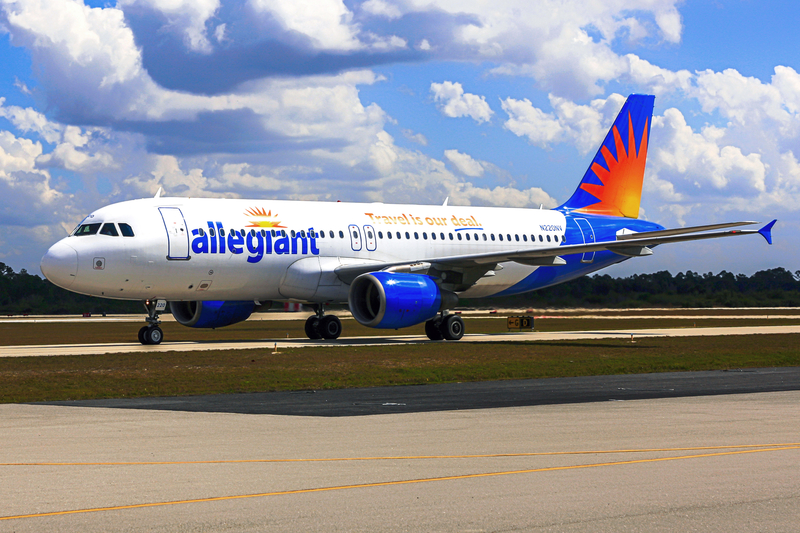
ID 221080172 © Christopher Smith | Dreamstime.com
Palm Beach–Indianapolis Shows Why Load Factor Matters
Palm Beach (PBI) to Indianapolis (IND) is one of the more revealing cuts.
On paper, the route makes sense. Indianapolis has cold-weather leisure demand, and Palm Beach offers access to South Florida without using Fort Lauderdale (FLL) or Miami (MIA). But the route reportedly filled only about 62% of seats over its operating life.
For Allegiant, that is not enough.
The airline’s model depends on high loads during the days it chooses to fly. Because Allegiant operates low frequency, it does not have the same schedule utility as a daily carrier. That means the flights it does operate need to perform well.
If passengers are still choosing to connect over Atlanta (ATL) on Delta or Charlotte (CLT) on American, Allegiant’s nonstop advantage may not be enough. A nonstop flight has value, but only if the operating days, fares, airport preference, and brand fit line up with how people want to travel.
Palm Beach (PBI) to Indianapolis (IND) appears to be a case where the market existed but Allegiant could not capture enough of it.
St. Pete-Clearwater Still Remains Core
St. Pete-Clearwater (PIE) loses Bismarck (BIS), McAllen (MFE), Norfolk (ORF), and Savannah (SAV), but the airport remains one of Allegiant’s core Florida operations.
PIE is a classic Allegiant airport. It is lower-cost, leisure-heavy, close to the Tampa Bay beaches, and highly aligned with the airline’s vacation model. Allegiant has built a large network there over many years, and the airport remains one of the most important pieces of the carrier’s Florida strategy.
The McAllen (MFE) route is a useful example of why Allegiant cuts quickly. It operated from June 2024 to March 2025 and reportedly filled only about 59% of seats. That kind of performance is hard to defend, especially when the aircraft could be moved into a stronger Florida market.
The broader lesson is that even at a strong Allegiant airport, not every city pair works. PIE can support dozens of leisure routes, but the weakest ones still get removed.
Allegiant Is Still Adding Florida Routes
The cuts should be balanced against new Florida flying.
Allegiant announced eight new nonstop routes in May 2026, all expanding Florida service. Those include new Fort Lauderdale (FLL) routes to Boston (BOS), Omaha (OMA), Pittsburgh (PIT), and Kansas City (MCI); new St. Pete-Clearwater (PIE) routes to Philadelphia (PHL) and Columbia (COU); Orlando Sanford (SFB) to Trenton (TTN); and Punta Gorda (PGD) to La Crosse (LSE).
That matters because it shows the airline is not shrinking Florida in a simple, linear way. It is exchanging weaker routes for markets it believes will perform better.
The Fort Lauderdale additions are especially notable. Even as Allegiant cuts several FLL routes, it is adding others to larger or more promising markets. Boston (BOS), Pittsburgh (PIT), Kansas City (MCI), and Omaha (OMA) may offer deeper demand, stronger fares, or better seasonal balance than some of the smaller markets being removed.
Likewise, the return of Columbia (COU) service to St. Pete-Clearwater (PIE) shows that a route cut from one Florida airport does not always mean the carrier is abandoning the origin market. Allegiant may simply decide that one Florida destination works better than another.
Aircraft Strategy Behind The Changes
Allegiant’s aircraft mix shapes the route decisions.
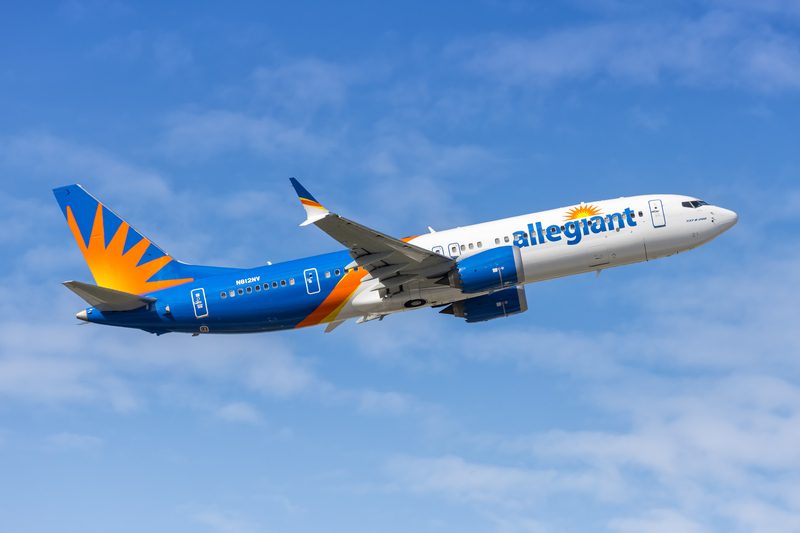
The airline operates Airbus A319s, Airbus A320s, and Boeing 737 aircraft. Allegiant lists the A319 with 156 seats, the A320 with 177 or 180 seats, and the Boeing 737 with 190 seats. These are all high-density narrowbody aircraft designed around low unit costs.
The aircraft are efficient when the seats are full. They are less forgiving when demand is thin.
That is why Allegiant often operates routes only on peak days. Flying fewer flights with more passengers is part of the model. But even a two-weekly route still needs enough traffic. A 156-seat A319 or 180-seat A320 operating to a small market can quickly become too much capacity if local demand is shallow.
The Boeing 737 adds another layer. Allegiant is introducing more 737 MAX aircraft as part of its fleet renewal strategy. Those aircraft bring better fuel efficiency and additional range, but they also seat more passengers than the A319 and many A320 layouts. That can be helpful in strong markets but harder in thin ones.
As the fleet changes, Allegiant may continue to shift away from routes that cannot support higher-capacity aircraft.
Why Florida Is Still The Heart Of Allegiant
Florida remains the natural center of Allegiant’s business.
The airline’s passengers are overwhelmingly leisure-focused. They are not primarily connecting through hubs, chasing alliance status, or flying dense corporate schedules. They are going to beaches, theme parks, vacation homes, cruises, golf trips, family visits, and winter escapes.
Florida offers all of that.
Allegiant’s Florida strategy works because it connects cities that often lack nonstop service to the state. Many of its customers live in markets where the alternative is a long drive to a larger airport or a connection over a hub. Allegiant offers a simple proposition: low fares, nonstop flights, and access to vacation destinations.
That proposition is still powerful. The route cuts do not change that. They simply show that Allegiant is becoming more selective about which Florida links deserve capacity.
Sun Country Adds A New Strategic Layer
The completed Sun Country acquisition gives Allegiant a broader leisure-airline platform, but it does not immediately change the Allegiant route map.
Allegiant Travel Company completed its acquisition of Sun Country Airlines in May 2026. The two airlines are complementary in some ways, especially because both are leisure-focused and operate flexible capacity models. But they continue operating separately in the near term while integration proceeds.
That is why this route analysis should exclude Sun Country flying.
Still, the merger matters strategically. Sun Country brings a Minneapolis/St. Paul (MSP)-centered network, Boeing 737 operations, charter flying, and cargo work. Allegiant brings a broad small-city leisure network, deep Florida exposure, and a large all-nonstop scheduled system.
Over time, the combined company will have more options for how to allocate capacity into Florida. That could influence which markets are served by Allegiant, which are served by Sun Country, and which are better dropped entirely.
For now, the 34 route cuts reflect Allegiant’s own network discipline.
What Passengers Should Expect
For passengers, the main takeaway is to check schedules carefully.
Allegiant routes can be highly seasonal, and a route that operated last year may not return this year. Some services are paused and later restored. Others disappear permanently. In several markets, passengers may still have nearby alternatives, but not necessarily from the same airport.
For example, Niagara Falls (IAG) passengers may still use Buffalo (BUF) for Orlando service, but that is a different airport. Columbia (COU) passengers may regain Florida access through St. Pete-Clearwater (PIE), but not necessarily through Sanford (SFB) or Fort Lauderdale (FLL). Passengers from small markets such as Minot (MOT), Grand Forks (GFK), or Tri-State/Huntington (HTS) may need to connect through a hub or drive to a larger airport.
That is the tradeoff with Allegiant. When the route exists, it can be extremely convenient and affordable. When it does not, the alternatives can be much less direct.
Bottom Line
Allegiant Air has removed 34 Florida-touching domestic routes that operated between January 2025 and May 2026 but are not scheduled to continue from June 2026 onward.
The cuts affect eight Florida airports, including Fort Lauderdale (FLL), Orlando Sanford (SFB), Punta Gorda (PGD), Sarasota/Bradenton (SRQ), St. Pete-Clearwater (PIE), Palm Beach (PBI), Jacksonville (JAX), and Destin-Fort Walton Beach (VPS). The largest number of removals came from Fort Lauderdale and Orlando Sanford, which together account for 15 discontinued routes.
This is not a retreat from Florida. Allegiant is still heavily focused on the state and is adding new Florida routes later in 2026. The better interpretation is that Allegiant is pruning weaker, thinner, or lower-yielding markets while redeploying capacity toward routes with stronger demand.
That is how Allegiant’s model works. The airline flies low-frequency, all-nonstop leisure routes from smaller cities to vacation markets. Some become durable winners. Others disappear quickly.
For passengers, the message is simple: Allegiant’s Florida network remains large, but it is not static. For the airline, the strategy is equally clear: keep Florida at the center of the network, but do not waste aircraft on routes that cannot produce the right returns.
Keep reading FlyMag
Get the Daily Brief in the morning or the Route Watch weekly recap on Fridays. Or both.