Riyadh Air has cleared a major regulatory hurdle in its international expansion after receiving approval to launch nonstop passenger flights from King Khalid International Airport in Riyadh (RUH) to Beijing and Shanghai.
The Civil Aviation Administration of China has authorized the Saudi carrier to operate three weekly round trips between Riyadh (RUH) and Beijing and four weekly services between Riyadh (RUH) and Shanghai. Combined, the approvals would give Riyadh Air as many as seven weekly flights to mainland China.
Industry schedule reporting identifies Beijing Daxing International Airport (PKX) and Shanghai Pudong International Airport (PVG) as the intended Chinese gateways. However, Riyadh Air has not announced launch dates, flight numbers, operating days, or departure times, and neither route has been placed on sale.
Read our stories in your inbox
Two aviation newsletters. Zero fluff.
The approval therefore represents permission to begin the final route-development process rather than confirmation that flights will start immediately.
CAAC Approves Three Beijing and Four Shanghai Flights
The routes appeared in the CAAC’s international operating approvals for the second quarter of 2026. The regulator approved both applications on May 7 before publishing the full quarterly list on July 9.
The official document describes the services as mixed passenger-and-cargo operations and authorizes the following capacity:
| Proposed route | Approved frequency | Intended airport | Planned aircraft |
|---|---|---|---|
| Riyadh (RUH)-Beijing | Three weekly | Beijing Daxing (PKX) | Boeing 787-9 |
| Riyadh (RUH)-Shanghai | Four weekly | Shanghai Pudong (PVG) | Boeing 787-9 |
| Combined China operation | Seven weekly | — | Boeing 787-9 |
The CAAC document formally lists Beijing and Shanghai rather than identifying individual airports. Aviation Week, citing the route plans, reports that Riyadh Air intends to use Beijing Daxing (PKX) and Shanghai Pudong (PVG).
That distinction is worth preserving until Riyadh Air publishes its timetable. Beijing has two major international airports, Daxing (PKX) and Beijing Capital International Airport (PEK), and the operating approval alone does not constitute a final slot allocation.
The airline must still secure commercially useful arrival and departure slots, finalize airport handling and maintenance arrangements, file a detailed schedule, and open reservations before either service can begin.
Seven Weekly Flights Could Create an Almost-Daily China Presence
Riyadh Air has not revealed how it will distribute the flights across the week.
The airline could alternate the Beijing and Shanghai departures to provide one China flight on most or all days. For example, Beijing could operate on three days and Shanghai on the remaining four, producing a daily departure from Riyadh (RUH) to mainland China.
That would be commercially useful because it would give Riyadh Air a continuous presence in the market without requiring daily service to either city during the opening phase.
The final schedule could also overlap on certain days if particular slots provide better connections at Riyadh (RUH), Beijing Daxing (PKX), or Shanghai Pudong (PVG). Until flight times and operating days are published, seven weekly flights should not automatically be interpreted as one departure every day.
The timetable will reveal whether Riyadh Air is prioritizing local Saudi-China traffic, onward connections through Riyadh, or a combination of the two.
Riyadh Air Will Not Be Entering an Unserved Market
The new airline will face substantial competition from the moment its China services begin.
OAG schedule data cited by Aviation Week shows that Saudia accounts for approximately 60% of scheduled seats between Saudi Arabia and mainland China during the summer 2026 season. The remaining capacity is provided by Chinese airlines, including Air China, China Eastern Airlines, China Southern Airlines, and Hainan Airlines.
The largest nonstop airport pairs between the two countries include:
| Saudi Arabia-China market | Existing competitive significance |
| Guangzhou (CAN)-Riyadh (RUH) | One of the largest Saudi-China city pairs |
| Beijing Daxing (PKX)-Riyadh (RUH) | Served by Saudia and China Southern |
| Beijing Capital (PEK)-Riyadh (RUH) | Served by Air China |
| Shanghai Pudong (PVG)-Riyadh (RUH) | Served by China Eastern |
| Guangzhou (CAN)-Jeddah (JED) | Important passenger and connecting market |
| Haikou (HAK)-Jeddah (JED) | Existing direct China-Saudi link |
Riyadh Air would therefore become another nonstop operator between Riyadh and both Beijing and Shanghai rather than opening entirely new city pairs.
Its challenge will be to persuade passengers to move away from established airlines with existing distribution, frequent-flyer memberships, corporate agreements, and local brand recognition.
Saudia has the advantage of being Saudi Arabia’s longstanding flag carrier. Air China, China Eastern, and China Southern can connect passengers throughout their extensive domestic networks after arrival in China.
Riyadh Air will need to compete through its onboard product, schedule, fares, digital experience, and future connecting opportunities at Riyadh (RUH).
Beijing Daxing Would Place Riyadh Air Alongside Saudia and China Southern
Beijing Daxing International Airport (PKX) is the newer of the Chinese capital’s two major international airports.
The airport opened in 2019 and has become an important base for China Southern Airlines and several other Chinese carriers. It is located south of central Beijing and was designed to accommodate extensive domestic and international connecting traffic.
Saudia already sells flights between Beijing Daxing (PKX) and Riyadh (RUH), while China Southern introduced its own Daxing-Riyadh service in April 2024. China Southern initially operated the route twice weekly with the Airbus A330-300.
Air China serves Riyadh from Beijing Capital International Airport (PEK), giving the Beijing market nonstop Saudi service from both of the city’s primary airports.
Riyadh Air’s selection of Daxing would put it into direct competition with Saudia and China Southern on the same airport pair. It would also avoid placing the new carrier at Beijing Capital (PEK), where Air China holds a particularly strong network and operational position.
The planned three-weekly frequency is cautious. It gives Riyadh Air enough service to establish a presence while limiting the amount of initial capacity placed into a market that already has several nonstop choices.
Shanghai Could Benefit From China Eastern Cooperation
Shanghai Pudong International Airport (PVG) is one of China’s largest international gateways and the primary long-haul hub of China Eastern Airlines.
China Eastern already operates nonstop service between Shanghai (PVG) and Riyadh (RUH), meaning Riyadh Air would enter direct competition with one of its prospective commercial partners.
The two airlines signed a memorandum of understanding in 2024 covering potential interline traffic, codesharing, loyalty cooperation, cargo, and broader network connectivity. Riyadh Air says the partnership is intended to connect Riyadh and Shanghai while eventually providing access to China Eastern’s domestic and regional network.
Competition and cooperation are not mutually exclusive. Riyadh Air could operate its own Shanghai flight while placing a China Eastern code on the service or receiving connecting passengers from China Eastern-operated domestic flights.
That type of arrangement would allow Riyadh Air to sell itineraries from cities beyond Shanghai without operating its own aircraft to every Chinese destination.
A passenger traveling from Chengdu, Wuhan, Xi’an, Qingdao, or another Chinese city could potentially connect at Shanghai Pudong (PVG) to a Riyadh Air flight. In the opposite direction, Riyadh Air could feed China Eastern passengers into its developing network at Riyadh (RUH).
No final codeshare or interline arrangement for the proposed route has been announced. The existing agreement establishes a framework for cooperation rather than confirming that the two airlines will share flight numbers from the first day of service.
Air China Could Provide Similar Feed at Beijing
Riyadh Air also signed a cooperation agreement with Air China in June 2024.
The carriers said they would explore interline traffic, codesharing, frequent-flyer cooperation, and other commercial opportunities. Riyadh Air describes the prospective partnership as a way to connect Riyadh with Beijing and eventually provide access to nearly 100 destinations within China.
The airport split could complicate those connections.
Air China’s Riyadh service operates from Beijing Capital Airport (PEK), while Riyadh Air is expected to use Beijing Daxing (PKX). Transferring between the two Beijing airports would not provide the type of seamless connection normally associated with a codeshare hub.
Riyadh Air could still work with Air China commercially, but the most convenient domestic feed at Daxing may come from airlines based at PKX rather than Air China’s principal operation at PEK.
The final airport announcement will therefore be important. If Riyadh Air confirms Daxing, the airline will need to explain how its Air China partnership fits into an operation located at a different Beijing gateway.
The Boeing 787-9 Is Well Suited to Both Routes
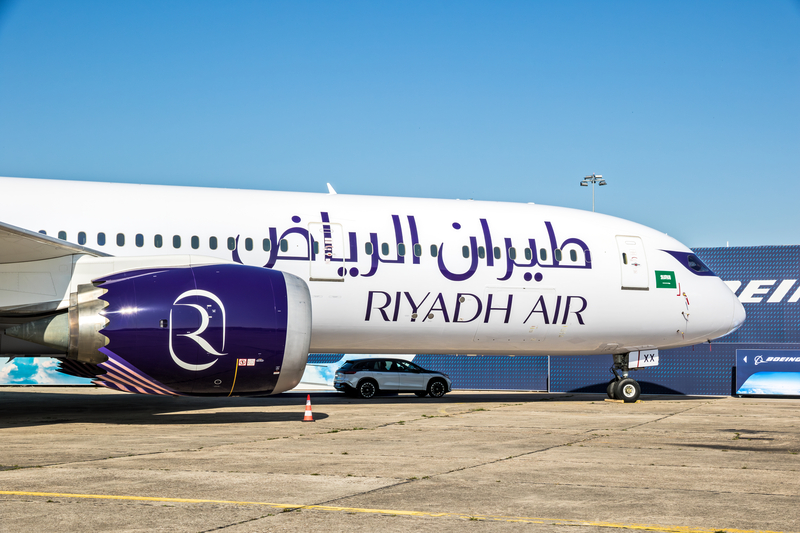
Riyadh Air is expected to use its new Boeing 787-9 Dreamliner fleet for the China services.
The direct distance from Riyadh (RUH) to Beijing Daxing (PKX) is approximately 3,560 nautical miles. Riyadh-Shanghai Pudong is longer at roughly 3,920 nautical miles.
Actual flights will cover more distance because of airways, weather deviations, restricted airspace, and air traffic control requirements. Both sectors nevertheless remain comfortably within the 787-9’s published maximum range of up to 8,300 nautical miles.
The 787-9 measures approximately 206 feet long and has a wingspan of just over 197 feet. Its composite construction, high-aspect-ratio wing, and modern engines were designed to reduce fuel consumption while allowing airlines to operate long routes with fewer seats than larger widebodies such as the Boeing 777-300ER or Airbus A380.
That makes the aircraft particularly useful for opening a market.
Riyadh Air can offer a full long-haul cabin product and substantial cargo capacity without placing 350 to 500 passenger seats onto each departure. If demand exceeds the initial capacity, the airline can increase frequency or eventually introduce the larger Airbus A350-1000.
Riyadh Air’s 787 Carries 290 Passengers
Riyadh Air configures its Boeing 787-9s with 290 seats across four distinct cabin products.
| Cabin | Seats | Typical layout |
| Business Elite | 4 | 1-2-1 |
| Business | 24 | 1-2-1 |
| Premium Economy | 39 | 2-3-2 |
| Economy | 223 | 3-3-3 |
| Total | 290 | — |
Business Elite consists of four suites at the front of the aircraft. Riyadh Air’s standard Business cabin contains another 24 suites, giving the airplane 28 lie-flat premium seats with direct aisle access.
Premium Economy provides 39 recliner-style seats with approximately 38 inches of pitch, while Economy contains 223 seats in the nine-abreast 3-3-3 arrangement commonly used on the 787. Riyadh Air lists approximately 31 inches of pitch in the standard Economy cabin.
The aircraft’s premium-heavy forward cabins may be particularly important in Beijing and Shanghai, where the airline will seek business travelers, government traffic, corporate contracts, and passengers connecting between China and other international destinations.
The larger Economy cabin will be needed to attract tour groups, leisure passengers, visiting-friends-and-relatives traffic, and price-sensitive connecting travelers.
Seven Weekly Flights Could Add More Than 4,000 Seats
If all seven weekly flights use Riyadh Air’s 290-seat Boeing 787-9, the airline would provide 2,030 one-way seats from Riyadh to China each week.
The return services would bring the combined two-way capacity to approximately 4,060 weekly seat positions.
| Route | Weekly flights in each direction | Estimated one-way weekly seats |
| Riyadh-Beijing | 3 | 870 |
| Riyadh-Shanghai | 4 | 1,160 |
| Total | 7 | 2,030 |
The estimate assumes every departure uses the standard 290-seat configuration. Aircraft substitutions, cancellations, or future cabin changes could alter the final total.
Riyadh Air would also provide 196 Business Elite and Business seats in each direction every week, along with 273 Premium Economy seats and 1,561 Economy seats.
That gives the airline a meaningful presence without immediately matching the frequency of larger, established operators.
Belly Cargo Could Be an Important Part of the Route Economics
The CAAC approval specifically authorizes mixed passenger and cargo service.
That means Riyadh Air will be able to carry commercial freight in the lower deck of its Boeing 787s in addition to passenger baggage.
Cargo could be particularly important on the Shanghai route. Pudong (PVG) is one of Asia’s largest international cargo gateways and supports extensive electronics, industrial, automotive, pharmaceutical, e-commerce, and high-value manufacturing traffic.
Beijing also generates government, technology, pharmaceutical, express, and time-sensitive freight demand.
The economics of a long-haul route are not determined by passenger seats alone. A flight with moderate passenger yields can still perform well when its cargo holds consistently generate additional revenue.
Riyadh Air is building a dedicated cargo business alongside its passenger operation. The China approvals give the carrier another opportunity to feed freight through Riyadh (RUH) to destinations across Saudi Arabia and, as its network develops, onward to Africa, Europe, the Middle East, and South Asia.
Flight Timing Will Be Critical
The success of both routes will depend heavily on their departure and arrival times.
A Riyadh Air flight arriving at King Khalid International Airport (RUH) during a major connection bank could distribute passengers onto flights to cities such as London (LHR), Madrid (MAD), Manchester (MAN), Cairo (CAI), Dubai (DXB), Jeddah (JED), Mumbai (BOM), Málaga (AGP), and other destinations added to the network.
An arrival outside those banks could require passengers to spend several hours in Riyadh, weakening the airline’s ability to compete with Emirates through Dubai (DXB), Qatar Airways through Doha (DOH), or Etihad Airways through Abu Dhabi (AUH).
The eastbound schedule presents another challenge. Riyadh Air must find Beijing and Shanghai slots that provide reasonable arrival times for local passengers and connections on Chinese partner airlines.
The approximately five-hour time difference between Riyadh and China also affects aircraft utilization. A late-night departure from Riyadh could arrive in China the following afternoon, while an evening return from China could reach Saudi Arabia during the night.
The final schedule will show whether Riyadh Air can complete each round trip efficiently or whether its 787s will spend extended periods on the ground in China.
China Fits Riyadh Air’s Hub Strategy
Riyadh Air is not being developed solely to carry passengers beginning or ending their journeys in Saudi Arabia.
The airline intends to turn Riyadh into a larger global connecting hub, competing for passengers traveling between Asia, Europe, Africa, the Middle East, and eventually North America.
China is essential to that model because of the scale of its population, business travel, manufacturing sector, tourism market, and international trade.
At the time the approvals became public, Riyadh Air had launched passenger service from Riyadh (RUH) to London Heathrow (LHR), Jeddah (JED), Dubai (DXB), and Cairo (CAI). The carrier had also announced service to Madrid, Manchester, Málaga, Kuala Lumpur, Dhaka, and Mumbai.
The airline plans to serve 22 cities by March 2027 and more than 100 destinations by the end of 2030. Beijing and Shanghai would represent two of its most strategically significant long-haul additions.
As the network grows, the Chinese routes could attract passengers traveling beyond Riyadh rather than relying entirely on local Saudi-China demand.
Potential flows could include China to Egypt, Spain, the United Kingdom, India, the Gulf states, and future African or North American destinations.
Riyadh Air Is Building a Large Long-Haul Fleet
The carrier’s initial long-haul expansion is being supported by the Boeing 787-9.
Riyadh Air has 39 firm Dreamliner orders and purchase options for another 33 aircraft. Its wider fleet plan also includes 60 Airbus A321neos and 25 Airbus A350-1000s, with purchase rights for 25 additional A350s.
The three aircraft families will serve different network roles.
The A321neo will be used primarily for shorter and medium-range services. The 787-9 is the airline’s initial long-haul workhorse and is appropriately sized for opening destinations such as Beijing and Shanghai.
The larger A350-1000 will eventually give Riyadh Air more capacity and range for its strongest long-haul markets. It could ultimately be deployed to China if demand justifies more seats than the 787-9 can provide.
Riyadh Air is also reportedly considering converting a substantial portion of its remaining Boeing 787 options into firm orders. No final agreement has been announced, but additional Dreamliners would be required if the airline is to reach more than 100 destinations by 2030.
Riyadh Air’s Cabin Product Will Be Part of Its Competitive Pitch
The airline will be competing against established Gulf and Chinese carriers with mature premium products.
Riyadh Air has designed its 787 cabin to position itself as a full-service premium airline rather than a low-cost newcomer.
Business Elite and Business suites include sliding privacy doors and fully flat beds. Premium Economy offers a dedicated cabin rather than extra-legroom Economy seats, while every Economy passenger receives a personal entertainment screen and access to charging facilities.
High-speed Wi-Fi is complimentary for passengers enrolled in Riyadh Air’s Sfeer loyalty program. It is therefore more accurate to describe the service as free for Sfeer members rather than automatically free for every passenger without registration.
Riyadh Air will not serve alcohol, reflecting Saudi regulations. The carrier instead emphasizes Arabic and international dining, nonalcoholic beverages, cabin design, connectivity, and digital services. Passengers are also prohibited from bringing alcoholic beverages aboard the airline’s flights.
The China routes will provide one of the first major tests of whether that product can persuade international connecting passengers to select Riyadh over the more established hubs at Dubai, Doha, and Abu Dhabi.
Approval Does Not Guarantee an Immediate Launch
Riyadh Air has received the legal authority required to move forward, but several stages remain.
The carrier must obtain airport slots, submit flight schedules for approval, arrange ground handling, establish maintenance support, recruit or assign local employees, complete sales and distribution arrangements, and coordinate with Chinese border and airport authorities.
The airline must also decide whether to launch both destinations simultaneously or introduce one before the other.
Shanghai may be commercially attractive because of Riyadh Air’s relationship with China Eastern and the four-weekly authority. Beijing offers political, government, and corporate significance but has the added complexity of two airports and multiple existing nonstop competitors.
Aircraft availability could also influence the timing. Riyadh Air is expanding rapidly while receiving its first production Boeing 787-9s, and every new destination must compete for a limited number of aircraft during the carrier’s early growth phase.
Until Riyadh Air announces dates and opens reservations, passengers should not treat either route as bookable or guaranteed for a particular travel period.
Bottom Line
Riyadh Air has received Civil Aviation Administration of China approval for three weekly flights between Riyadh (RUH) and Beijing and four weekly flights between Riyadh and Shanghai.
Industry reporting identifies Beijing Daxing International Airport (PKX) and Shanghai Pudong International Airport (PVG) as the intended destinations, although the official CAAC document lists only the cities and Riyadh Air has not yet published a final schedule.
The seven weekly services are expected to use the airline’s 290-seat Boeing 787-9 Dreamliners. If every approved flight operates, Riyadh Air would offer approximately 2,030 seats in each direction every week, along with significant lower-deck cargo capacity.
The airline will not enter either market without competition. Saudia already holds the largest share of Saudi Arabia-China capacity, while Air China, China Eastern, China Southern, and Hainan Airlines operate existing nonstop routes between the two countries.
Riyadh Air does have potential strategic advantages. It has cooperation agreements with Air China and China Eastern, a new four-cabin 787 product, and a rapidly expanding network designed to connect passengers through King Khalid International Airport (RUH).
The regulatory approval is an important milestone, but it is not a launch announcement. Start dates, flight numbers, operating days, fares, and departure times remain unconfirmed.
When those details emerge, the schedule will show whether Riyadh Air views Beijing and Shanghai primarily as local Saudi-China routes or as major building blocks in its effort to turn Riyadh into a global connecting hub.