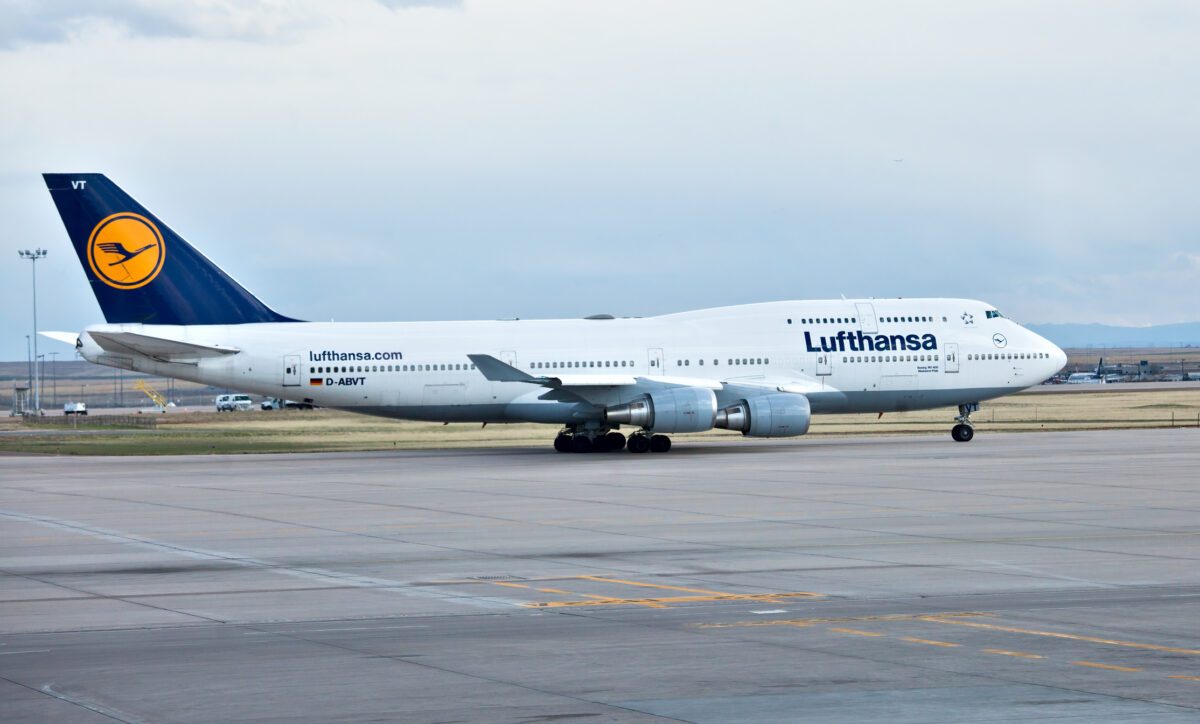
Lufthansa will begin withdrawing its final eight Boeing 747-400s this month, starting the last stage of a fleet program that will remove the older Jumbo variant during 2027.

The airline’s capacity and fleet plan calls for two 747-400s to be grounded after the end of the 2026 summer schedule. Lufthansa said its final farewell to the subtype is planned for next year.
A Lufthansa Group investor presentation places the 747-400’s complete phaseout in 2027. The schedule will close 38 years of Lufthansa 747-400 operations, rather than end the airline’s relationship with the 747 altogether. The newer Boeing 747-8 will remain part of the long-haul fleet.
Read our stories in your inbox
Two aviation newsletters. Zero fluff.
Two Aircraft Will Be Grounded This Month
Lufthansa listed eight 747-400s in its fleet as of July 31, 2026. Each aircraft has 371 seats: 67 in Business Class, 32 in Premium Economy and 272 in Economy. Unlike Lufthansa’s 747-8, Airbus A380 and outgoing A340-600, the 747-400 does not carry a First Class cabin.
The four-engine aircraft has a published range of 11,850 kilometers, or about 6,400 nautical miles, and a maximum takeoff weight of 394.6 metric tons. Its combination of 371 seats and substantial belly capacity has continued to give Lufthansa a useful high-density platform from Frankfurt (FRA), particularly while the group has waited for new-generation widebodies.
The two aircraft leaving the active schedule this fall are part of a broader reduction in long-haul capacity. Lufthansa will also retire its final four Airbus A340-600s in October. The group linked the accelerated measures to fuel costs and other operating pressures, saying the removal of less-efficient aircraft would reduce its exposure to fuel purchased outside its hedging program.
The 747-400’s economics have become progressively harder to defend against newer twin-engine aircraft. Four engines bring higher fuel and maintenance requirements, while a small and shrinking subfleet increases the cost of retaining dedicated crews, spares and technical support.
The Remaining Six Are Due to Follow in 2027
The 747-400 is one of several older widebody types Lufthansa Group is eliminating as it reduces long-haul fleet complexity. Its 2025 annual report identifies the 747-400, Airbus A340-300 and A340-600, Boeing 767-300ER, Boeing 777-200ER and Airbus A330-200 for complete retirement across the group.
That process is being supported by Airbus A350 and Boeing 787 deliveries, followed by the Airbus A350-1000 and Boeing 777-9. Lufthansa Group said it expected about 45 aircraft deliveries during 2026, including more than twice as many new long-haul aircraft as it received in 2025.

The 777-9 remains an important part of the 747-400 replacement program, although its delayed entry into service has forced Lufthansa to retain older aircraft longer than originally expected. Lufthansa’s first 777-9 flew in May 2026 as part of Boeing’s certification work, with the manufacturer preparing for the program’s first delivery in 2027.
The arrival of 777-9s therefore overlaps with the planned final year of 747-400 service, but Lufthansa is not relying on that model alone. The group’s order book also includes A350-900s, A350-1000s and 787-9s, giving it several options for reallocating capacity as individual 747-400s leave.
A 38-Year Lufthansa 747-400 Career
Lufthansa received its first 747-400 at Frankfurt in 1989, according to the airline’s corporate chronicle. The model brought a longer upper deck, winglets, a two-pilot flight deck and greater range than the earlier passenger 747 variants it replaced.
The subtype became a central part of Lufthansa’s intercontinental fleet through the 1990s and 2000s. Its withdrawal in 2027 will conclude the 747-400 chapter after approximately 38 years, but Lufthansa’s wider passenger 747 history will continue through the 747-8.
That history began on April 26, 1970, when 747-130 D-ABYA operated Lufthansa’s first scheduled Jumbo service between Frankfurt and New York John F. Kennedy (JFK). Lufthansa says it was the first European carrier to operate the 747 in passenger service, following Pan American World Airways internationally.
The 747-8 extended that relationship into a new generation. Lufthansa became the launch airline for the passenger 747-8 Intercontinental, taking delivery of its first example in April 2012. Those aircraft are not covered by the 2027 retirement date for the 747-400.
Three Twente Aircraft Returned to Service
The final phaseout also closes an unexpected second career for aircraft once considered unlikely to fly passengers again. In June 2020, Lufthansa sent six 747-400s to Twente Airport (ENS), near Enschede, for storage after international demand collapsed.
Twente Airport said at the time that Lufthansa Technik would manage and maintain the aircraft during storage. Their arrival subsequently exposed a regulatory problem: the airport could accept large aircraft, but its infrastructure and certification did not support their normal departure.
The dispute centered on runway turn pads and strengthened shoulders required for large aircraft. A temporary exemption was ultimately issued for the Lufthansa departures. Twente later said the matter had been resolved specifically for the six aircraft, while it pursued a broader exemption allowing large jets to arrive and depart routinely.
Several of those 747-400s eventually returned to Lufthansa’s passenger network as long-haul demand recovered and new-aircraft deliveries remained constrained. Their survival demonstrated the operational value of keeping stored aircraft maintained and recoverable, but the 2027 deadline now places a firm limit on that extension.
Bottom Line
The 747-400’s departure will give Lufthansa a simpler and more efficient long-haul operation, but it also removes a large-capacity aircraft at a time when replacement programs remain exposed to delivery and certification risk. A 371-seat 747-400 cannot be replaced like-for-like by Lufthansa’s roughly 290-seat A350-900s and 787-9s without accepting lower capacity, adding frequency or assigning another large widebody.
The 747-8 and Airbus A380 will therefore remain valuable at the top end of Lufthansa’s fleet, particularly on routes where slots, premium demand and cargo volume reward higher gauge. The airline’s willingness to keep both types also shows that its strategy is not simply to eliminate four-engine aircraft, but to remove older subfleets whose fuel and support costs no longer justify their role.
The key issue in 2027 will be the pace of new widebody arrivals. If the 777-9 enters service as planned and A350 and 787 deliveries remain steady, Lufthansa can complete the 747-400 withdrawal without a substantial capacity gap. Further delays would make the remaining six aircraft operationally useful until their final months, even as their retirement date approaches.
Keep reading FlyMag
Get the Daily Brief in the morning or the Route Watch weekly recap on Fridays. Or both.