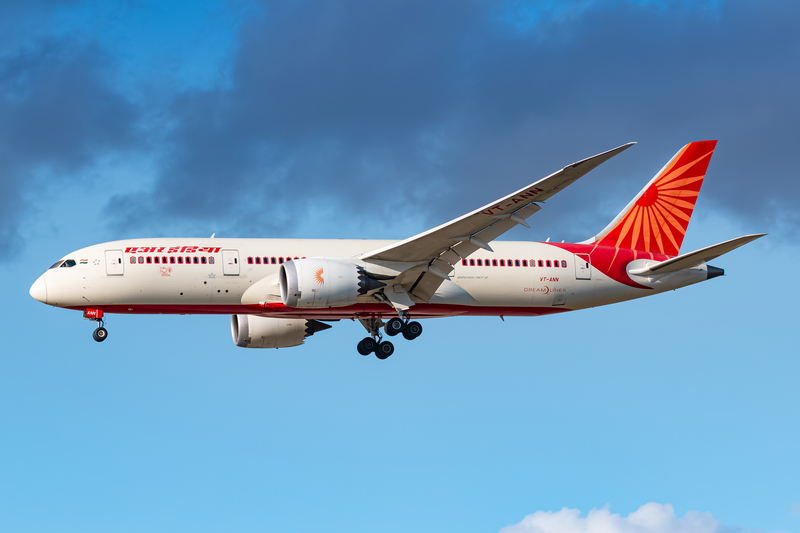
Air India has resumed nonstop service between Indira Gandhi International Airport (DEL) and Rome Fiumicino Airport (FCO), bringing the Italian capital back into its network after a gap of nearly six years.
The route operates four times weekly with the Boeing 787-8, and with its return, Rome becomes Air India’s eighth destination in mainland Europe and its second in Italy after Milan Malpensa Airport (MXP).
That makes the launch more important than a routine network addition. Rome is not just another European city on the map. It is a major political, cultural, leisure, and business market, and its return says a great deal about how Air India is rebuilding its long-haul network.
Read our stories in your inbox
Two aviation newsletters. Zero fluff.
Rome Fits The New Air India Much Better Than It Once Did
The resumed Delhi (DEL)–Rome (FCO) service makes strategic sense for several reasons.
First, Italy remains an important market for India across tourism, trade, and visiting-friends-and-relatives traffic. Second, Rome gives Air India a stronger two-point presence in Italy, which matters because serving both FCO and MXP allows the airline to address different kinds of demand rather than relying on one gateway alone.
Milan is the obvious commercial and business anchor. Rome adds a broader mix of government, tourism, religious, and cultural traffic. Together, they give Air India a more complete Italy strategy.
The Boeing 787-8 Is The Right Aircraft For The Job
The Boeing 787-8 is also a sensible fit.
For Air India, the type remains one of the core tools in its long-haul fleet, especially on routes that need true intercontinental capability without the larger capacity of a Boeing 777. On Delhi (DEL)–Rome (FCO), the 787-8 gives the airline the right balance of range, economics, and cabin mix for a market that is important, but not necessarily one that demands very large-gauge aircraft from day one.
That matters because Air India is clearly trying to rebuild long-haul service with more discipline than in the past. Rome’s return looks like part of that pattern.
Delhi Hub Connectivity Is A Big Part Of The Story
Air India is not just selling Rome as a point-to-point route.
One of the airline’s main arguments for the new service is connectivity through Delhi (DEL), where passengers arriving from Italy can continue onward to a wide range of destinations across India and Southeast Asia. That is important because it turns Rome into more than just an Italy–India market. It becomes part of a broader hub flow.
For aviation readers, this is one of the more meaningful parts of the launch. Air India is no longer trying to be only a set of nonstop long-haul city pairs. It is trying to make Delhi work more effectively as a connecting hub.
Europe Is Clearly A Priority Again
The return to Rome also fits into a wider European push.
With Rome now added back, Air India’s mainland European network has grown to eight destinations, showing that the airline continues to place considerable value on Europe as it rebuilds its international map. That matters because Europe remains one of the most important intercontinental regions for Indian carriers, combining premium traffic, diaspora flows, tourism, and strong bilateral economic links.
Rome’s return therefore says something broader than just Italy. It says Air India still sees Europe as central to its long-haul rebuilding strategy.
Bottom Line
Air India’s resumed Delhi (DEL)–Rome Fiumicino (FCO) route is more than the restoration of a previously served market. It gives the airline a stronger position in Italy, expands its mainland Europe network to eight destinations, and adds another useful long-haul spoke into its Delhi hub.
Operated four times weekly by the Boeing 787-8, the service looks like the kind of route that fits Air India’s current strategy well: important, internationally visible, and supported by both local demand and onward connectivity.
For aviation readers, the key takeaway is clear: Rome is not just back. It is back as part of a much more deliberate European network rebuild.
Keep reading FlyMag
Get the Daily Brief in the morning or the Route Watch weekly recap on Fridays. Or both.