Alaska Airlines Adds Athens and Paris as Seattle Long-Haul Expansion Accelerates
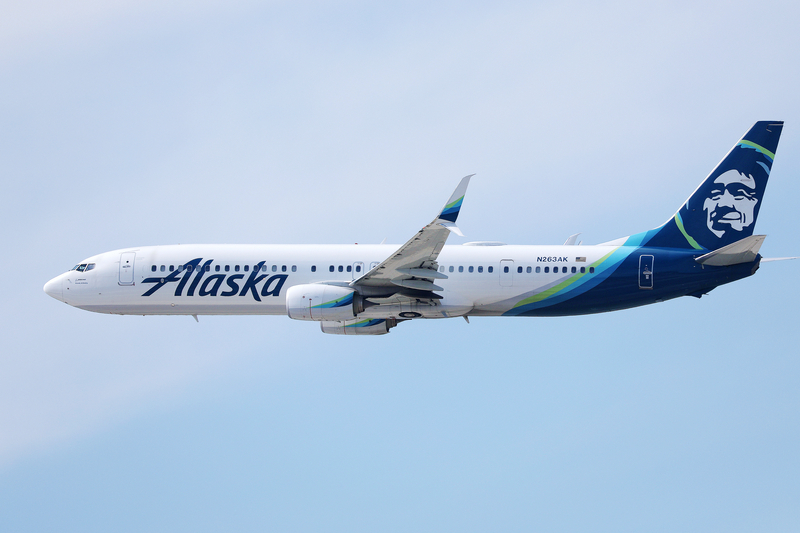
Alaska Airlines is adding two more major European destinations from Seattle-Tacoma International Airport (SEA), with nonstop Boeing 787-9 Dreamliner flights to Athens International Airport (ATH) and Paris Charles de Gaulle Airport (CDG) beginning in May 2027.

The expansion will take Alaska to seven intercontinental destinations from its Seattle Airport (SEA) hub and represents another major step in the airline’s transformation from a predominantly domestic West Coast carrier into a long-haul international competitor.
According to Alaska Airlines’ official route announcement, Seattle–Athens will begin May 12, 2027, with three weekly flights, while Seattle–Paris will launch May 25 with five weekly departures. Both routes are currently scheduled seasonally through October 2027.
Read our stories in your inbox
Two aviation newsletters. Zero fluff.
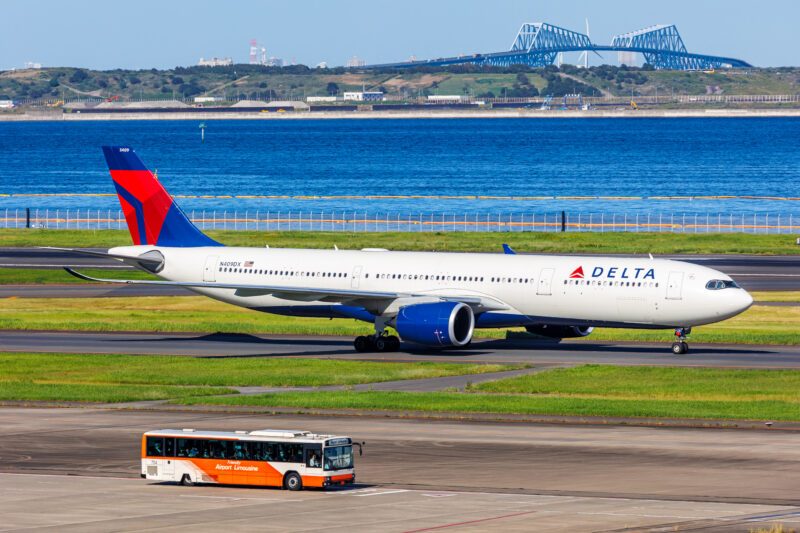
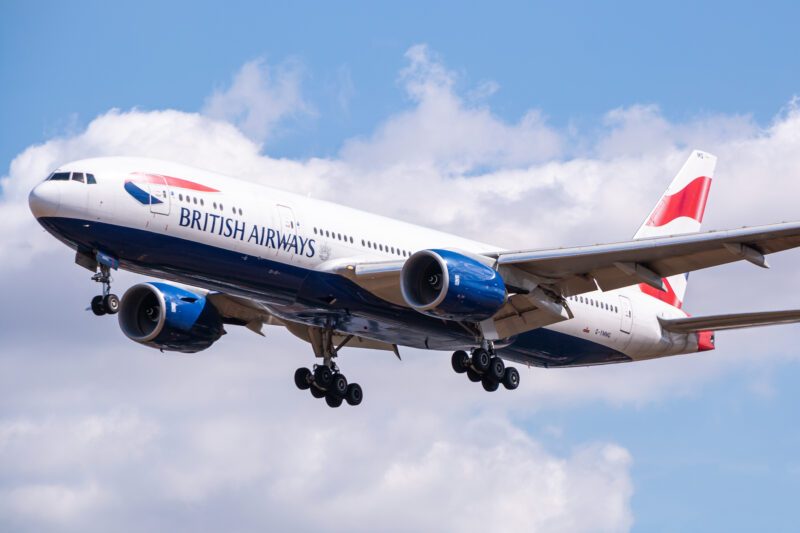
Athens Airport (ATH) will be an entirely new nonstop market from Seattle and Alaska’s longest route ever. Paris Airport (CDG), meanwhile, will place Alaska directly against two established SkyTeam competitors: Air France and Delta Air Lines.
Seattle–Athens Will Become Alaska’s Longest Route
Alaska will begin three weekly flights between Seattle Airport (SEA) and Athens International Airport (ATH) on May 12, 2027.
The schedule is:
AS196: Seattle-Tacoma International Airport (SEA) 4:30 p.m. – Athens International Airport (ATH) 2:20 p.m. the following day
AS197: Athens International Airport (ATH) 4:20 p.m. – Seattle-Tacoma International Airport (SEA) 6:55 p.m.
Flights from Seattle will operate every Sunday, Wednesday, and Friday. The returns from Athens will operate Mondays, Thursdays, and Saturdays.
The eastbound service has a scheduled block time of 11 hours and 50 minutes. The westbound flight is scheduled for 12 hours and 35 minutes.
At approximately 6,200 miles, Seattle Airport (SEA)–Athens Airport (ATH) will become the longest route Alaska Airlines has ever operated.
The flight number also contains an intentional reference to Greek history. Alaska selected AS196 as a tribute to Athens and the first modern Olympic Games, which were held there in 1896.
More important operationally, Alaska will open a market that has never had nonstop service. Current schedules show no nonstop airline between Seattle and Athens, meaning Pacific Northwest travelers generally have to connect through another U.S. gateway, Western Europe, or the Middle East.
Alaska says it will become both the first airline to connect Seattle and Athens nonstop and the only carrier flying nonstop between Greece’s capital and the U.S. West Coast.
Athens Gives Alaska a Distinctive European Market
Athens is an interesting choice because it offers Alaska something increasingly difficult to find in transatlantic aviation: a large European destination without direct competition from Seattle.
The route should be heavily leisure-driven during the summer, with Greece attracting substantial demand for Athens itself as well as onward travel to islands such as Santorini, Mykonos, Crete, and Rhodes.
However, Alaska will not need to fill the 787 entirely with Seattle-originating passengers.
Seattle Airport (SEA) is Alaska’s largest hub, with more than 360 peak-day departures and nonstop service to roughly 110 destinations in the Seattle area. Passengers from cities throughout Alaska, the Pacific Northwest, California, and the Mountain West can connect onto the Athens departure.
That feeder network is particularly important on a three-times-weekly long-haul route. A city pair might not generate enough local demand for a 300-seat Boeing 787-9 three times every week, but combining Seattle passengers with customers originating elsewhere in Alaska’s network changes the economics considerably.
Athens Airport (ATH) can provide onward connectivity as well, particularly through Alaska’s Oneworld partners and other commercial relationships.
Paris Will Be a Much More Competitive Route
Alaska will enter a very different market when flights to Paris Charles de Gaulle Airport (CDG) begin May 25, 2027.
The airline will operate five times weekly:
AS136: Seattle-Tacoma International Airport (SEA) 5:25 p.m. – Paris Charles de Gaulle Airport (CDG) 12:25 p.m. the following day
AS137: Paris Charles de Gaulle Airport (CDG) 2:25 p.m. – Seattle-Tacoma International Airport (SEA) 3:50 p.m.
The eastbound flight will operate every day except Sunday and Wednesday, while the return will operate every day except Monday and Thursday.
Scheduled block time is 10 hours from Seattle to Paris and 10 hours and 25 minutes on the return.
Unlike Athens, Paris already has substantial nonstop service from Seattle Airport (SEA). Current Seattle–Paris schedules show both Air France and Delta Air Lines operating the route, typically with one daily flight each.
If those schedules remain broadly intact for summer 2027, Alaska will become the third nonstop carrier between Seattle Airport (SEA) and Charles de Gaulle Airport (CDG).
That creates a particularly interesting competitive environment because Air France and Delta are close SkyTeam joint-venture partners. Alaska will be entering against two airlines that can coordinate much of their transatlantic network while feeding passengers through Paris and Seattle.
Alaska does have one distinction: the carrier says it will become the first Oneworld airline offering nonstop service between the U.S. West Coast and Paris.
Why AS136? Paris Has 136 Museums
Alaska has again tied the flight number to the destination.
Flight AS136 was chosen because the airline says Paris is home to 136 museums.
It is a small branding detail, but it follows the same strategy as AS196 to Athens and shows Alaska trying to give its new international services identities rather than simply selecting available numbers from its timetable.
Paris is also one of the most searched international destinations on Alaska’s website, according to the airline.
That demand is unsurprising. Paris attracts leisure, business, visiting-friends-and-relatives, educational, and premium travel throughout much of the year.
Interestingly, however, Alaska has not announced the route as year-round. Its August 20 announcement says flights will operate five times weekly through October 2027.
That differs from earlier speculation that Paris would become a permanent year-round counterpart to Alaska’s London Heathrow Airport (LHR) service. The airline could extend Paris into winter later, but no such schedule has been announced.
Boeing 787-9 Will Operate Both Routes
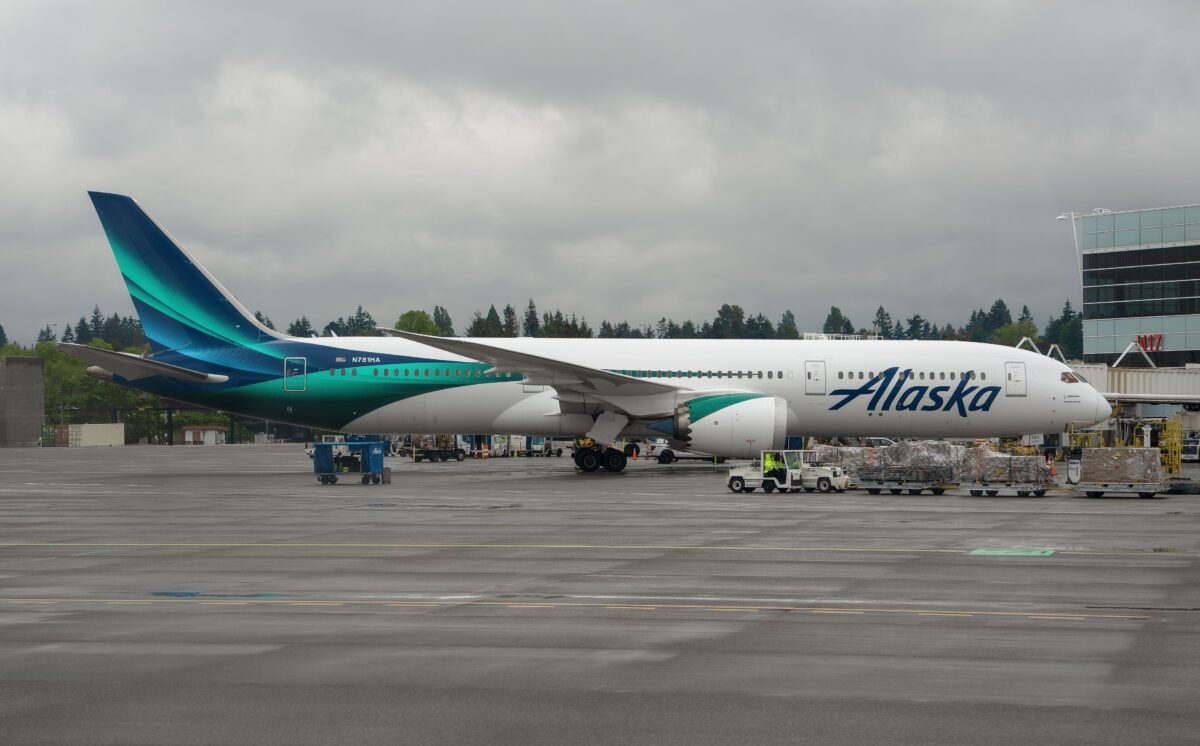
Alaska will use the Boeing 787-9 Dreamliner to operate both Athens Airport (ATH) and Paris Airport (CDG).
The carrier currently has five 787-9s in its fleet. Its published fleet specifications show a capacity of 300 passengers:
- 34 International Business Class Suites
- 79 Premium Class seats
- 187 Main Cabin seats
The original article’s description of 34 Business Class and 266 Economy seats technically reaches the same 300-seat total, but it misses an important product distinction. Alaska markets 79 of those 266 non-business seats as Premium Class, providing additional legroom and enhanced benefits compared with standard Main Cabin.
Business Class is arranged 1-2-1 and contains 34 enclosed suites. Each passenger has direct aisle access, a fully flat bed, an 18-inch entertainment screen, personal power, wireless device charging, and a sliding privacy door.
Alaska detailed the new International Business Class product earlier in 2026 as part of the airline’s move into long-haul European and Asian flying.
The 787’s Main Cabin uses the Dreamliner’s standard 3-3-3 arrangement.
2,400 Weekly Seats Each Way Across the Two Routes
At their announced frequencies, Athens and Paris will add a meaningful amount of international capacity at Seattle Airport (SEA).
Three weekly Athens flights with 300 seats provide 900 seats in each direction per week.
Five weekly Paris flights provide another 1,500 seats each way.
Combined, Alaska will offer up to 2,400 seats from Seattle to the two European cities every week, plus the same amount returning to Seattle.
That is 4,800 individual one-way seats across the complete weekly operation.
Athens carries substantially more risk because Alaska is creating a completely new nonstop market over one of the longest distances in its network. The three-times-weekly seasonal schedule limits that exposure.
Paris is almost the reverse. Demand is already well established, but Alaska must take market share from two strong incumbents.
Alaska’s 787 Fleet Is Growing to 17 Aircraft
Athens and Paris are possible because Alaska is rapidly building a dedicated Boeing 787 operation at Seattle Airport (SEA).
The Dreamliners originally entered Alaska Air Group through its acquisition of Hawaiian Airlines. Alaska subsequently decided to build its future long-haul operation around Seattle and place new aircraft into its Alaska global brand.
In January 2026, the airline placed the largest aircraft order in Alaska’s history, including five additional Boeing 787s.
That brings Alaska’s firm future Dreamliner fleet to 17 aircraft, including the five currently in service.
The carrier intends the five most recently ordered aircraft to be Boeing 787-10s, although Boeing model flexibility can remain part of large fleet agreements. The larger 787-10 sacrifices some range compared with the 787-9 but provides additional passenger and cargo capacity, making it potentially useful on dense long-haul routes that do not require the -9’s maximum range.
Alaska plans to deploy up to 17 Dreamliners across its global network as it builds Seattle into a genuine intercontinental hub.
Seven Intercontinental Destinations From Seattle in 2027
By summer 2027, Alaska’s Seattle Airport (SEA) intercontinental network will contain seven destinations:
Athens International Airport (ATH)
Paris Charles de Gaulle Airport (CDG)
London Heathrow Airport (LHR)
Rome Fiumicino Airport (FCO)
Seoul Incheon International Airport (ICN)
Tokyo Narita International Airport (NRT)
Keflavík International Airport (KEF) near Reykjavík
The aircraft strategy is not identical across all seven markets.
London, Rome, Seoul, Tokyo, Athens, and Paris are built around the Boeing 787-9. Reykjavík uses the much smaller Boeing 737-8 MAX, which gives Alaska a lower-capacity aircraft for the comparatively shorter transatlantic flight to Iceland.
The airline says it intends to serve at least 12 intercontinental destinations from Seattle by 2030, meaning another five markets remain to be announced after Athens and Paris.
That target is considerably more important strategically than any single route. Alaska is attempting to make Seattle Airport (SEA) a connecting gateway capable of supporting domestic, Asian, and European traffic rather than relying almost exclusively on its historically strong West Coast and Alaska network.
Alaska and Delta’s Seattle Battle Moves Across the Atlantic
Paris will also add another dimension to Alaska Airlines’ long-running competition with Delta Air Lines at Seattle Airport (SEA).
Delta has invested heavily in Seattle as its primary Pacific Northwest gateway and operates long-haul service to several destinations in Europe and Asia.
Alaska remains much larger overall at the airport. Its 2025 annual report said approximately 78% of Alaska’s Seattle capacity competes with Delta in some form, demonstrating how directly the two carriers overlap across the market.
The two airlines are now increasingly meeting on international routes rather than only domestic services.
Delta already flies nonstop from Seattle Airport to Paris Charles de Gaulle Airport, and it recently announced plans to add Seattle–Tokyo Narita Airport (NRT), entering another route served by Alaska.
Paris will put the carriers head-to-head again, although Delta has the additional advantage of its joint venture and extensive connectivity with Air France at Charles de Gaulle Airport (CDG).
Athens is different. Delta currently serves Athens Airport (ATH) from Atlanta Hartsfield-Jackson International Airport (ATL), Boston Logan International Airport (BOS), and New York John F. Kennedy International Airport (JFK), but Alaska will initially have the Seattle market to itself.
Whether Delta eventually responds with Seattle–Athens service remains speculation. There is no announced Delta route at present.
Seasonal Europe Creates a Winter Fleet Question
Athens and Paris are currently scheduled only through October 2027, while Rome is also heavily oriented toward the summer transatlantic season.
That creates an interesting fleet-utilization question for Alaska.
Widebody aircraft are expensive assets that generate little value sitting on the ground. Demand to southern Europe falls substantially after summer, meaning operating the same capacity to Rome and Athens throughout winter may produce weak fares and load factors.
Alaska could increase Dreamliner flying to Hawaii during winter, add capacity to established Asian markets, or develop seasonal Southern Hemisphere destinations whose peak travel periods occur during the Northern Hemisphere winter.
The airline has not announced what will replace the seasonal European utilization.
Its growing fleet provides enough flexibility to consider destinations deeper in the South Pacific or additional Asian markets, but any new route must also fit available aircraft, crew, airport-slot, and connecting-bank requirements.
That counterseasonal challenge will become increasingly important as Alaska approaches a 17-aircraft Dreamliner fleet.
Seattle Is Becoming the Center of Alaska’s New Identity
Alaska Airlines is still overwhelmingly a domestic carrier by flight count, but the strategy emerging at Seattle is materially different from the airline that existed before the Hawaiian acquisition.
The company now operates Boeing 787 Dreamliners, sells enclosed international Business Class Suites, participates in the Oneworld alliance, operates long-haul flights across the Atlantic and Pacific, and plans a much larger international lounge at Seattle Airport (SEA).
Alaska says it is already Seattle’s largest international carrier by the number of nonstop destinations and intends to continue adding long-haul markets.
Athens demonstrates how Alaska can use its large Seattle feeder network to create a route that did not previously exist. Paris demonstrates the other side of the strategy: entering a major established market and competing directly against powerful global airlines.
Both will provide useful tests of whether Alaska can translate its dominant Pacific Northwest position into a sustainable long-haul international franchise.
Bottom Line
Alaska Airlines will launch two new Boeing 787-9 routes from Seattle-Tacoma International Airport (SEA) to Europe in May 2027.
Three weekly seasonal flights to Athens International Airport (ATH) begin May 12. At approximately 6,200 miles, Seattle–Athens will become Alaska’s longest-ever route and the only nonstop service between the U.S. West Coast and Greece.
Five weekly flights to Paris Charles de Gaulle Airport (CDG) begin May 25. Alaska will compete directly with Air France and Delta Air Lines in the Seattle–Paris market.
Contrary to some initial reports, Alaska currently describes both routes as seasonal through October 2027. Paris has not yet been announced as a year-round service.
Each route will use Alaska’s 300-seat Boeing 787-9, configured with 34 enclosed lie-flat Business Class Suites, 79 Premium Class seats, and 187 Main Cabin seats.
The additions will give Alaska seven intercontinental destinations from Seattle in summer 2027, with at least five more planned by 2030. With a firm future fleet of 17 Boeing 787s, Athens and Paris are not isolated experiments—they are part of a much larger attempt to turn Seattle Airport (SEA) into a true global hub.
Keep reading FlyMag
Get the Daily Brief in the morning or the Route Watch weekly recap on Fridays. Or both.