Sun Country’s Brand Is Set to Fade as Allegiant Integration Moves Toward One Certificate
Sun Country Airlines is still flying under its own name today, but the brand’s long-term future is now clear: once Allegiant and Sun Country complete their operational integration, the combined airline is expected to operate under the Allegiant name.

That does not mean the change is immediate. Travelers booking through Sun Country Airlines or Allegiant Air should not expect overnight changes to flights, schedules, loyalty programs, or airport procedures. Allegiant’s own merger information says both airlines will continue operating independently while integration is underway.
But the direction of travel is unmistakable. The May 2026 acquisition has created a larger leisure-focused U.S. airline with roughly 195 aircraft, nearly 175 cities, and more than 650 routes. The Sun Country name, one of the more distinctive brands in U.S. leisure aviation, is expected to disappear once the two airlines operate under a single FAA certificate.
For airline professionals, this is not simply a rebranding story. It is an operating-certificate story, a fleet-integration story, and a business-model story.
The Single Operating Certificate Is the Real Milestone
The key phrase in this merger is single operating certificate. In U.S. airline mergers, the financial transaction can close well before the carriers actually operate as one airline.
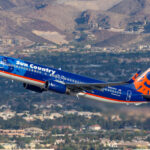
That is what is happening here. Allegiant has completed its acquisition of Sun Country, but the two airlines remain separate operators for now. They have separate certificates, separate procedures, separate operating manuals, separate training programs, separate work groups, separate reservation systems, and separate customer-facing processes.
A single FAA operating certificate is what eventually allows the airlines to become one integrated operation. That process requires the carrier to align safety management systems, dispatch procedures, pilot training, maintenance programs, manuals, checklists, operational control, and regulatory oversight into one approved framework.
Until that happens, Sun Country remains operationally distinct. Its aircraft, crews, cargo operation, charter flying, and scheduled passenger service continue under the existing Sun Country structure.
That is why the airline brand will not disappear in weeks. The integration will be measured in years, not days.
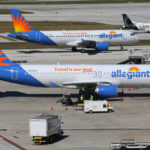
Allegiant Gets Scale It Could Not Build Quickly Alone
The strategic appeal for Allegiant is scale. Before the merger, Allegiant was already one of the most unusual U.S. carriers, focused heavily on low-frequency, point-to-point leisure flying from smaller cities to vacation destinations such as Las Vegas, Orlando, Phoenix, Florida beach markets, Myrtle Beach, and other warm-weather destinations.
Sun Country brings something different. Based at Minneapolis-St. Paul International Airport (MSP), Sun Country has built a hybrid model around scheduled leisure flying, passenger charters, and cargo operations. Nearly all of its flying touches MSP, making it a deeply local airline with a national leisure footprint.
Together, the two airlines create a much larger leisure platform. Allegiant brings strength in small and mid-sized city leisure markets. Sun Country brings Minneapolis scale, broader international leisure exposure, charter contracts, and a narrowbody cargo business tied to Amazon.
That combination is why the deal is more than a simple acquisition. Allegiant is not just buying routes. It is buying a diversified operating model.
Sun Country’s Boeing Fleet Adds a New Dimension
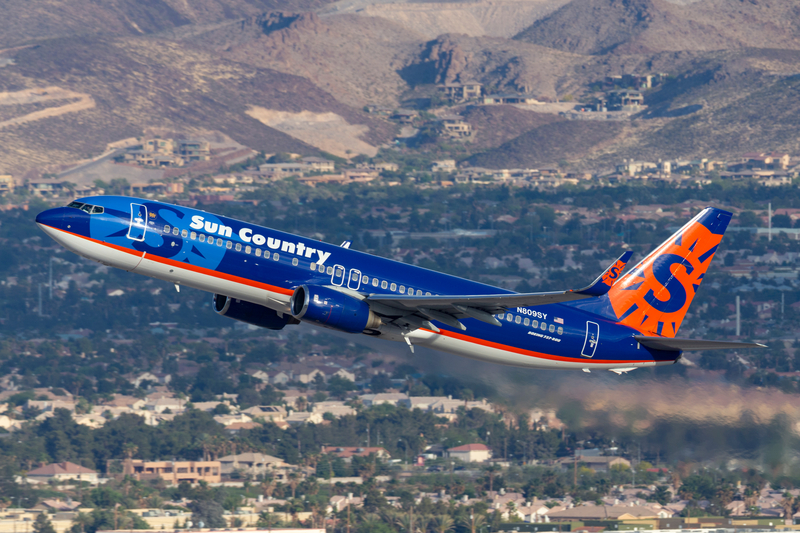
Sun Country entered the merger with a fleet built around the Boeing 737 Next Generation family. Its passenger operation uses Boeing 737-800 and 737-900ER aircraft, while its cargo business uses 737-800 freighters.
Sun Country’s investor materials describe the fleet as 44 passenger aircraft and 20 freighters, with the passenger fleet including fully owned 737-800s and five 737-900ERs. The cargo fleet consists of 20 Boeing 737-800 freighters operated as part of Sun Country’s Amazon relationship.
That matters because Allegiant historically built its modern fleet around the Airbus A320 family, including A319s and A320s. More recently, Allegiant began adding Boeing 737 MAX aircraft, giving it a mixed narrowbody future even before the Sun Country deal closed.
Sun Country’s 737NG fleet therefore does not create a completely new Boeing path for Allegiant. Allegiant was already moving toward Boeing through the MAX. But it does add an existing, operationally mature Boeing 737 platform with crews, maintenance experience, charter capability, and freighter operations already in place.
From a fleet-planning perspective, that is valuable. The merged airline will have both Airbus A320-family aircraft and Boeing 737-family aircraft, giving it more flexibility but also more complexity.
The Cargo Business Is a Major Piece of the Deal
Sun Country’s cargo operation is one of the most important parts of this merger. In 2019, Sun Country signed an agreement to operate Boeing 737-800 freighters for Amazon’s Prime Air network. That relationship later expanded, with Sun Country increasing its cargo fleet to 20 737-800 freighters and extending the contract through 2030, with options to extend further.
For a leisure airline, that cargo business is powerful because it provides revenue diversification. Pure leisure demand can be highly seasonal. Spring break, summer vacation, holidays, and winter sun markets can be strong, but off-peak periods are more difficult.
Cargo helps smooth that cycle. So do charters. Sun Country has built its model around scheduled service, charter flying, and cargo, allowing it to use pilots, aircraft, and operational resources across different business lines.
That is one of the biggest differences between Sun Country and many other low-cost carriers. It is not only a scheduled airline. It is a hybrid operator with passenger, charter, and cargo revenue streams.
For Allegiant, which already has an integrated travel model built around flights, hotels, rental cars, and vacation packages, Sun Country’s cargo and charter platform adds another layer of resilience.
MSP Remains Strategically Important
The eventual disappearance of the Sun Country brand does not mean Minneapolis disappears from the network. Allegiant has repeatedly said it expects to maintain a significant presence in Minneapolis-St. Paul.
That is essential. Sun Country is the second-largest carrier at Minneapolis-St. Paul International Airport (MSP) behind Delta Air Lines, and its local relevance is one of its strongest assets. The airline has deep Minnesota roots, a recognizable local identity, and a customer base that understands its seasonal leisure model.
For Allegiant, MSP is different from many of its traditional airports. Allegiant has historically specialized in smaller and mid-sized cities with less competition. MSP is a major airport with a dominant Delta hub, substantial business traffic, and a sophisticated local travel market.
That makes Sun Country’s position at MSP valuable but delicate. Allegiant will need to preserve the strengths of the Sun Country model while eventually bringing the operation under a different brand.
The biggest risk is local brand erosion. Sun Country has spent more than 40 years building identity in Minnesota. Allegiant will have to convince MSP travelers that the network, fares, and customer experience remain worth choosing even after the Sun Country name fades.
A 40-Year Airline Brand Nears Its Final Chapter
Sun Country’s history makes the branding decision emotionally significant. The airline was founded in 1982 by former Braniff International Airways employees, and its first flight departed on January 20, 1983, from Sioux Falls to Las Vegas.
Over the decades, Sun Country reinvented itself several times. It began as a charter-oriented airline, expanded into scheduled service, endured financial instability, went through ownership changes, became a hybrid low-cost carrier, added an Amazon cargo business, went public in 2021, and eventually became one of the more profitable and unusual midsize airlines in the United States.
That history is why the brand’s planned retirement matters. Sun Country is not a generic airline name. It is tied closely to Minnesota, winter leisure travel, vacation flying, sports charters, and an airline culture that differs from both legacy carriers and ultra-low-cost carriers.
The Allegiant brand will survive because Allegiant is the acquiring company and the combined airline will be headquartered in Las Vegas. But Sun Country’s operational DNA will remain important, even if the paint scheme and booking path eventually change.
What Travelers Should Expect During the Transition
For passengers, the near-term message is simple: keep using the airline you booked.
Allegiant’s merger information says customers should continue managing reservations, check-in, customer service, and loyalty accounts through the airline used at booking. Allegiant Allways Rewards and Sun Country Rewards remain separate for now, and current trips are expected to operate as booked unless the airline later announces specific changes.
That is typical in airline mergers. Reservation systems, loyalty programs, credit-card benefits, baggage policies, seat-selection rules, and ancillary products cannot be merged overnight without creating customer confusion.
The most likely sequence is gradual. First, the companies continue separate operations under common ownership. Then they work toward operational integration and a single operating certificate. After that, customer-facing systems, loyalty programs, liveries, airport signage, uniforms, and brand presentation can be consolidated.
The visible brand change may be the last thing passengers notice, even though the operational work begins much earlier.
Why Integration Will Be Complicated
This merger is operationally more complicated than it may appear from the outside.
Allegiant and Sun Country are both leisure-focused airlines, but they do not operate identical models. Allegiant has historically flown low-frequency routes from smaller cities to leisure destinations, often with aircraft utilization patterns very different from larger network airlines. Sun Country has a heavier MSP orientation, a meaningful charter business, and a cargo operation that requires different planning from passenger service.
The fleet mix adds another layer. Allegiant’s aircraft include Airbus A319s and A320s as well as Boeing 737 MAX aircraft. Sun Country brings Boeing 737-800s, 737-900ERs, and 737-800 freighters. Even though all are narrowbody aircraft, they involve different pilot groups, training programs, maintenance systems, spare parts, cabin configurations, airport handling requirements, and operational assumptions.
Then there are labor groups and contracts. Pilots, flight attendants, mechanics, dispatchers, customer-service teams, corporate employees, and cargo staff all have to be integrated carefully. Airline mergers can create value, but only if the operational integration is disciplined.
That is why the single operating certificate is not just a bureaucratic milestone. It is the point where the combined airline proves it can operate safely and consistently as one carrier.
The Leisure Airline Landscape Is Changing
The Allegiant-Sun Country merger also says something bigger about U.S. low-cost aviation.
The budget airline sector has been under pressure from higher fuel costs, aircraft delivery delays, labor cost inflation, engine maintenance issues, changing consumer preferences, and aggressive basic-economy pricing from the major network carriers.
Scale matters more than it did a decade ago. A larger airline can spread technology, procurement, maintenance, distribution, and administrative costs over more aircraft and more passengers. It can negotiate more effectively with suppliers. It can move capacity more flexibly across seasons. It can withstand weak periods better than a smaller carrier.
That is the logic behind combining Allegiant and Sun Country. Both airlines are built around leisure demand, but they have different strengths. Allegiant is broader across small and mid-sized leisure markets. Sun Country is deeper in MSP and more diversified through charter and cargo.
Together, they are trying to create a leisure airline with more stability than either carrier could have alone.
The Brand May Disappear, But the Model Will Not
The Sun Country name is expected to go away eventually, but some of its most important business features are likely to survive.
The Amazon cargo operation is too valuable to discard. The charter business gives the combined airline useful counterseasonal revenue. The MSP base provides a large northern leisure market that Allegiant could not easily replicate from scratch. The Boeing 737 operating experience helps support Allegiant’s broader move into the 737 MAX family.
In that sense, Sun Country’s brand may disappear before its business model does. The aircraft, employees, contracts, routes, cargo operation, and Minneapolis presence are the real assets Allegiant bought.
The challenge will be preserving those strengths while moving everything under one name.
Bottom Line
Sun Country Airlines is not disappearing tomorrow, but its long-term independence is over. Allegiant has completed the acquisition, and the combined company is expected to operate under the Allegiant brand once both airlines complete integration and secure a single FAA operating certificate.
For travelers, the near-term experience should remain familiar: separate booking channels, separate loyalty programs, separate operations, and no immediate changes to existing flights. For the airline industry, the real story is deeper. Allegiant is absorbing a 40-year Minnesota airline with a Boeing 737 passenger fleet, 20 Amazon-linked freighters, a strong charter business, and a major presence at Minneapolis-St. Paul (MSP).
The Sun Country name may eventually leave airport signs and aircraft fuselages. But its network, cargo operation, employees, and MSP foundation will become important pieces of a much larger Allegiant.