Breeze Packs 19 Route Launches Into Three Days As Florida-Led Expansion Accelerates
Breeze Airways is rolling out one of its busiest launch weeks yet, adding 19 new or returning routes between July 1 and July 3 as the carrier continues to build a network around underserved nonstop markets, secondary airports, and leisure-heavy city pairs.

The additions touch a wide spread of airports, including Fort Lauderdale-Hollywood International Airport (FLL), Tampa International Airport (TPA), Orlando International Airport (MCO), Atlantic City International Airport (ACY), Tallahassee International Airport (TLH), Birmingham-Shuttlesworth International Airport (BHM), Raleigh-Durham International Airport (RDU), Akron-Canton Airport (CAK), Portland International Jetport (PWM), Wilkes-Barre/Scranton International Airport (AVP), Salisbury Regional Airport (SBY), and Punta Cana International Airport (PUJ).
For most airlines, launching 19 routes in three days would be operationally extraordinary. For Breeze, it reflects the company’s central model: identify city pairs with limited or no nonstop service, operate them at low weekly frequencies, and use efficient narrowbody aircraft to connect travelers who would otherwise drive or connect through larger hubs.
Read our stories in your inbox
Two aviation newsletters. Zero fluff.
The expansion is heavily Florida-focused, but the bigger story is more strategic. Breeze is not simply adding seats to obvious trunk routes. It is entering markets that larger airlines have either ignored, abandoned, or served only indirectly.
A Three-Day Launch Wave Across 20 Airports
Breeze’s launch window begins July 1 with a set of Florida, Atlantic City, and Mid-Atlantic routes, expands July 2 with Tallahassee and several Southeast services, then adds Birmingham and several Midwest-to-leisure links on July 3.
The full July 1–3 launch group includes:
| Route | Start Date | Frequency |
|---|---|---|
| Atlantic City (ACY) – Tampa (TPA) | July 1 | 2x weekly |
| Columbus (CMH) – Savannah (SAV) | July 1 | 2x weekly |
| Fort Lauderdale (FLL) – Jacksonville (JAX) | July 1 | Daily |
| Fort Lauderdale (FLL) – Salisbury/Ocean City (SBY) | July 1 | 2x weekly |
| Fort Lauderdale (FLL) – Tampa (TPA) | July 1 | 13x weekly |
| Fort Lauderdale (FLL) – Wilkes-Barre/Scranton (AVP) | July 1 | 2x weekly |
| Akron-Canton (CAK) – Portland, Maine (PWM) | July 2 | 2x weekly |
| Charleston (CHS) – Fort Lauderdale (FLL) | July 2 | 3x weekly |
| Fort Lauderdale (FLL) – Greenville-Spartanburg (GSP) | July 2 | 4x weekly |
| Fort Lauderdale (FLL) – Tallahassee (TLH) | July 2 | 3x weekly |
| Raleigh-Durham (RDU) – Tallahassee (TLH) | July 2 | 3x weekly |
| Tampa (TPA) – Punta Cana (PUJ) | July 2 | 2x weekly |
| Atlantic City (ACY) – Orlando (MCO) | July 3 | Daily |
| Birmingham (BHM) – Fort Lauderdale (FLL) | July 3 | 2x weekly |
| Birmingham (BHM) – Raleigh-Durham (RDU) | July 3 | 2x weekly |
| Cincinnati/Northern Kentucky (CVG) – Greenville-Spartanburg (GSP) | July 3 | 2x weekly |
| Cincinnati/Northern Kentucky (CVG) – Portland, Maine (PWM) | July 3 | 2x weekly |
| Columbus (CMH) – Tampa (TPA) | July 3 | 2x weekly |
| Myrtle Beach (MYR) – Pittsburgh (PIT) | July 3 | 2x weekly |
The pattern is classic Breeze. Only a handful of the routes are daily or near-daily. Most operate two to four times weekly, which lets the airline test demand without committing daily aircraft time to every market.
That low-frequency model is not a weakness by itself. It is central to how Breeze can enter thinner routes that would not support traditional daily service from a legacy carrier or even from a larger ultra-low-cost operator.
Florida Is The Center Of Gravity
Florida dominates the launch wave.
Fort Lauderdale (FLL), Tampa (TPA), Orlando (MCO), Jacksonville (JAX), Tallahassee (TLH), and Punta Cana (PUJ) all sit inside the same broader demand story: leisure, visiting-friends-and-relatives traffic, students, retirees, seasonal residents, and price-sensitive travelers who prefer nonstop flights over hub connections.
Fort Lauderdale (FLL) is especially important. Breeze is adding or expanding multiple routes from the airport, including Birmingham (BHM), Charleston (CHS), Greenville-Spartanburg (GSP), Jacksonville (JAX), Salisbury (SBY), Tallahassee (TLH), Tampa (TPA), and Wilkes-Barre/Scranton (AVP).
That is a lot of activity for one station. Fort Lauderdale (FLL) gives Breeze a South Florida airport with strong leisure demand, cruise traffic, beach traffic, and access to Broward, Miami-Dade, and Palm Beach counties. It is also less dominated by one network carrier than Miami International Airport (MIA), giving an airline like Breeze more room to build point-to-point routes.
Tampa (TPA) is also increasingly important. The airline is adding Atlantic City (ACY), Columbus (CMH), Fort Lauderdale (FLL), and Punta Cana (PUJ) service in this launch wave, while Tampa continues to develop as one of Breeze’s strongest Florida platforms.

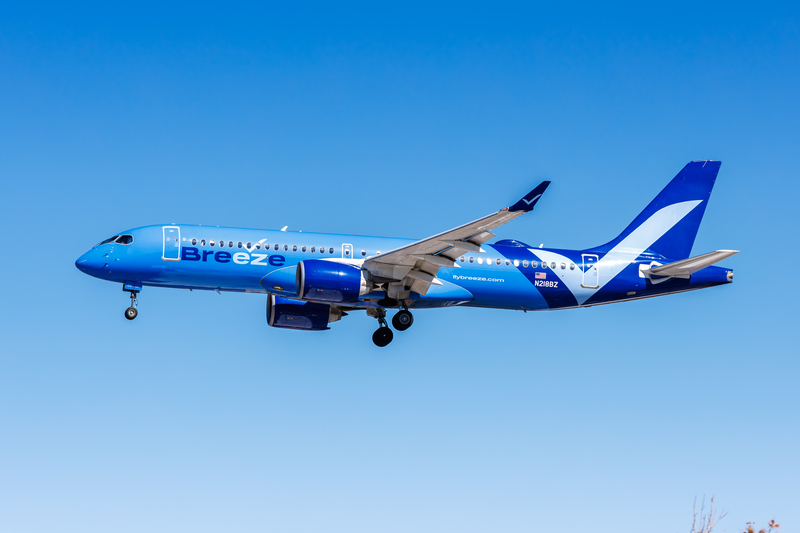
ID 347018549 © Boarding1now | Dreamstime.com
Tallahassee Joins The Breeze Map
Tallahassee (TLH) is one of the two new cities entering Breeze’s network this week, and it may be the more strategically interesting of the pair.
The Florida capital has long struggled with limited low-cost competition. Its air service is shaped by government travel, university demand, visiting-friends-and-relatives traffic, state business, and regional travel, but fares have often been higher than travelers would like because nonstop competition is limited.
Breeze is entering Tallahassee (TLH) with two routes: Fort Lauderdale (FLL) and Raleigh-Durham (RDU). The Fort Lauderdale route restores a useful intrastate link that had been served by other carriers in recent years, while Raleigh-Durham is especially notable because it appears to be a first-time nonstop market.
The Raleigh-Durham (RDU)–Tallahassee (TLH) route also shows how Breeze thinks. Neither airport is a fortress hub for a legacy carrier. Both have strong local demand characteristics. RDU brings the Research Triangle, universities, technology, healthcare, and a fast-growing population base. TLH brings state government, Florida State University, Florida A&M University, and a catchment that can benefit from nonstop access without connecting over Atlanta (ATL), Charlotte (CLT), or Miami (MIA).
On paper, that is a thin route. In Breeze’s model, that is the opportunity.
Birmingham Gives Breeze A Larger Alabama Presence
Birmingham (BHM) joins Breeze on July 3 with nonstop flights to Fort Lauderdale (FLL) and Raleigh-Durham (RDU).
Breeze has served Alabama before through Huntsville (HSV) and, in earlier periods, Mobile (BFM/MOB-area service depending on schedule history), but Birmingham is the state’s largest commercial airport and a more important long-term market.
The Birmingham (BHM)–Fort Lauderdale (FLL) route is straightforward: Alabama-to-South Florida leisure and visiting-friends-and-relatives demand. The Birmingham (BHM)–Raleigh-Durham (RDU) route is more interesting. It connects two growing Southeastern markets that are close enough to have real travel demand but far enough apart that driving is inconvenient for many travelers.
Both routes launch twice weekly, on Mondays and Fridays. That schedule is designed for long weekends, flexible leisure trips, and passengers who prioritize nonstop convenience over daily frequency.
For Birmingham, the arrival of Breeze adds another low-fare carrier option and gives the airport nonstop links that are not dependent on a large connecting hub. For Breeze, BHM offers a medium-sized market with a catchment that can support targeted flights without requiring a large base.
Four Routes Appear To Be True First-Time Nonstops
Among the 19 additions, four stand out because they appear to be brand-new nonstop markets rather than revived or replaced routes.
Those are Akron-Canton (CAK)–Portland, Maine (PWM), Fort Lauderdale (FLL)–Wilkes-Barre/Scranton (AVP), Fort Lauderdale (FLL)–Salisbury/Ocean City (SBY), and Raleigh-Durham (RDU)–Tallahassee (TLH).
Those are exactly the kinds of routes Breeze was built to try.
Akron-Canton (CAK)–Portland (PWM) looks thin if measured only by existing nonstop demand because there has been no nonstop service to stimulate the market. But CAK is not just Akron and Canton. It also functions as an alternative airport for parts of Northeast Ohio, including travelers who might otherwise use Cleveland Hopkins International Airport (CLE). Portland (PWM), meanwhile, has strong summer leisure appeal and can attract travelers heading to coastal Maine.
Fort Lauderdale (FLL)–Wilkes-Barre/Scranton (AVP) and Fort Lauderdale (FLL)–Salisbury (SBY) are classic cold-to-warm leisure routes. They link smaller Northeast and Mid-Atlantic airports with South Florida, allowing Breeze to avoid direct head-to-head battles at larger airports while still capturing strong Florida demand.
Raleigh-Durham (RDU)–Tallahassee (TLH) is a different kind of market. It is less purely beach-driven and more about connecting two growing government, education, and business regions that have historically required a connection.
These routes may not generate huge traffic on day one. That is not the point. Breeze is betting that nonstop availability can create demand that traditional traffic data does not fully show.
Atlantic City Is Becoming A Real Breeze Focus City
Atlantic City (ACY) is another important piece of the story.
Breeze only recently entered Atlantic City, but the airline has been building quickly. The July launch wave adds Tampa (TPA) on July 1 and Orlando (MCO) on July 3. Those routes join Breeze’s earlier ACY service and help make the airport more than a single-route experiment.
Atlantic City (ACY) is an unusual airport. It sits in South Jersey, close to the Jersey Shore, with access to Atlantic City, southern New Jersey, parts of the Philadelphia region, and coastal leisure demand. It also has a history of relying heavily on leisure carriers, most notably Spirit Airlines.
That history matters because Breeze is stepping into markets that have sometimes been served before, including routes tied to Florida leisure demand. When an incumbent exits or reduces service, Breeze can test whether the underlying demand still exists with a different cost structure, different aircraft, and a different customer proposition.
The Atlantic City (ACY)–Orlando (MCO) daily route is particularly important. Daily service is unusual within this launch group and suggests Breeze sees real potential in the market.
The Aircraft: Airbus A220-300 At The Center
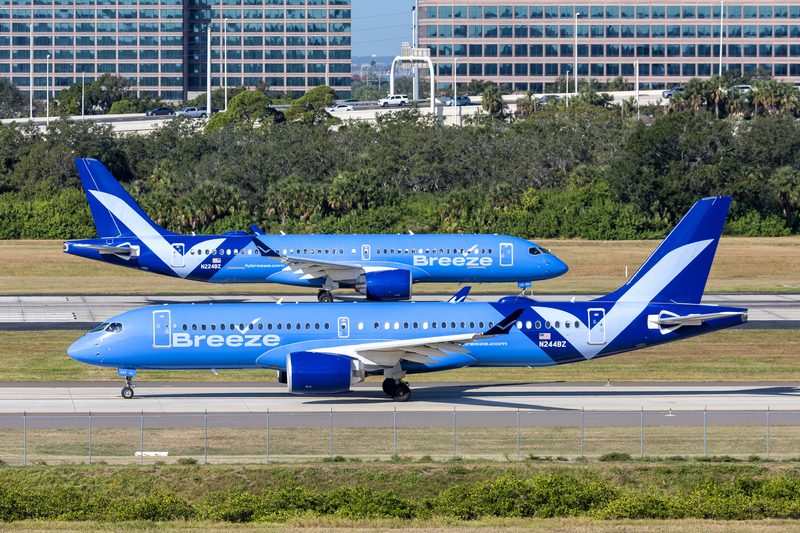
Breeze’s route development is closely tied to the Airbus A220-300.
The A220-300 is the aircraft that allows Breeze to fly longer thin routes more efficiently than many older narrowbodies. It has the range for longer domestic and near-international sectors, the cabin comfort to support flights of several hours, and a seat count that is smaller than an Airbus A320 or Boeing 737 but larger and more capable than many regional jets.
That matters for routes such as Akron-Canton (CAK)–Portland (PWM), Tampa (TPA)–Punta Cana (PUJ), Cincinnati (CVG)–Portland (PWM), and longer Florida-to-Northeast or Florida-to-Mid-Atlantic sectors. The A220 gives Breeze enough seats to make the route meaningful, but not so many that the airline needs large-airline demand levels to succeed.
The aircraft’s cabin is also part of the Breeze sales pitch. The A220 uses a 2-3 seating layout in economy, meaning fewer middle seats than a 3-3 Boeing 737 or Airbus A320 cabin. Breeze also offers bundled fare products, extra-legroom seating, Wi-Fi on many aircraft, and a more premium onboard proposition than a bare-bones ultra-low-cost carrier.
Breeze still uses Embraer E190 aircraft in parts of its operation, but the A220-300 is the airline’s flagship growth platform and the aircraft most closely associated with its longer, more ambitious routes.
Why Low Frequency Works For Breeze
Aviation professionals often look at a two-weekly route and ask whether it is sustainable. For Breeze, that low frequency is often the business case.
Traditional network carriers prefer daily or near-daily service because they are building schedules around connectivity, corporate contracts, and hub banks. Breeze is doing something different. It is selling nonstop convenience in markets where the alternative is often a connection, a long drive, or both.
A two-weekly flight can work if the route is leisure-oriented, if travelers are flexible, and if the airline can sell both ends of the market. Thursday/Sunday and Friday/Monday patterns can support long weekends. Wednesday/Saturday patterns can support vacation-week travel. Tuesday/Thursday/Sunday patterns can create a bit more schedule flexibility without becoming a full daily commitment.
The challenge is that low frequency can limit business demand. A traveler who needs to leave Tuesday and return Wednesday may not be able to use Breeze. That means these routes must be judged by a different standard than a Delta, American, United, or Southwest hub route.
For Breeze, the question is not whether every traveler can use the schedule. The question is whether enough travelers can use it at the right fare.
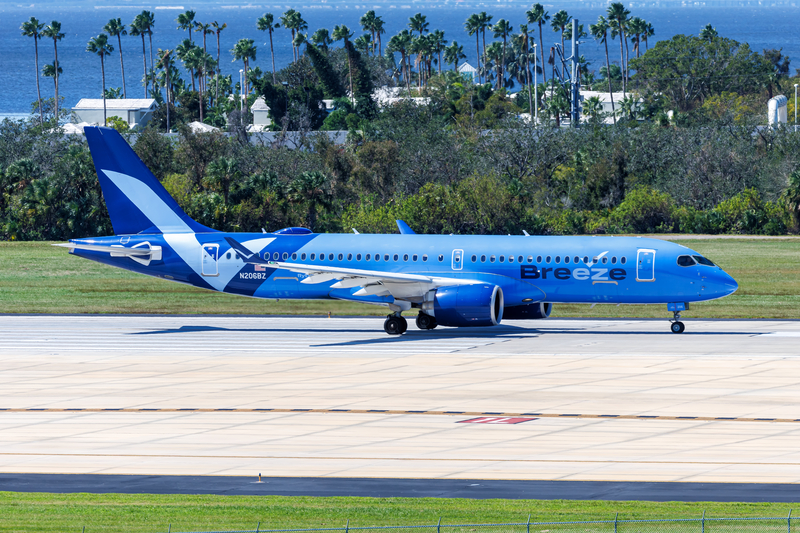
ID 347018738 | Breeze Air © Boarding1now | Dreamstime.com
The Spirit Airlines Shadow
Several of the new Breeze routes have a Spirit Airlines connection, either because Spirit served them previously or because they fit markets Spirit has historically pursued.
That is especially relevant in Atlantic City (ACY), Fort Lauderdale (FLL), Orlando (MCO), and Tampa (TPA). Spirit has long been associated with low-fare Florida flying and with Atlantic City in particular. As Spirit’s network has shifted, reduced, or disappeared in certain markets, opportunities have opened for other carriers to test demand.
Breeze is not Spirit. Its product, fleet, fare structure, and network design are different. But it is clearly willing to move into markets where Spirit once proved that price-sensitive leisure demand existed.
The difference is that Breeze often uses smaller aircraft, lower frequencies, and more selective city pairs. That can make routes viable even when a larger ULCC schedule did not last.
Fort Lauderdale–Tampa Is The Outlier
Most of the 19 routes are low-frequency additions. Fort Lauderdale (FLL)–Tampa (TPA) is the exception.
Breeze is launching the intrastate Florida route at 13 weekly frequencies, making it one of the densest routes in this expansion wave. That is a very different kind of bet from a two-weekly Northeast-to-Florida route.
FLL–TPA is short, competitive, and operationally useful. It can serve local passengers who do not want to drive across the state, but it can also support aircraft rotations, crew positioning, and network flow within Breeze’s Florida operation. The route faces competition, but its high frequency suggests Breeze sees enough local and network value to justify a more aggressive entry.
Intra-Florida flying can be difficult because driving is a real substitute. But Florida’s population growth, road congestion, tourism flows, and spread-out metro areas can still create a role for air service when fares and schedules are right.
International Growth Enters The Mix
The Tampa (TPA)–Punta Cana (PUJ) route adds an international element to the July wave.
Service begins July 2 and operates twice weekly on Thursdays and Sundays. Punta Cana (PUJ) is a major Caribbean leisure airport and one of the Dominican Republic’s strongest tourism gateways, especially for resort travelers.
For Breeze, Punta Cana is part of a broader international buildout from Tampa. The airline has also been adding or planning service from TPA to destinations such as Nassau (NAS), San José, Costa Rica (SJO), Cancun (CUN), St. Thomas (STT), and Montego Bay (MBJ) in different schedule periods.
That is significant because Breeze began as a domestic point-to-point airline. The gradual move into near-international leisure markets shows the carrier is using the same logic beyond the U.S.: connect underserved or under-competitive city pairs with low-frequency nonstop service and rely on the A220’s economics to make the route work.
Punta Cana (PUJ) is not an obscure market, but Tampa (TPA) gives Breeze a strong Florida base from which to compete for leisure traffic.
A Network Built On Market Creation
The most important theme across these 19 launches is market creation.
Some airline routes are built around large existing demand pools. Others are built around the belief that demand will appear once the nonstop exists. Breeze is largely in the second category.
Traditional data can understate these opportunities because it only captures passengers already making the trip. If a route has never had nonstop service, many potential travelers may not be flying at all. They may be driving, choosing a different destination, or avoiding the trip because the connection is inconvenient.
That is why Breeze can look at a market such as Akron-Canton (CAK)–Portland (PWM) differently from a legacy carrier. The existing traffic may be small, but the broader catchment, summer leisure appeal, and nonstop convenience may create a larger market than historical data suggests.
It is a risky model, but it is also one of the few ways new U.S. route development can still find white space in a mature market.
Bottom Line
Breeze Airways’ 19-route launch wave from July 1 to July 3 is a clear example of the airline’s route-development strategy at scale.
The carrier is adding new cities, restoring previously served markets, entering former Spirit-style leisure routes, and testing first-time nonstops that larger airlines are unlikely to touch. Florida is the center of the expansion, with Fort Lauderdale (FLL), Tampa (TPA), Orlando (MCO), Tallahassee (TLH), and Punta Cana (PUJ) playing major roles.
The aircraft strategy matters just as much as the route map. Breeze’s Airbus A220-300 gives the airline a modern, efficient, passenger-friendly platform for thin routes that do not need a full-size 737 or A320. Combined with low weekly frequency, that allows Breeze to launch markets that would look marginal under a traditional daily-service model.
Not every route will last. That is part of the model. Breeze can test, adjust, increase, reduce, or exit routes as demand becomes clearer.
But the larger point is unmistakable: Breeze is still finding room in the U.S. market by flying where others do not, or where others no longer do. In a network dominated by hubs, megacarriers, and congested big-city airports, that makes this 19-route launch wave more than a schedule update. It is a statement of how Breeze intends to keep growing.
Keep reading FlyMag
Get the Daily Brief in the morning or the Route Watch weekly recap on Fridays. Or both.