Air Europa Opens Johannesburg As Madrid Gains A New Southern Africa Link
Air Europa has launched its first scheduled route to sub-Saharan Africa, opening a new nonstop service between Madrid and Johannesburg.

The new route connects Adolfo Suárez Madrid-Barajas Airport (MAD) with O.R. Tambo International Airport (JNB). It launched on June 24, 2026, and operates three times per week.
For Air Europa, this is a major network step. The airline has long used Madrid (MAD) as a bridge between Europe and Latin America. Johannesburg (JNB) now gives the carrier a new long-haul anchor in Southern Africa.
The route also gives South Africa a direct link to Spain, with onward connections across Europe and Latin America through Air Europa’s Madrid hub.
Air Europa’s First Scheduled Sub-Saharan African Route
The Johannesburg service is Air Europa’s first scheduled route into sub-Saharan Africa.
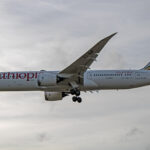
That is important because the airline already has a broader African presence in North Africa, including markets such as Marrakech, Tunis and Tangier. Johannesburg is different.
It is a long-haul route into Southern Africa and connects Madrid with one of the continent’s most important business and aviation centers.
The new service is designed to support tourism, trade, business travel and connecting traffic. It also gives South African travelers another way to reach Europe without backtracking through another major hub.
For Spanish travelers, the route makes Johannesburg easier to reach. It also improves access to South Africa’s safari, wine, coastal and business destinations.
Three Weekly Boeing 787 Flights
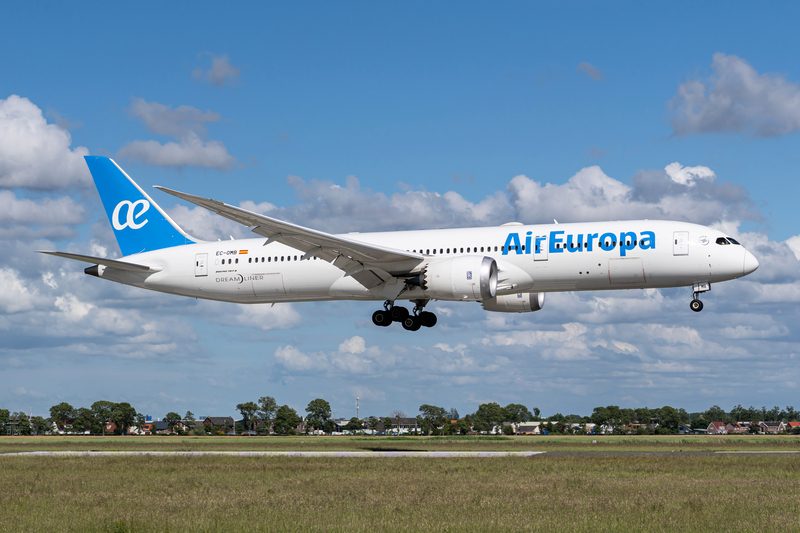
Air Europa is operating the Madrid (MAD)–Johannesburg (JNB) route three times weekly using the Boeing 787 Dreamliner.
The 787 is the right aircraft for this route.
It gives Air Europa long-haul range, good fuel efficiency and a cabin built for overnight intercontinental flying. Air Europa says its Dreamliner fleet is used on long-distance routes and can carry around 300 passengers, depending on configuration.
That capacity works well for Madrid–Johannesburg.
The route is long enough to require a true long-haul aircraft, but it is still a market where careful capacity matters. A 787 gives Air Europa the range to operate nonstop without the seat risk of a larger widebody.
Air Europa also highlights the 787’s quieter cabin, improved air systems, onboard Wi-Fi and inflight entertainment. Those details matter on a flight of more than 10 hours.
Why Johannesburg Matters
Johannesburg is South Africa’s largest commercial center and one of Africa’s most important aviation markets.
O.R. Tambo International Airport (JNB) is South Africa’s principal airport and one of the busiest gateways on the African continent. It handles domestic, regional and long-haul traffic and serves as a major connecting point for Southern Africa.
That makes Johannesburg a logical first sub-Saharan African destination for Air Europa.
The city has strong business demand, corporate travel, tourism flows and regional connectivity. It is also a gateway to South Africa’s wider tourism network, including Cape Town, Durban, Kruger National Park, the Garden Route and private safari reserves.
For passengers arriving from Spain or Latin America, JNB can serve as the starting point for a much broader Southern African itinerary.
Madrid Becomes The Bridge
The strategic value of this route is not only Madrid–Johannesburg local traffic.
Air Europa’s strength is its hub at Madrid-Barajas (MAD). From there, the airline connects passengers across Spain, Europe and Latin America.
That is where the Johannesburg route becomes more interesting.
A traveler from Johannesburg (JNB) can connect in Madrid to cities across Spain and Europe. More importantly, Air Europa can also connect South Africa with Latin American markets where it already has a strong presence.
That creates a useful South Africa–Latin America bridge.
Passengers traveling between Johannesburg and cities such as Buenos Aires, São Paulo, Lima, Bogotá, Santo Domingo or other Air Europa long-haul markets may now have another one-stop option through Madrid.
For Air Europa, this kind of connecting traffic is essential. It helps support a route that may not depend only on Spain–South Africa point-to-point demand.
CemAir Interline Adds Regional Reach
Air Europa has also signed a unilateral interline agreement with CemAir, effective June 23, 2026.
This is a smart move.
CemAir gives Air Europa passengers access to domestic and regional destinations beyond Johannesburg. The agreement allows travelers to book connecting flights on a single itinerary with a streamlined baggage process.
That is important because Johannesburg is not always the final destination.
Many inbound passengers may want to continue to other South African cities, safari gateways or regional points in Southern Africa. CemAir can help Air Europa extend its reach without operating those routes itself.
CemAir’s network includes domestic South African cities and regional destinations such as Maun, Kasane, Harare and Victoria Falls. That gives the partnership strong tourism value.
For example, a passenger from Madrid could fly to Johannesburg with Air Europa, then continue on CemAir to a safari or regional destination.
That makes the new route much more useful.
A Route With Tourism Potential
South Africa has strong appeal for Spanish and European travelers.
The country offers wildlife, wine tourism, coastlines, city breaks, culture and adventure travel. Johannesburg also works as a practical gateway for safari itineraries and onward domestic travel.
South African tourism authorities expect the route to raise the country’s visibility in Spain and other connected markets.
That is realistic.
Direct flights often change how destinations are sold. Tour operators can build cleaner itineraries. Travel agents can promote easier access. Independent travelers have fewer connection barriers.
This matters for South Africa.
The country competes with many long-haul leisure destinations. A direct Madrid–Johannesburg route gives it another platform in Europe and Latin America.
Business And Trade Are Also Part Of The Story
Tourism is important, but this route is not only about holidays.
Johannesburg is a major financial, mining, industrial and corporate center. Madrid is one of Europe’s largest business cities and a natural connection point to Latin America.
That creates several demand streams.
There is Spain–South Africa business travel. There is European corporate traffic. There is Latin America–South Africa connectivity. There is also government, education, conference and investment-related demand.
Cargo may also help.
A Boeing 787 passenger flight can carry belly freight under the passenger cabin. That can support high-value or time-sensitive shipments between Southern Africa, Spain and onward markets.
Air cargo will not be the only reason the route works, but it can improve the economics.
Air Europa’s SkyTeam Role
Air Europa is a member of SkyTeam.
That gives the route added alliance value. Johannesburg is already served by several global carriers, but Air Europa now adds a SkyTeam option through Madrid.
This could appeal to passengers earning or redeeming miles through Air Europa SUMA and eligible SkyTeam partner programs.
It may also help with corporate travel.
Business travelers often look for loyalty benefits, through-ticketing and easier connections. Air Europa’s Madrid hub gives the airline a strong platform to offer that.
The CemAir interline agreement adds another layer by expanding the route’s practical reach beyond JNB.
Why The 787 Product Matters
The aircraft product matters on this route.
A Madrid–Johannesburg flight is long enough for comfort to influence booking decisions. Passengers will compare not only price, but also schedule, seat comfort, onboard service and connection time.
Air Europa’s long-haul business product on the 787 includes lie-flat seating on many aircraft, while the airline also promotes onboard connectivity and entertainment.
Economy passengers benefit from the 787 cabin environment as well. The Dreamliner is known for larger windows, quieter operation and a modern cabin design.
For a new long-haul route, that helps.
Air Europa needs the route to attract leisure passengers, business travelers and connecting traffic. A modern aircraft gives it a stronger product than an older-generation widebody.
Competition Will Be Indirect
Air Europa is not entering a market filled with nonstop Spain–South Africa competition.
Instead, the main competition comes from one-stop carriers.
Passengers between South Africa and Spain can already connect through hubs such as Doha, Dubai, Istanbul, Frankfurt, Amsterdam, Paris, Zurich, Addis Ababa and other European or Middle Eastern gateways.
That means Air Europa’s advantage is simplicity.
A nonstop Madrid–Johannesburg flight removes a connection for Spain-bound passengers. It also creates a new one-stop path for travelers going beyond Madrid.
The airline will need to compete on price, schedule and network utility. However, nonstop service gives it a strong starting point.
Johannesburg Strengthens Air Europa’s Long-Haul Map
The route also broadens Air Europa’s long-haul identity.
The airline has historically been strongest across the Atlantic, especially between Europe and the Americas. Johannesburg gives it a deeper role in Africa and a more balanced intercontinental network.
That is useful strategically.
Airlines with strong long-haul hubs benefit when they can connect multiple regions. Madrid can now link Europe, Latin America and Southern Africa more directly under the Air Europa brand.
That does not make Johannesburg an easy route.
It still needs strong loads, good yields and reliable connections. But the logic is clear.
Air Europa is using Madrid to connect markets that are not always well linked to each other.
Bottom Line
Air Europa’s new Madrid (MAD)–Johannesburg (JNB) service is a major step for the Spanish carrier.
It is the airline’s first scheduled route to sub-Saharan Africa and operates three times weekly with Boeing 787 Dreamliner aircraft.
The route gives South Africa a direct link to Spain and opens new connections through Madrid to Europe and Latin America. It also gives Air Europa a stronger role in Southern Africa.
The CemAir interline agreement makes the launch more powerful. It allows passengers to continue beyond Johannesburg on domestic and regional services across Southern Africa through a single itinerary and smoother baggage process.
For travelers, the benefit is clear: fewer connections and more options.
For Air Europa, Johannesburg is more than a destination. It is a new long-haul gateway, a tourism play, a business link and a bridge between Southern Africa, Europe and Latin America.