Breeze Airways Makes Florida Its Growth Engine With 38 Added Sunshine State Routes
Breeze Airways is leaning heavily into Florida for summer 2026, adding 38 routes that touch the state and making the Sunshine State one of the most important parts of its fast-growing network.

The expansion includes 36 domestic routes and two international routes. It also shows how quickly Breeze is moving into markets left open by shifting airline strategies, changing leisure demand and the collapse of some previous service patterns.
Florida is already central to Breeze. During July and August 2026, schedule data shows the state will account for nearly half of the airline’s flights.
That is a remarkable concentration for a carrier that only began flying in 2021.
The strategy is clear. Breeze is using Florida to connect underserved cities, build leisure demand and create nonstop routes that larger network airlines may not prioritize.
Fort Lauderdale Becomes A Major Breeze Growth Market
The biggest Florida story is Fort Lauderdale-Hollywood International Airport (FLL).
Breeze only entered FLL in November 2025. Less than a year later, the airport has become one of the airline’s most active growth points.
Fourteen of Breeze’s 36 added domestic Florida routes involve Fort Lauderdale (FLL). That is a major buildout for an airport that has seen heavy competitive change in recent years.
Breeze’s July 2026 additions from Fort Lauderdale include Birmingham (BHM), Charleston (CHS), Greenville-Spartanburg (GSP), Jacksonville (JAX), Salisbury (SBY), Tallahassee (TLH), Tampa (TPA) and Wilkes-Barre/Scranton (AVP).
Several of those markets are classic Breeze routes. They connect secondary or midsize cities that may not have had strong nonstop access to South Florida.
Others, such as Jacksonville and Tampa, are intra-Florida markets where Breeze is betting that convenience and frequency can stimulate demand.
Why FLL Works For Breeze
Fort Lauderdale is a logical airport for Breeze.
It is a major South Florida gateway, but it is not as slot-constrained or internationally dominant as Miami International Airport (MIA). It also serves a large local market across Broward, Palm Beach and northern Miami-Dade counties.
For Breeze, FLL offers both local demand and leisure appeal.
It can attract passengers heading to beaches, cruises, family visits and South Florida vacations. It can also work as a destination for travelers from smaller cities that do not have nonstop service on larger carriers.
That is exactly where Breeze likes to operate.
The airline’s business model is built around connecting underserved markets nonstop. Fort Lauderdale gives it a large leisure destination with room to build that kind of network.
Tampa Adds Domestic And International Growth
Tampa International Airport (TPA) is another major Florida growth point for Breeze.
The airline is adding domestic routes from Tampa (TPA) to Atlantic City (ACY), Columbus (CMH) and Fort Lauderdale (FLL). It is also expanding internationally from TPA.
Breeze launched Tampa (TPA)–Nassau (NAS) service on June 11, 2026. Tampa Airport said the route marked the first time in 20 years that the airport had jet service to Nassau’s Lynden Pindling International Airport (NAS).
The Nassau route is also notable because it is short. At around 324 nautical miles, Tampa–Nassau is a very compact international sector.
That makes it a good example of Breeze’s route philosophy.
Not every international flight needs to be long-haul. Some can be short, leisure-focused and underserved.
ID 347018549 © Boarding1now | Dreamstime.com
Punta Cana Adds Another Caribbean Link
Breeze is also adding Tampa (TPA)–Punta Cana (PUJ) service.
The route is scheduled to begin in July 2026 and adds another Caribbean leisure market to Breeze’s Florida network.
Punta Cana is one of the Dominican Republic’s strongest resort destinations. It is heavily driven by leisure travel, all-inclusive resorts and sun-seeking passengers from the United States.
For Tampa travelers, the route adds a nonstop option to a market that has not always had consistent service from TPA.
For Breeze, it strengthens Tampa as an international gateway.
Tampa Airport says Breeze will serve 37 destinations from TPA by the end of 2026, including six in the Caribbean and Latin America: Nassau, San José, Punta Cana, St. Thomas, Cancún and Montego Bay.
That is a major international buildout for an airline that only recently moved beyond domestic flying.
Orlando, Tallahassee And Other Florida Airports Gain Too
The expansion is not limited to Fort Lauderdale and Tampa.
Orlando International Airport (MCO) gains Atlantic City (ACY). Tallahassee International Airport (TLH) gains Raleigh-Durham (RDU). Tampa (TPA) gains Atlantic City and Columbus, while Fort Lauderdale becomes the core of the July 2026 Florida push.
These routes show how Breeze is using Florida in multiple ways.
Orlando is a national leisure magnet. Tampa is becoming a domestic and international growth airport. Fort Lauderdale is a South Florida beach and cruise gateway. Tallahassee brings a smaller capital-city market into the network.
That mix gives Breeze more than one Florida identity.
The state is not just one destination. It is a collection of different traffic flows, from beaches and theme parks to government travel, family visits and small-city connectivity.
Breeze Is Filling Gaps Others Leave Behind
Several of the new Florida routes have seen nonstop service before.
Some were served by other carriers in previous seasons. Others became more attractive after competitors reduced capacity or exited markets.
That is an important part of the story.
Breeze is not only inventing new demand. It is also moving into ready-made markets where passengers already showed interest in nonstop service.
This is especially useful for a young airline.
Launching a completely new city pair can be risky. Restarting or replacing a route that already had some demand can reduce that risk.
The Fort Lauderdale additions are a good example. Several FLL markets have had service from carriers such as JetBlue, Allegiant, Southwest or Spirit in the past.
Breeze can now test whether those routes still work under its own cost structure and brand.
The Airbus A220 Is Central To The Strategy
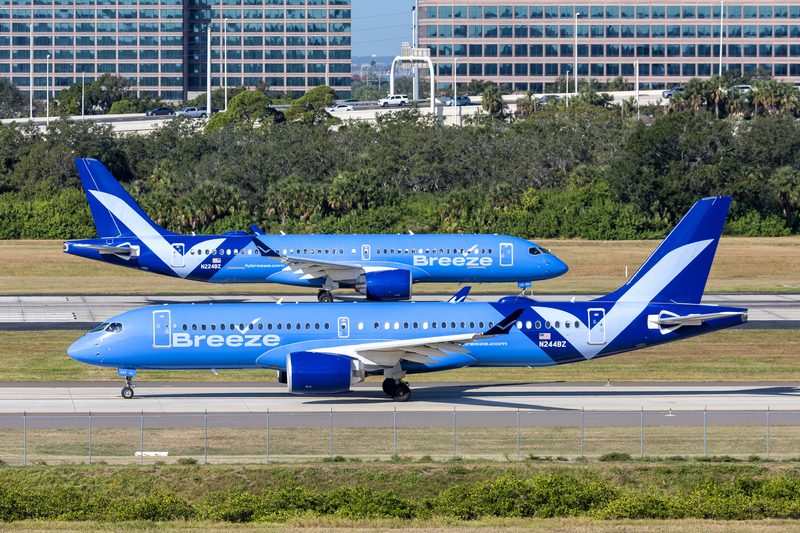
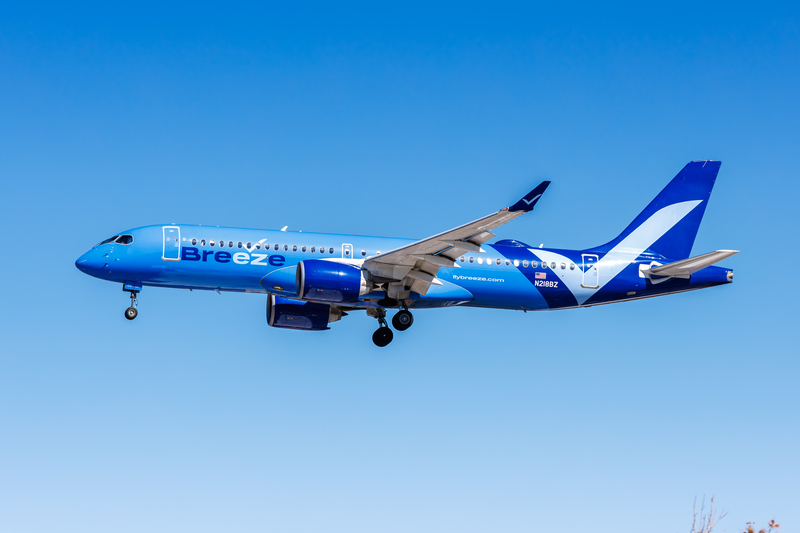
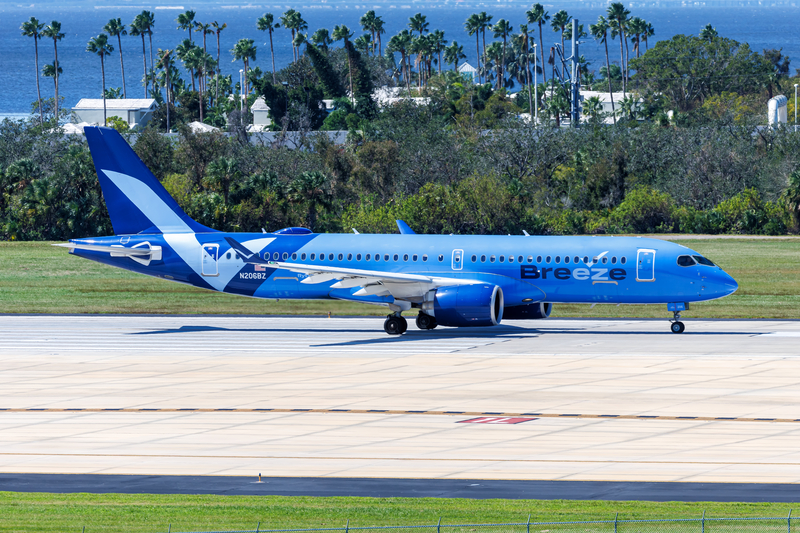
Breeze’s growth is built around the Airbus A220-300.
The aircraft is one of the most important tools in the airline’s network plan. It has the range to fly longer domestic routes, but it is smaller than a Boeing 737 or Airbus A320 in many airline layouts.
That matters for underserved routes.
Breeze does not always need 180 or 190 seats to make a market work. The A220-300 allows the airline to offer nonstop service with a right-sized aircraft.
Breeze lists the A220-300 with a range of 3,400 nautical miles and a cruising speed above 500 mph. The aircraft also includes USB-C charging, AC power outlets and the airline’s Breeze Ascent premium cabin.
The cabin product helps Breeze compete for more than just the lowest fare.
Passengers can buy a basic seat or pay for more space, power and a more premium experience. That gives the airline a broader revenue base on routes that may otherwise be heavily price-sensitive.
A Jet Fleet Changes Smaller Markets
Breeze’s Florida expansion is also notable because the airline uses jets.
Some of these markets have historically been served by regional aircraft or turboprops. Others had no nonstop service at all.
By using the A220, Breeze can offer a mainline-style product on thinner routes.
That matters in markets such as Salisbury (SBY), Wilkes-Barre/Scranton (AVP), Tallahassee (TLH) and Greenville-Spartanburg (GSP). These airports often depend on hub connections through larger airlines.
A nonstop flight to Florida changes the passenger proposition.
Instead of connecting through Charlotte, Atlanta, Philadelphia or another hub, travelers can fly directly to South Florida or another Florida destination.
That saves time and makes short leisure trips easier.
ID 347018738 | Breeze Air © Boarding1now | Dreamstime.com
The RDU–Key West Example Shows The Effect
Breeze’s Raleigh-Durham (RDU)–Key West (EYW) route offers a good example of how a new nonstop can stimulate demand.
Before Breeze entered the market, passengers traveled indirectly through hubs such as Charlotte (CLT) or Miami (MIA). After nonstop service began, the market grew sharply, while average base fares fell.
That is exactly what Breeze wants to do.
The airline identifies city pairs where people are already traveling indirectly. Then it adds nonstop service and tries to grow the total market.
This can hurt connecting carriers, because some passengers who once flew through hubs move to the nonstop option.
But it can also create new demand.
Lower fares and shorter travel times can convince people to take trips they may not have booked before.
Florida Is Perfect For This Model
Florida works well for Breeze because it has broad, durable demand.
Travelers go to Florida for beaches, cruises, theme parks, spring training, retirement communities, family visits, business trips and seasonal escapes.
That creates year-round demand, but it also creates strong peaks.
Breeze can use that demand across multiple types of routes. It can fly northern cities to South Florida. It can connect smaller southeastern markets to Florida. It can add intra-Florida links. It can also use Tampa as a Caribbean and Latin America gateway.
This flexibility is valuable.
A state like Florida gives Breeze many route types to test, not just one.
International Growth Changes Breeze’s Profile
Breeze’s move into international flying is another major development.
The airline launched as a domestic U.S. carrier, but its international authority has opened new opportunities. Tampa is becoming one of the clearest examples of that shift.
The Nassau and Punta Cana routes are not huge long-haul moves. They are measured, leisure-focused additions that fit Breeze’s aircraft and brand.
That is a smart way to go international.
Rather than launching complex long-distance routes, Breeze is starting with markets that are close, popular and underserved from certain U.S. airports.
If Tampa’s international routes perform well, Breeze could use the same approach from other focus cities.
Competition Will Vary By Route
Not every Breeze Florida route will face the same competitive environment.
Some routes will be uncontested. Others will go head-to-head with carriers such as JetBlue, Allegiant, Southwest or American.
That matters because Breeze’s strongest performance often comes in markets where it is the only nonstop carrier.
On routes with competition, Breeze will need to win on fare, schedule, airport convenience and onboard product.
The airline’s ability to offer premium seating on the A220 could help. So could its focus on nonstop travel between markets that lack strong service.
Still, Florida is not an easy market.
It is heavily served, highly seasonal and price-sensitive. Airlines can add flights quickly, but they can also cut them just as fast if yields disappoint.
A Young Airline Acting More Mature
The scale of this Florida expansion shows Breeze growing up as a network airline.
This is no longer only about launching a few thin routes from underserved airports. Breeze is now building depth in major leisure states, developing airport focus points and adding international service.
That is a more mature strategy.
It also brings more risk.
A larger Florida network means more exposure to weather, competition, seasonal swings and operational complexity. Summer thunderstorms, hurricane season and air traffic control delays can all pressure Florida operations.
Breeze will need reliability as much as growth.
The airline is adding routes quickly. The next challenge is making them perform consistently.
Why The Expansion Matters
The broader significance is that Breeze is reshaping parts of the U.S. leisure map.
Large airlines often route passengers through hubs. Ultra-low-cost carriers often focus on large leisure flows. Breeze is trying to occupy a middle space.
It offers nonstop flights on routes that are too small for legacy hub airlines to prioritize, but attractive enough to support service with the right aircraft.
Florida is a natural testing ground for that model.
The demand is real. The cities are varied. The airport options are broad. The aircraft can be sized carefully.
That makes the 38-route Florida expansion one of Breeze’s most important network moves yet.
Bottom Line
Breeze Airways is making Florida one of the main engines of its 2026 growth.
The airline has added 38 routes touching the state when comparing July and August 2025 with July and August 2026 schedules. That includes 36 domestic routes and two international routes.
Fort Lauderdale (FLL) is the biggest winner, with 14 added domestic routes. Tampa (TPA) is becoming a larger domestic and international platform, with new or expanded links to Nassau (NAS), Punta Cana (PUJ), Atlantic City (ACY), Columbus (CMH) and Fort Lauderdale (FLL).
The expansion shows why Breeze’s Airbus A220-300 matters.
It gives the airline a right-sized jet for routes that larger carriers may overlook and allows Breeze to build nonstop service in markets where passengers have often been forced to connect.
For Florida travelers, the result is more choice. For smaller cities, it means better access to the Sunshine State. For Breeze, it is a major bet that Florida can anchor the next phase of its growth.