Aer Lingus Faces Network Review, But U.S. Routes Remain Too Important To Assume Cuts
Aer Lingus is facing growing pressure to improve profitability, raising questions about whether parts of its fast-growing transatlantic network could eventually be reduced.

For now, there is no confirmed evidence that the airline’s U.S. routes are the primary target.
That distinction matters.
Aer Lingus is reviewing costs, staffing and future schedules after a difficult start to 2026. But the airline’s North American operation is also one of its most important strategic assets. It connects Ireland with the United States and Canada, supports Dublin’s hub role and gives parent company International Airlines Group a valuable position in the North Atlantic market.
So the better question is not whether Aer Lingus is about to slash U.S. routes.

The better question is how deep any future cuts may go, and whether weaker short-haul flying could indirectly hurt the long-haul network.
Financial Pressure Is Driving The Review
The concern comes from Aer Lingus’ weaker financial performance.
IAG reported that Aer Lingus posted a first-quarter operating loss of €103 million in 2026. That was almost double the €55 million loss recorded in the same period a year earlier.
The group said the wider loss mainly reflected higher fuel costs and lower passenger revenues linked to competition on North Atlantic routes.

That is a key detail.
Aer Lingus has grown strongly across the Atlantic, but growth alone does not guarantee strong margins. The airline is facing more competition, more cost pressure and higher expectations from IAG.
Reports in Ireland say management has warned pilots that the winter 2026/2027 schedule could be smaller than the previous winter. The summer 2027 program may also fall below 2026 levels.
That does not automatically mean U.S. route cuts. But it does mean the airline is looking hard at capacity.

North America Is Still The Core Strategy
Aer Lingus has spent years building Dublin into a North Atlantic connecting hub.
That strategy is built around Dublin Airport (DUB), Shannon Airport (SNN), U.S. preclearance, and Ireland’s strong geographic position between North America and Europe.
The airline’s own 2026 schedule announcement described it as the largest transatlantic program in Aer Lingus history. Aer Lingus said it would serve 26 destinations across North America in 2026, including the new Dublin–Raleigh-Durham route.
That growth is not random.
Aer Lingus has added U.S. markets that larger European network carriers may struggle to serve nonstop from their own hubs. Its aircraft mix gives it more flexibility. Its Dublin hub gives it U.S. preclearance. Its IAG ownership gives it group support and commercial reach.
That is why the transatlantic network remains central to the airline’s future, even as the cost review intensifies.
The U.S. Network Is Larger Than Ever
Aer Lingus’ U.S. presence is broad.
From Dublin (DUB), the airline sells service to major U.S. gateways such as New York JFK (JFK), Boston Logan (BOS), Chicago O’Hare (ORD), Los Angeles (LAX), San Francisco (SFO), Seattle (SEA), Washington Dulles (IAD), Philadelphia (PHL), Orlando (MCO), Miami (MIA), Denver (DEN) and others.
It also serves U.S. routes from Shannon (SNN), including Boston (BOS) and New York JFK (JFK).
Recent growth has added or expanded routes such as Nashville (BNA), Indianapolis (IND), Pittsburgh (PIT) and Raleigh-Durham (RDU). These markets are exactly where Aer Lingus has tried to use Dublin’s geography and smaller long-haul aircraft to its advantage.
That is the important context.
Aer Lingus is not simply flying trunk routes to New York, Boston and Chicago. It has built a wider U.S. network that depends on local Irish demand, U.S. inbound tourism and connecting passengers moving between North America, Ireland, the United Kingdom and Europe.
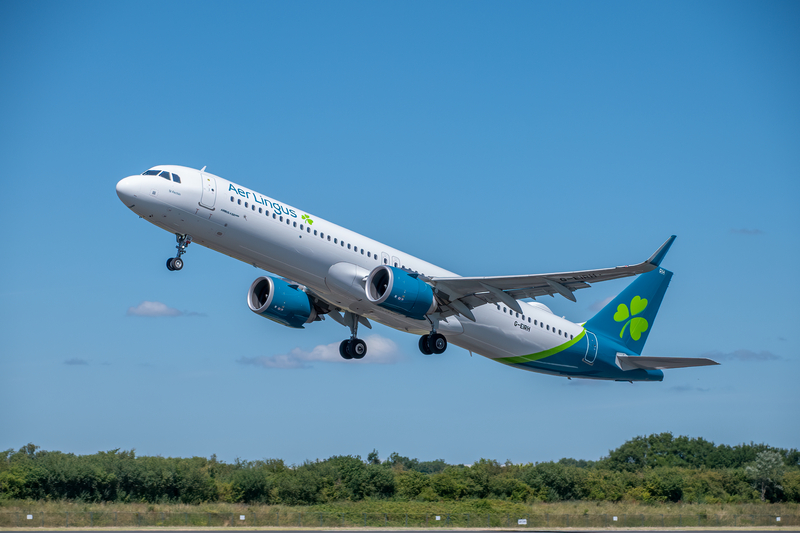
ID 251551051 | Aer Lingus A321 © Craig Russell | Dreamstime.com
The A321XLR Is Central To The Growth
Aer Lingus’ North American expansion depends heavily on Airbus narrowbody long-haul aircraft.
The Airbus A321XLR is especially important. Aer Lingus describes it as the newest aircraft in its fleet, with range of up to 8,700 kilometers and missions of up to 11 hours.
Airbus says Aer Lingus’ A321XLR has 184 seats in a two-class layout. That includes 16 full-flat Business Class seats and 168 Economy seats.
That is exactly the kind of aircraft Aer Lingus needs for thinner U.S. markets.
A widebody may be too large for cities such as Raleigh-Durham (RDU), Nashville (BNA), Indianapolis (IND) or Pittsburgh (PIT). The A321XLR gives Aer Lingus enough range to fly nonstop while keeping seat risk lower than an Airbus A330.
This aircraft is one reason direct U.S. cuts are not a simple assumption.
If the A321XLR is central to the Dublin hub strategy, Aer Lingus will likely protect the routes where the aircraft is doing the job it was purchased for.
The A330 Still Anchors The Bigger Markets
Aer Lingus’ larger transatlantic routes still rely on the Airbus A330.
The A330-300 is the largest aircraft in the Aer Lingus fleet. It is well suited to heavier routes such as Dublin (DUB)–New York JFK (JFK), Dublin–Boston (BOS), Dublin–Chicago (ORD) and other high-demand markets.
The A330-200 has the longest range capability in the fleet and gives the airline additional flexibility on longer or more seasonal missions.
Together, the A330 and A321XLR give Aer Lingus a useful long-haul structure.
The A330 handles larger markets. The A321XLR opens smaller U.S. cities. The A321LR supports medium long-haul routes where demand does not justify a widebody.
This is a strong aircraft mix for a carrier trying to connect Ireland with a broad North American map.
It also gives management options if cuts become necessary. Aer Lingus can adjust frequency, swap aircraft types, or consolidate capacity before exiting a market entirely.
U.S. Preclearance Is A Major Advantage
Aer Lingus has one advantage that most European airlines cannot match: U.S. preclearance in Ireland.
Passengers flying to the United States from Dublin and Shannon can complete U.S. immigration and customs checks before departure. U.S. Customs and Border Protection describes preclearance as the stationing of CBP personnel at foreign airports to inspect travelers before they board U.S.-bound flights.
Aer Lingus promotes Dublin and Shannon as the only locations in Europe where passengers can complete U.S. preclearance before flying.
This is a real competitive advantage.
Passengers arriving in the United States can land as domestic arrivals. That can make onward connections easier and reduce the stress of U.S. border processing after a transatlantic flight.
For Aer Lingus, this supports the Dublin hub.
A passenger can travel from Manchester, Edinburgh, Amsterdam, Paris, Berlin or another European city to Dublin, clear U.S. formalities there, and then arrive in the U.S. without using the international arrivals process.
That is one reason the short-haul network matters so much.
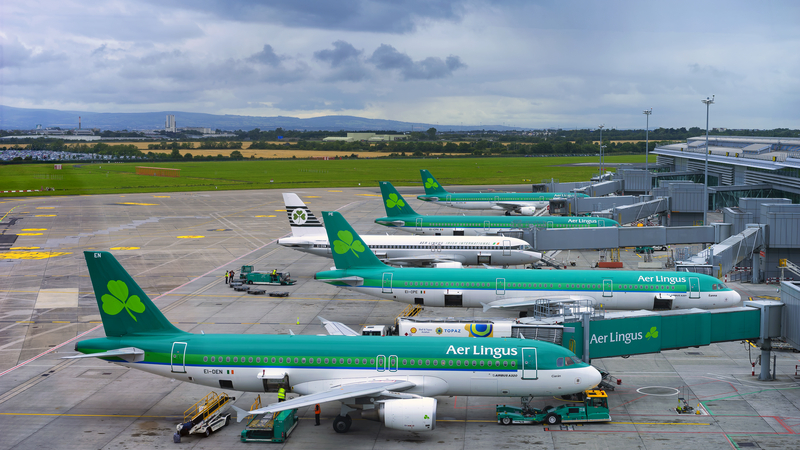
ID 179460041 | Aerlingus © Peter Krocka | Dreamstime.com
The Bigger Risk May Be Feeder Cuts
If Aer Lingus trims its network, the biggest U.S. risk may not be direct route cancellations.
It may be weaker feed.
Aer Lingus’ long-haul flights rely on a mix of Irish local traffic and connecting passengers. Those connecting passengers often come from the United Kingdom and continental Europe.
If Aer Lingus reduces short-haul frequencies, drops weaker European routes or cuts off-peak capacity, the long-haul network could feel the impact.
This is especially important for smaller U.S. markets.
A Dublin–New York flight has large local demand and strong brand recognition. A route such as Dublin–Pittsburgh or Dublin–Raleigh-Durham may depend more heavily on a balanced mix of local passengers, U.S. inbound traffic and European connections.
If feeder flow weakens, the economics of those routes become more exposed.
That is why U.S. routes can be affected even if they are not directly cut.
Manchester Shows Aer Lingus Will Cut Long-Haul If Margins Lag
Aer Lingus has already shown it is willing to cut long-haul flying when the numbers do not work.
The airline confirmed the closure of its Manchester long-haul base by the end of March 2026. That ended its transatlantic operation from Manchester Airport (MAN) to New York, Orlando and Barbados.
The Manchester operation was separate from the core Irish network. It did not have the same strategic value as Dublin or Shannon.
That makes it different from the current U.S. network out of Ireland.
Still, the message is relevant.
Aer Lingus is not keeping every long-haul route simply for footprint. If a market underperforms or fails to meet margin targets, management has shown it will act.
That should make weaker U.S. routes worth watching.
Competition Across The Atlantic Is Intensifying
Aer Lingus is not alone in chasing the North Atlantic.
U.S. and European airlines have added capacity as travel demand recovered. Dublin has also become more competitive, with more transatlantic options and more pressure on fares.
IAG specifically pointed to competition on North Atlantic routes as one factor behind Aer Lingus’ weaker passenger revenues.
That matters because North Atlantic flying is seasonal.
Summer can be very strong. Winter can be much harder. Airlines often make money in peak months and then struggle to maintain acceptable returns in the off-season.
Aer Lingus’ future review may therefore focus on winter flying.
The airline may not need to abandon U.S. destinations. It could instead reduce winter frequencies, shorten seasonal windows, or move aircraft into markets with better returns.
That would be less dramatic than “slashing U.S. routes,” but it could still reshape the network.
Which U.S. Routes Would Be Most Exposed?
Aer Lingus has not identified any U.S. routes for cuts.
Still, aviation logic suggests some routes are more protected than others.
New York JFK, Boston, Chicago, Washington, Orlando, Los Angeles and San Francisco are core markets. They have large demand bases, stronger brand recognition and deeper corporate or leisure traffic.
Shannon–Boston and Shannon–New York are also important because they support western Ireland’s direct U.S. links.
The more exposed routes would likely be thinner, newer or more seasonal markets. That could include routes with lower frequency, weaker winter demand, or heavier dependence on connecting traffic.
However, that does not mean those routes are doomed.
The A321XLR was designed to make exactly those markets possible. If the aircraft performs well and the route has good yields, a smaller U.S. city can still be strategically valuable.
The real test is not route size. It is profitability.
Cuts Could Mean Frequency Changes, Not Route Exits
A “cut” does not always mean an airport disappears from the map.
Airlines have many ways to reduce capacity.
Aer Lingus could reduce a daily flight to five weekly. It could shorten a seasonal route. It could move a widebody market to an A321XLR. It could reduce shoulder-season flying while keeping peak-summer service intact.
Those moves would still be meaningful.
They would reduce seats, affect schedules and change customer options. But they would not necessarily mean Aer Lingus is retreating from the U.S.
This is important for readers.
A headline about “slashing U.S. routes” may overstate what is currently known. The confirmed information points to a cost and schedule review. It does not yet point to a published list of U.S. route eliminations.
Dublin Airport Capacity Is Another Factor
Aer Lingus also faces uncertainty at Dublin Airport.
The airport’s passenger cap has been a major issue for airlines, airport management and regulators. Reuters reported earlier this year that Aer Lingus warned of potential U.S. retaliation if the cap was not resolved.
That dispute is separate from the airline’s internal cost review, but it adds pressure.
Dublin is the center of Aer Lingus’ transatlantic strategy. If airport capacity or regulatory constraints limit growth, the airline may need to choose more carefully which routes get slots and aircraft.
That could make network decisions even more selective.
For Aer Lingus, DUB is the machine that makes the North Atlantic strategy work. Anything that affects Dublin’s capacity, costs or connectivity can affect the wider network.
Why U.S. Routes Are Still Likely To Be Protected
Despite the pressure, Aer Lingus has strong reasons to protect its U.S. operation.
The transatlantic network is part of IAG’s broader North Atlantic strategy. It gives the group a different kind of platform from British Airways at London Heathrow and Iberia at Madrid.
Aer Lingus can serve thinner U.S. cities through Dublin. It can use preclearance. It can connect passengers from the UK and Europe. It can operate smaller long-haul aircraft efficiently.
That is a distinctive role inside IAG.
Cutting too deeply into the U.S. network would weaken one of Aer Lingus’ clearest strategic advantages.
A more likely outcome is targeted pruning.
The airline may reduce less profitable flying, adjust winter capacity, or shift aircraft between routes. It may also look for labor and management savings before cutting the long-haul network too aggressively.
What To Watch Next
The next schedule updates will matter.
The clearest signals will come from winter 2026/2027 filings and the first version of summer 2027 schedules.
Watch for reduced weekly frequencies on smaller U.S. routes. Also watch for shorter operating seasons, aircraft swaps, and changes in short-haul European feed into Dublin.
The short-haul changes may be just as important as the long-haul ones.
If Aer Lingus cuts European routes that feed North America, the impact could show up later in U.S. load factors and yields.
For now, the airline’s public 2026 North America strategy remains ambitious. The cost review may change that, but it has not yet produced confirmed U.S. route exits.
Bottom Line
Aer Lingus is under real pressure.
The airline reported a €103 million first-quarter operating loss in 2026, and management has warned that future winter and summer schedules could be smaller than recent levels. Reports also suggest IAG wants stronger margins from the Irish carrier.
But it is too early to say Aer Lingus is preparing to slash U.S. routes.
North America remains central to the airline’s strategy. Aer Lingus has built its largest-ever transatlantic schedule, added new U.S. markets, expanded frequencies and invested in the Airbus A321XLR to make thinner long-haul routes work.
The bigger risk may be indirect.
If Aer Lingus cuts short-haul flying, reduces European feed or trims winter capacity, the economics of some U.S. routes could weaken. Smaller and newer markets would be the ones to watch most closely.
For now, the story is not a confirmed U.S. retreat.
It is a profitability review at an airline whose most important growth engine is also facing tougher competition.