A ceremonial water cannon salute for Iberia’s Airbus A350 at Guayaquil ended with aircraft damage, a canceled long-haul flight, and an avoidable operational headache for passengers traveling to Madrid.

The incident occurred on June 4, 2026, at José Joaquín de Olmedo International Airport (GYE) in Guayaquil, Ecuador, as Iberia Airbus A350-941 EC-NXD was preparing to operate flight IB132 to Adolfo Suárez Madrid-Barajas Airport (MAD). During a traditional water arch conducted by airport fire vehicles, the aircraft’s left wingtip contacted part of an elevated fire-service vehicle assembly.
The aircraft returned to the stand for inspection, emergency protocols were activated, and the scheduled Guayaquil (GYE) to Madrid (MAD) departure was suspended. No injuries were reported among passengers, crew, or ground personnel.
Read our stories in your inbox
Two aviation newsletters. Zero fluff.
For Iberia, the timing was especially unfortunate. The A350 had been temporarily introduced on the Guayaquil route, replacing the Airbus A330 that normally serves the market. What should have been a promotional moment for Iberia’s flagship long-haul aircraft instead became a reminder that even ceremonial ramp activity around widebody aircraft leaves very little room for error.
A Water Salute Turns Into A Ground Incident
The aircraft involved, EC-NXD, had arrived in Guayaquil (GYE) earlier in the day and was later preparing for the return flight to Madrid (MAD) as IB132.
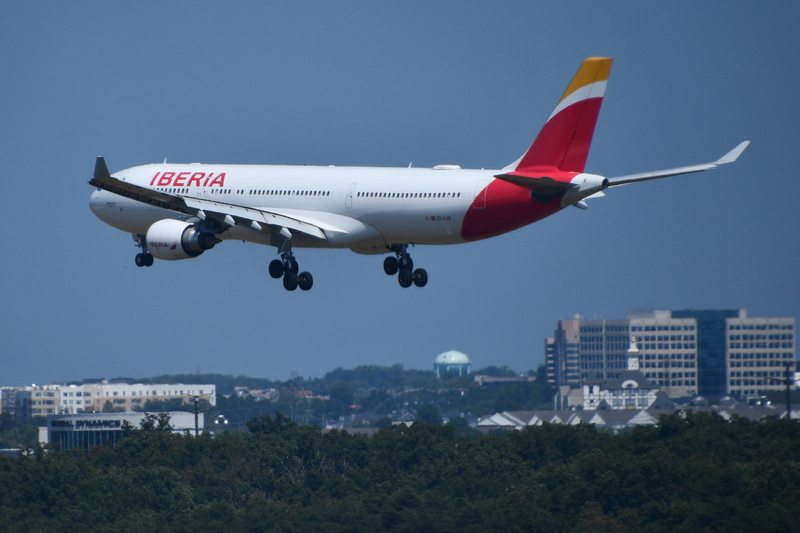
The airport’s concessionaire said Iberia had brought a new aircraft type to Guayaquil and requested a water arch. During the ceremony, the A350 taxied between fire-service vehicles spraying water over the aircraft. As the jet moved through the arch, the left wingtip made contact with the raised arm or turret of one of the firefighting vehicles.
The crew then returned the aircraft to the platform so technical personnel could evaluate the damage.
That sequence matters. This was not an in-flight event, not a runway excursion, and not a landing accident. It was a ground-handling and airport-operations incident involving a widebody aircraft and emergency-service equipment positioned close to the taxi path.
The aircraft’s return to Madrid could not proceed until engineers inspected the wingtip and confirmed whether the damage affected airworthiness.
Why A Winglet Strike Grounds An A350
At first glance, a winglet may look like a small piece of the aircraft compared with the fuselage, engines, or landing gear. In reality, damage to a wingtip device on a modern long-haul aircraft is treated seriously.
The Airbus A350’s wingtip is part of the aircraft’s aerodynamic design. It helps reduce induced drag by managing wingtip vortices, improving long-haul fuel efficiency and overall performance. On a route such as Guayaquil (GYE) to Madrid (MAD), where the aircraft is operating a long transatlantic sector, even small aerodynamic and structural considerations matter.
The bigger issue, however, is not fuel burn. It is structural integrity.
A visible strike to the wingtip requires inspection of the composite structure, attachment points, surrounding wing skin, lighting systems, wiring, and any adjacent aerodynamic surfaces. Engineers must determine whether the damage is superficial, repairable locally, or significant enough to require replacement components or a more substantial repair.
On a modern composite aircraft such as the A350, repairs must follow approved procedures. Even if the aircraft appears mostly intact from passenger-window distance, maintenance teams cannot simply clear it for a long-haul flight without a detailed assessment.
That is why canceling IB132 was the safe and correct operational decision.
The Aircraft: Iberia Airbus A350-941 EC-NXD
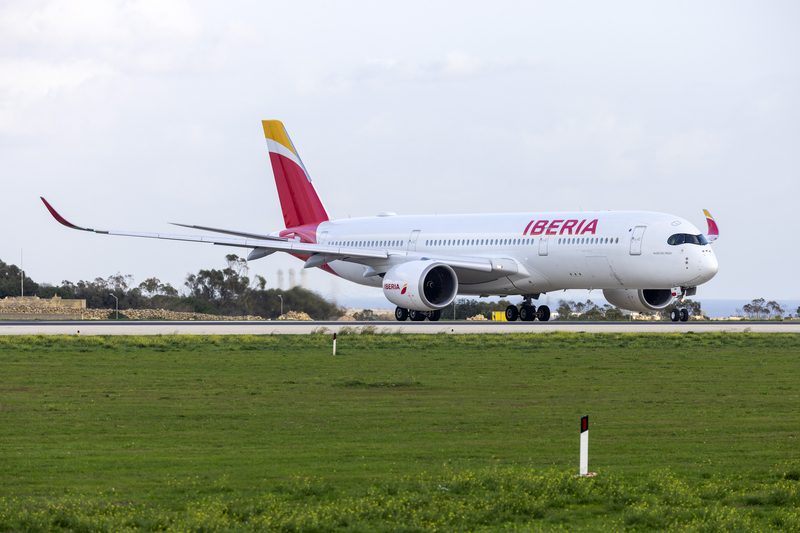
EC-NXD is an Airbus A350-900, officially an A350-941 variant, in Iberia’s long-haul fleet.
The A350 is Iberia’s flagship long-haul aircraft and is used on many of the airline’s most important intercontinental routes. Iberia lists the aircraft with 348 seats, a range of 12,300 kilometers, and a wingspan of 64.75 meters. That wingspan is an important detail in this incident. A nearly 65-meter-wide aircraft requires precise clearance when taxiing near vehicles, equipment, terminal infrastructure, or ceremonial installations.
The A350 is powered by Rolls-Royce Trent XWB engines and is built with extensive use of composite materials. It is more fuel efficient and quieter than previous-generation widebodies, and it has become central to Iberia’s long-haul modernization strategy.
Iberia had temporarily deployed the A350 on the Guayaquil route, which is normally associated with Airbus A330 operations. The A350’s arrival was therefore a noteworthy moment for the airport and the airline’s Ecuador operation.
Unfortunately, the water salute meant to highlight that upgraded aircraft type became the reason the return flight did not depart.
Passenger Disruption On The Madrid Flight
The canceled return flight to Madrid (MAD) created immediate disruption for passengers booked on IB132.
Local reporting said the aircraft was full at the time of the planned international departure, though Iberia had not publicly confirmed an exact passenger count. The cancellation affected travelers with onward connections, hotel bookings, business plans, and other arrangements in Europe.
For passengers on a long-haul route, this type of disruption can be especially difficult. Guayaquil (GYE) does not have the same depth of Europe-bound nonstop alternatives as larger Latin American gateways such as Bogotá (BOG), Lima (LIM), São Paulo (GRU), Mexico City (MEX), or Buenos Aires (EZE). Reaccommodating passengers may require rerouting through Madrid on a later Iberia service, connecting through another Latin American gateway, or using partner airline itineraries.
Iberia’s immediate task would have been to protect passengers and recover the schedule. That includes rebooking travelers, arranging accommodations where required, managing missed connections, and determining when the damaged A350 could return to service or be repositioned.
For the airline, the costs include more than the physical repair. There are passenger-care expenses, missed revenue, crew and aircraft-rotation disruption, and the operational burden of having a long-haul aircraft unavailable outside its home base.
Water Cannon Salutes Are Symbolic But Not Risk-Free
Water cannon salutes are one of aviation’s most familiar traditions.
Airports use them to mark inaugural flights, aircraft type debuts, route anniversaries, airline milestones, pilot retirements, and other special events. Fire vehicles position on either side of the taxiway or stand area, spray water over the aircraft, and create a ceremonial arch as the aircraft passes through.
When properly coordinated, the practice is routine. But it depends on clearances, positioning, aircraft size, taxi speed, crew awareness, and vehicle placement. The larger the aircraft, the smaller the margin for error.
That is the key issue in Guayaquil.
The Airbus A350 is a large widebody aircraft. Its 64.75-meter wingspan is close to the scale of a Boeing 777 and larger than many aircraft routinely handled at some airports. A fire truck positioned too close to the taxi path, or an elevated water cannon arm extending into the wingtip clearance envelope, can quickly become a hazard.
This was not a high-speed collision. It did not involve a runway incursion or loss of aircraft control. But it still damaged a long-haul aircraft and canceled an international flight.
The Clearance Problem
Widebody ground operations depend on exact spacing.
Taxiway centerlines, stand markings, service roads, vehicle stop lines, marshallers, wing walkers, and ground equipment positions all exist because the aircraft’s extremities can be difficult to judge from the cockpit. Pilots sitting near the nose of a large aircraft cannot directly see the wingtip in the way a driver sees the corners of a car.
That is why the responsibility for wingtip clearance is shared. The flight crew must taxi along the cleared path, but ground teams and airport vehicles must ensure the path is actually clear.
During ceremonial operations, that discipline becomes even more important. A water arch is not part of routine taxiing. It introduces fire vehicles and elevated equipment into an area where they would not normally be positioned so close to a moving aircraft.
The Guayaquil incident suggests that the clearance between the A350’s wingtip and the fire-service vehicle was misjudged. Whether the issue was vehicle positioning, taxi guidance, procedural planning, communication, or another factor is something investigators will need to determine.
Why This Matters For Airport Operations
This incident is a good example of how non-essential airport activities can create operational risk.
A water cannon salute is ceremonial. It does not help the aircraft operate safely. It does not improve passenger service. It does not reduce delay. Its purpose is symbolic and promotional.
That does not mean airports should never do them. But it does mean the safety case must be treated seriously. Aircraft size, taxi route, vehicle type, water cannon height, stand geometry, wingtip clearance, and communication procedures all need to be planned in advance.
Airports that regularly handle widebodies may have well-established procedures for water salutes. Smaller or less frequent widebody stations need to be especially careful when a larger aircraft type is introduced, as was the case with Iberia’s A350 in Guayaquil.
The lesson is not that the tradition is inherently unsafe. The lesson is that it must be treated as an aircraft ground movement with equipment positioned nearby — not as a harmless photo opportunity.
A Costly Aircraft To Have Stuck Away From Base
Grounding an Airbus A350 away from its main maintenance base can become expensive quickly.
If the damage is minor and within local repair capability, Iberia may be able to return the aircraft to service after inspection and corrective work. If the damage requires parts, specialist composite repair, Airbus engineering support, or ferry-flight approval, the timeline becomes more complicated.
The aircraft is also not easy to replace. A long-haul widebody assigned to Ecuador is part of a larger rotation plan. If EC-NXD remains in Guayaquil (GYE), Iberia may need to substitute another aircraft, alter schedules, or adjust fleet planning on other long-haul routes.
Iberia’s A350 fleet is heavily used across its intercontinental network from Madrid (MAD), including routes to the Americas. Losing one aircraft for even a short period can create knock-on effects across the schedule.
That is why the damage is more consequential than the visual size of the winglet might suggest.
No Evidence Of A Flight Crew Error Yet
It is important not to assign blame before the investigation is complete.
The available reporting shows that the A350’s wingtip contacted the arm or turret of a fire-service vehicle during the ceremonial water arch. That points to a clearance and coordination problem, but the specific cause remains to be determined.
Investigators will likely review video, aircraft taxi path, fire truck position, vehicle clearances, airport procedures, communications, marshalling instructions, and whether the water salute had been approved and coordinated according to local operating rules.
The crew’s decision to return to the platform after the contact was appropriate. Once the wingtip was damaged, continuing with a long-haul transatlantic flight would not have been acceptable without inspection.
The investigation should focus on how the aircraft and vehicle came into contact, not on speculation.
A350 Deployment Shows Iberia’s Ecuador Commitment
The incident should not obscure the larger commercial context: Iberia remains an important carrier between Ecuador and Spain.
Madrid (MAD) is one of the most important European gateways for Latin America, and Iberia has long used its hub to connect Spain with South America. Guayaquil (GYE) and Quito (UIO) are both important Ecuadorian markets, supported by a mix of business, visiting-friends-and-relatives, tourism, and connecting demand.
The temporary use of the A350 on the Guayaquil route signaled added capacity and product enhancement. Compared with the A330, the A350 offers a newer cabin, better fuel efficiency, and a higher-profile passenger experience.
That is why the water salute was arranged in the first place. The airport and airline were marking a notable aircraft upgrade.
The operational irony is that the ceremony intended to celebrate the A350’s arrival directly caused the aircraft to be grounded.
Bottom Line
Iberia Airbus A350-941 EC-NXD was damaged at Guayaquil José Joaquín de Olmedo International Airport (GYE) on June 4, 2026, when its left wingtip contacted the elevated arm of a fire-service vehicle during a ceremonial water cannon salute.
The aircraft was preparing to operate IB132 from Guayaquil (GYE) to Madrid (MAD). After the strike, the crew returned to the platform for inspection, emergency protocols were activated, and the long-haul return flight was canceled. No injuries were reported.
The incident is a reminder that ceremonial airport events still require the same discipline as any other aircraft movement. An Airbus A350 has a wingspan of nearly 65 meters, and even a small misjudgment in vehicle positioning can damage a high-value widebody aircraft.
For Iberia, the cost includes aircraft downtime, repairs, passenger disruption, and the loss of a Madrid-bound long-haul rotation. For Guayaquil Airport, the investigation will likely focus on fire vehicle positioning, wingtip clearance, and coordination procedures.
A water cannon salute is supposed to be a welcome. In this case, it became the reason Iberia’s flagship aircraft could not leave.
Keep reading FlyMag
Get the Daily Brief in the morning or the Route Watch weekly recap on Fridays. Or both.