Smartwings Adds Venice And Bergen As Prague Winter Network Push Continues
Smartwings is adding two more European routes from Prague for the 2026/2027 winter season, with new nonstop service from Václav Havel Airport Prague (PRG) to Venice Marco Polo Airport (VCE) and Bergen Airport, Flesland (BGO).

The additions strengthen the Czech carrier’s scheduled network from Prague (PRG) at a time when Smartwings is clearly working to broaden its winter flying beyond the traditional sun-and-leisure markets that have long defined much of its operation.
The new Prague (PRG)–Venice (VCE) service is scheduled to begin on October 22, 2026, with four weekly flights. Prague (PRG)–Bergen (BGO) will follow on October 26, 2026, operating twice weekly. Tickets are already being promoted through Smartwings’ sales channels, with the airline positioning both routes as part of a wider winter expansion from the Czech capital.
Venice Brings A Strong Short-Haul Leisure Market From Prague
The Prague (PRG)–Venice (VCE) route is the more conventional of the two additions, but it is also the easier one to understand commercially.
Venice remains one of Europe’s most durable city-break markets, drawing leisure demand throughout the year rather than only during the summer peak. For Czech travelers, a nonstop flight from Prague (PRG) to Venice Marco Polo (VCE) offers a fast alternative to long surface travel or one-stop itineraries through larger hubs such as Vienna (VIE), Munich (MUC), Frankfurt (FRA), or Zurich (ZRH).

Smartwings lists Venice Marco Polo Airport (VCE) as the airport for the route, which is important because Venice is served by more than one airport in the broader region. Marco Polo (VCE) is the primary airport for Venice itself and is significantly closer to the city than Treviso (TSF), which is more commonly associated with low-cost traffic.
The sector is short, at roughly 540 kilometers from Prague (PRG) to Venice (VCE). That makes it an easy fit for Smartwings’ narrowbody fleet and an efficient aircraft-utilization opportunity. On a route of this length, the commercial challenge is less about aircraft performance and more about frequency, pricing, distribution, and whether the airline can capture enough winter city-break demand outside peak holiday periods.
Four weekly flights give Smartwings a meaningful presence without overcommitting capacity. For a leisure-heavy city pair, that frequency is enough to support long weekends, midweek travel, and package demand while still allowing the airline to manage weaker winter shoulder periods.
Bergen Opens A More Distinctive Northern Market
The new Prague (PRG)–Bergen (BGO) service is more strategically interesting.

Bergen Airport, Flesland (BGO) is the primary airport serving Bergen and western Norway. The city is widely marketed as the gateway to the Norwegian fjords, and for aviation planners it represents a different kind of market from Venice. Bergen (BGO) is not simply another Mediterranean or southern European leisure add. It gives Smartwings a northern European destination with strong inbound tourism appeal, outdoor travel demand, cruise-related traffic, and potential city-break demand from both ends of the route.
Smartwings lists the Prague (PRG)–Bergen (BGO) distance at approximately 1,270 kilometers. That still sits comfortably within short- to medium-haul narrowbody territory, but it is long enough to be a more substantial winter route than Venice (VCE). The twice-weekly schedule suggests Smartwings is entering carefully, testing demand without flooding the market.
Bergen (BGO) also helps diversify Prague’s winter connectivity. From a network standpoint, it gives Václav Havel Airport Prague (PRG) a nonstop link to western Norway rather than relying entirely on one-stop connections through Nordic or Central European hubs. For Czech outbound travelers, the appeal is obvious: direct access to fjord country, winter scenery, and Norway’s western coast. For inbound travelers, Prague remains one of Europe’s strongest short-break cities, with year-round demand supported by culture, architecture, events, and competitive hotel pricing compared with many Western European capitals.
A Winter Schedule Built Around More Than Charter Flying
The two new routes fit into a broader Smartwings strategy that has become increasingly clear over the last two winter seasons.

Smartwings has historically been heavily associated with leisure and charter flying, particularly to Mediterranean, North African, Middle Eastern, and island destinations. That business remains important, but the carrier has also been expanding its scheduled European network from Prague (PRG), especially in winter, when pure holiday flying is more seasonal.
For the 2026/2027 winter schedule, Smartwings has already announced new Prague (PRG)–Lisbon (LIS) flights from October 23, 2026, alongside higher frequencies from Prague (PRG) to Porto (OPO), Bilbao (BIO), and Toulouse (TLS). Nice (NCE), previously more summer-oriented, is also being carried into year-round service.
That matters because it shows this is not a one-off Venice or Bergen experiment. Smartwings is building a broader winter proposition from Prague (PRG), using a mix of western European city markets, leisure destinations, and secondary business-leisure routes to improve off-season aircraft productivity.
For an airline with a large narrowbody fleet, winter utilization is critical. Aircraft that are heavily used in summer charter programs must still produce revenue in the quieter months. Scheduled European city pairs can help smooth that seasonality, particularly when the airline can sell through both direct channels and tour-operator relationships.
Aircraft Context: A Natural Fit For Smartwings’ 737 Fleet
Smartwings has not publicly confirmed a specific aircraft type for the Venice (VCE) or Bergen (BGO) routes in the material reviewed, so it would be premature to state that either city pair will definitely be operated by a particular aircraft.
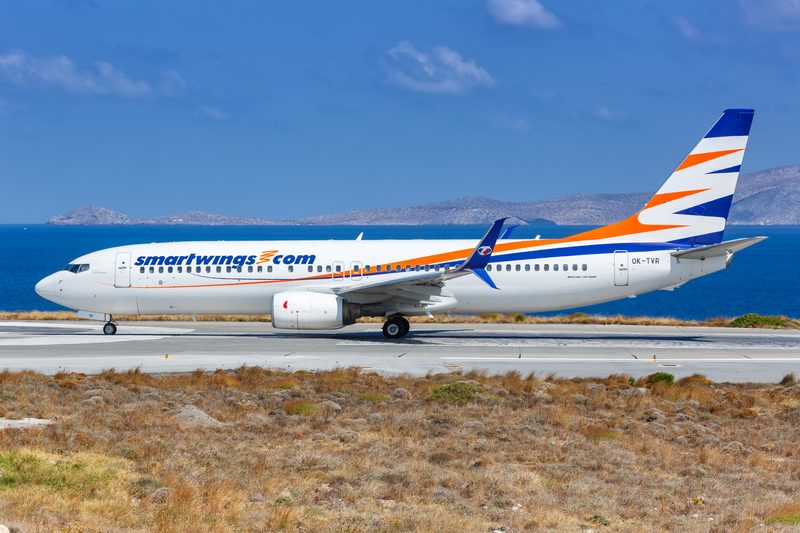
However, both sectors are a natural fit for Smartwings’ Boeing 737-family operation. The carrier’s fleet includes Boeing 737-800, Boeing 737-900ER, and Boeing 737 MAX 8 aircraft, with the 737-800 and 737 MAX 8 forming the backbone of many Smartwings short- and medium-haul services.
The Boeing 737 MAX 8 gives Smartwings more than enough performance for these routes. The airline lists the type with a range of 6,584 kilometers, a maximum cruising speed of Mach 0.82, and commonly used configurations including 189 economy seats or a mixed layout with 18 business-class seats and 150 economy seats.
For Prague (PRG)–Venice (VCE), the aircraft capability is far beyond what is required. The route is short enough that airport charges, turnaround efficiency, and load factor will likely matter more than fuel range or cruise performance. Prague (PRG)–Bergen (BGO), while longer, is still comfortably inside the operating envelope of Smartwings’ 737 fleet.
The larger question will be capacity. A 189-seat 737 on a twice-weekly Bergen (BGO) route is a very different revenue proposition from a smaller regional aircraft. Smartwings will need to stimulate leisure demand, work group and package traffic effectively, and price the route carefully during the weaker parts of winter.
Prague’s Role As Smartwings’ Scheduled Base Keeps Growing
Václav Havel Airport Prague (PRG) is central to the strategy. Prague is not a megahub like Frankfurt (FRA), Paris Charles de Gaulle (CDG), or Amsterdam Schiphol (AMS), but it has a strong local catchment, a powerful inbound tourism brand, and limited direct competition on many thinner European routes.
That creates an opening for Smartwings. By adding routes such as Venice (VCE), Bergen (BGO), Lisbon (LIS), Porto (OPO), Bilbao (BIO), Toulouse (TLS), and year-round Nice (NCE), the airline can position Prague (PRG) as a more useful nonstop gateway for Czech travelers while also bringing more inbound visitors directly into the Czech market.
The strategy also reflects the changed Czech aviation landscape. With the historic Czech Airlines brand no longer operating as it once did, Smartwings has effectively become the most visible Czech airline brand in scheduled international service. That gives the company an opportunity, but also a responsibility, to build a Prague-based network that goes beyond seasonal holiday traffic.
The Venice (VCE) and Bergen (BGO) additions show how Smartwings is approaching that role. Venice is a proven, high-recognition leisure market with year-round appeal. Bergen is more niche, but potentially higher-yielding if it captures fjord tourism, city-break demand, and travelers looking for nonstop access between Czechia and western Norway.
Competitive And Market Implications
The Prague (PRG)–Venice (VCE) market is likely to be price-sensitive. Venice is a well-known destination, and travelers can compare nonstop, one-stop, rail, bus, and self-drive options depending on trip length and budget. Smartwings’ advantage will be convenience, particularly if it can offer attractive timings and maintain enough frequency to support short breaks.
Bergen (BGO) is different. The route is less about mass-market frequency and more about creating a nonstop option where passengers would otherwise connect. That can give Smartwings more pricing power, but only if the route is marketed effectively and if demand from both ends is strong enough.
From Prague Airport’s perspective, both additions are valuable. Venice (VCE) adds depth to southern European connectivity, while Bergen (BGO) improves access to Norway and the wider Nordic leisure market. Together, they help Prague (PRG) look less seasonal and more balanced during the winter timetable.
Bottom Line
Smartwings’ new Prague (PRG) flights to Venice (VCE) and Bergen (BGO) are small additions individually, but they are part of a much larger shift in the airline’s winter network strategy.
Venice (VCE) gives Smartwings a proven, short-haul leisure market with strong city-break demand. Bergen (BGO) adds a more distinctive northern destination and creates a direct link between Prague and western Norway’s fjord region.
The airline has not confirmed the exact aircraft type for these routes, but both fit comfortably within Smartwings’ Boeing 737-family operation, including the 737-800 and 737 MAX 8 aircraft that underpin much of its European flying.
For Prague (PRG), the bigger story is connectivity. Smartwings is steadily adding scheduled winter flying to markets that can help reduce seasonality, improve aircraft utilization, and give Czech travelers more nonstop options. Venice and Bergen may not be the largest routes in the network, but they show a carrier increasingly focused on making Prague a more useful year-round European base.