S7 Boeing 737 Overruns Runway At Mirny As Russian Carrier Faces Renewed Scrutiny
An S7 Airlines Boeing 737-800 overran the runway after landing at Mirny Airport in Russia’s Sakha Republic, bringing renewed attention to the airline’s flight operations just days after reports emerged of a highly unusual internal landing restriction affecting many first officers.

The aircraft was operating flight S7 5241 from Novosibirsk Tolmachevo Airport (OVB) to Mirny Airport (MJZ) on June 30 when it exited the runway after landing. All 173 passengers and six crew members onboard were reported safe, and no injuries were announced.
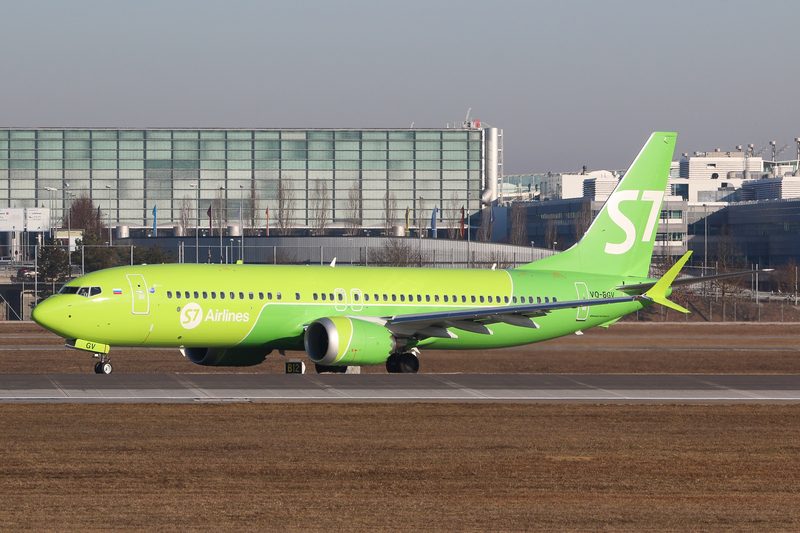
The aircraft involved has been identified as RA-73359, a Boeing 737-800, one of the most widely used narrowbody aircraft in commercial service. S7 Airlines confirmed that passengers were disembarked using mobile stairs after the aircraft came to a complete stop, while the crew was temporarily removed from flying duties pending the airline’s internal review.
Russian aviation authorities have classified the event as a serious aviation incident, and an official investigation is now underway.

What Happened At Mirny (MJZ)
Flight S7 5241 was operating a domestic service from Novosibirsk (OVB), one of S7’s main bases, to Mirny (MJZ), a remote but strategically important city in Yakutia.
After landing at Mirny Airport (MJZ), the Boeing 737-800 left the paved runway surface and came to rest beyond the runway area. Images released by Russian transport prosecutors showed the aircraft on the ground beyond the runway environment, with emergency and airport personnel responding.
S7 said that after the aircraft came to a complete stop, the captain acted in accordance with established procedures. Passengers were then removed from the aircraft using mobile stairs rather than emergency slides, which suggests the evacuation was controlled rather than a rapid emergency slide evacuation.
Mirny Airport (MJZ) was temporarily closed for aircraft arrivals and departures while the runway and aircraft position were assessed. That closure matters because Mirny is not a large multi-runway hub. When an aircraft is disabled on or near the runway environment, airport operations can be affected quickly.
View this post on Instagram
The Aircraft: S7’s Boeing 737-800
The aircraft involved was a Boeing 737-800, registration RA-73359.
The 737-800 is part of Boeing’s 737 Next Generation family and remains one of the most common narrowbody aircraft in the world. Boeing lists the 737-800 with typical two-class seating of 160 to 180 passengers, a maximum passenger capacity of 189, a maximum takeoff weight of 174,200 pounds, and a range of up to 2,800 nautical miles.
S7’s own 737-800 configuration is listed with 176 seats: 8 in Business Class and 168 in Economy Class. The airline lists the aircraft with a cruising speed of 840 km/h and a maximum range of 5,765 km. That makes the type more than capable of operating the roughly three-hour domestic sector between Novosibirsk (OVB) and Mirny (MJZ).
In other words, the aircraft type itself was appropriate for the mission. The investigation will need to determine why the aircraft did not stop within the available runway distance after landing.
A runway overrun can involve many possible contributing factors, including touchdown point, approach speed, tailwind, runway contamination, braking performance, autobrake or manual braking use, reverse-thrust performance, aircraft weight, flap setting, runway condition reporting, pilot technique, or a technical malfunction. At this stage, no final cause has been established.
Why Mirny Is An Important Airport
Mirny (MJZ) is a remote airport serving one of Russia’s most important diamond-producing regions.
The city of Mirny is closely associated with the diamond industry and the nearby Mir mine, one of the most famous open-pit diamond mines in the world. Because of the region’s geography and limited surface transportation alternatives, air service is especially important for passenger movement, industrial activity, and essential connectivity.
That gives the airport a role beyond ordinary scheduled passenger service. In a remote region such as Yakutia, an aircraft incident that temporarily closes the airport can affect workers, residents, business travel, cargo movement, and onward connections.
Mirny Airport (MJZ), also known by its ICAO code UERR, is not a major international hub, but it handles medium-sized aircraft and scheduled domestic service. For S7, the route from Novosibirsk (OVB) links a major Siberian hub with a remote resource-driven city that depends heavily on air access.
Rosaviatsiya Opens Serious Incident Investigation
Russia’s Federal Air Transport Agency, Rosaviatsiya, classified the overrun as a serious aviation incident. That classification means the event will be examined in detail even though there were no injuries.
Runway excursions are taken seriously because the outcome can vary dramatically. In the best cases, an aircraft leaves the runway at low speed and passengers walk away. In the worst cases, an overrun can lead to structural damage, collapsed landing gear, fire, collision with terrain or obstacles, injuries, or fatalities.
Investigators will likely review flight data recorder information, cockpit voice recordings, weather reports, runway condition reports, aircraft maintenance history, braking-system data, pilot actions, touchdown location, speed at touchdown, thrust reverser deployment, autobrake settings, and air traffic control communications.
The aircraft will also require a detailed inspection. Even if a runway excursion appears low-energy, landing gear, tires, brakes, fuselage structure, engines, and lower airframe areas can be exposed to loads and debris that require maintenance assessment before the aircraft can return to service.
S7’s Internal Review And Crew Stand-Down
S7 Airlines said it has opened its own internal investigation into the event. The airline also temporarily removed the crew from flight duties in line with its internal procedures.
That step should not automatically be read as a finding of fault. It is common for crews involved in serious incidents to be stood down while the airline and authorities gather facts, review data, and determine whether additional training, medical checks, interviews, or operational reviews are needed.
In a landing overrun investigation, the crew’s actions will be only one part of the picture. Investigators will also examine aircraft systems, runway conditions, weather, airport infrastructure, performance calculations, dispatch data, and any relevant technical issues.
The key point is that the investigation is still at an early stage. Until official findings are released, it would be premature to attribute the overrun to pilot error, aircraft malfunction, runway condition, or S7’s broader operational policies.
The First Officer Landing Restriction Adds Context, Not Causation
The timing of the Mirny overrun is drawing attention because it came shortly after reports that S7 Airlines had temporarily restricted most first officers from performing landings at many airports.
According to those reports, the restriction runs from June 1 to October 1 and requires captains to physically perform landings at most destinations, with exceptions for certain major S7 bases and training or check flights. The policy was reportedly introduced after a rise in hard landings that exceeded aircraft vertical-load limits and triggered additional inspections.
That is an unusually blunt operational measure. In normal airline practice, first officers regularly perform landings as part of line flying. This is essential for maintaining proficiency, developing experience, and preparing for eventual captain upgrade. A broad restriction on first-officer landings is therefore notable and suggests the airline is prioritizing aircraft preservation, maintenance avoidance, and operational stability.
However, there is currently no evidence that the Mirny (MJZ) overrun is linked to that policy. The two events should not be merged into a single causal story unless investigators establish a connection.
The policy is relevant because it provides context about the operational pressures surrounding S7. It does not explain the overrun by itself.
Why Hard Landings Matter More In Russia’s Current Environment
Hard landings are not only a passenger-comfort issue. They can create significant maintenance consequences.
When an aircraft lands with vertical loads above specified limits, the operator may need to perform structural inspections before the aircraft can be released back into service. Those inspections can involve landing gear, fuselage structure, wing attachments, engine mounts, and other load-bearing components. If damage is suspected or found, the aircraft can remain grounded for an extended period.
For airlines operating in normal supply-chain conditions, that is costly and inconvenient. For Russian airlines operating Western-built aircraft under sanctions, it can be more consequential.
Since 2022, Russian carriers have faced restricted access to official Airbus and Boeing technical support, original spare parts, maintenance documentation, leasing channels, and Western service networks. That does not mean every Russian aircraft is unsafe or that every incident is sanctions-related. It does mean that preserving airframe availability has become more strategically important for Russian airlines.
In that context, an airline policy aimed at reducing hard landings becomes easier to understand. If every excessive landing load can remove an aircraft from service and create difficult maintenance demands, management may try to reduce those events quickly.
The tradeoff is pilot development. If first officers are not allowed to land regularly, they may lose real-world landing practice at exactly the time when the airline needs strong crew resilience.
Runway Excursions Are Rare, But Complex
A runway overrun after landing is rarely explained by one factor.
A Boeing 737-800 can stop safely on runways much shorter than many major commercial runways when the approach is stabilized, the touchdown point is correct, the runway condition is accurately known, and the aircraft’s braking and deceleration systems perform as expected. But if several margins shrink at once, an overrun can develop quickly.
A slightly long touchdown, a higher-than-planned approach speed, reduced braking action, a tailwind, delayed reverse thrust, or a braking-system issue may not be decisive alone. Combined, they can erode the stopping margin.
Remote airports add another layer. Weather reporting, runway condition assessment, maintenance response, rescue equipment, and operational alternates can all be more limited than at major hubs. That makes performance planning and conservative decision-making especially important.
For Mirny (MJZ), investigators will need to reconstruct not only the aircraft’s final landing roll, but also the conditions that shaped the crew’s landing decision before touchdown.
The Boeing 737-800 Remains A Core Workhorse
The 737-800’s involvement should not be misread as an indictment of the aircraft type.
The Boeing 737-800 is one of the most widely used commercial aircraft in the world and has operated millions of flights across every kind of environment: short domestic sectors, charter flights, high-density leisure routes, challenging terrain airports, hot-and-high fields, and remote regional services.
For S7, the 737-800 is a logical aircraft for domestic Russian flying. It offers more capacity than smaller regional jets, lower trip cost than a widebody, and enough range for long domestic sectors across Siberia and the Russian Far East.
The investigation will focus on this specific landing, aircraft, crew, weather, airport, and operational context. Broad conclusions about the 737-800 would be inappropriate unless evidence points to a type-specific issue.
The Airline’s Larger Fleet Challenge
S7 is one of Russia’s most important private airlines, and its network has long relied on Western-built aircraft, including Boeing 737s and Airbus A320-family jets.
That fleet structure has become more complicated under sanctions. Russian operators have had to adapt to an environment where parts, inspections, leased-aircraft ownership issues, software support, and manufacturer-linked maintenance channels are far more difficult than they were before 2022.
This does not mean the Mirny overrun was caused by sanctions. The investigation may ultimately find a technical issue, runway condition factor, operational error, environmental factor, or a combination unrelated to supply chains.
But the broader pressure matters. When airlines are operating in a constrained maintenance environment, every landing incident, hard landing, bird strike, engine event, or runway excursion can have a larger operational impact. Aircraft availability becomes a strategic asset.
That is why the reported first-officer landing restriction and the Mirny overrun are being discussed together. One is a policy response to landing-related maintenance risk. The other is a serious landing-related incident. The connection is not established, but the shared theme is operational stress around aircraft preservation.
What To Watch Next
The most important next step will be the official investigation.
Key questions include where the aircraft touched down, what speed it carried across the threshold, whether the approach was stabilized, what braking action was reported, whether the runway was contaminated, whether reverse thrust deployed normally, whether autobrake or manual braking was used as expected, and whether any technical faults were recorded.
The investigation will also need to determine whether airport infrastructure or runway condition reporting played any role. In runway excursion cases, the airport side of the operation can be just as important as the aircraft side.
The condition of RA-73359 will also be worth watching. If the aircraft sustained meaningful damage, S7 may face a more complicated return-to-service process. If the damage is limited, the operational impact may be relatively short.
For passengers, the most important immediate fact is that everyone onboard survived without reported injury. For aviation professionals, the significance lies in what the event may reveal about runway safety, landing performance, maintenance pressure, and operational decision-making inside Russia’s constrained aviation system.
Bottom Line
The S7 Airlines runway overrun at Mirny Airport (MJZ) was a serious but nonfatal incident involving a Boeing 737-800 operating from Novosibirsk (OVB) with 179 people onboard.
The aircraft, identified as RA-73359, left the runway after landing at Mirny (MJZ). Passengers and crew were safely disembarked, no injuries were reported, and Russian authorities have classified the event as a serious aviation incident.
The timing is difficult to ignore. The overrun occurred shortly after reports that S7 had temporarily restricted most first officers from performing landings at many destinations following a series of hard landings. That policy is highly unusual and reflects the pressure Russian airlines face in preserving aircraft availability under sanctions and supply-chain constraints.
But timing is not causation. There is currently no evidence that the landing restriction caused or contributed to the Mirny overrun. The investigation must determine whether the event involved aircraft systems, runway condition, approach and landing performance, weather, operational decision-making, or some combination of factors.
For now, the safest conclusion is also the most important one: the passengers and crew walked away. The bigger aviation story will depend on what investigators find in the data behind the landing.