JetBlue Targets Venezuela For The First Time With Planned Fort Lauderdale-Caracas Route
JetBlue Airways is preparing to enter Venezuela for the first time, with plans to launch nonstop service between Fort Lauderdale-Hollywood International Airport (FLL) and Simón Bolívar International Airport (CCS), the main airport serving Caracas.
The proposed route would connect South Florida with Venezuela’s capital region using JetBlue’s Airbus A320 aircraft. Service is expected to begin before the end of 2026, although the route remains subject to government approval and the completion of required operating processes in Venezuela.
That approval caveat is important. JetBlue has announced its intent to fly Fort Lauderdale (FLL) to Caracas (CCS), but tickets are not yet on sale and the airline has not released a final schedule, frequency, or launch date.
Still, the strategic direction is clear. JetBlue is trying to use Fort Lauderdale (FLL) as a larger gateway to Latin America and the Caribbean, and Caracas (CCS) fits that plan. The route would give South Florida’s large Venezuelan community another nonstop option at a time when U.S.–Venezuela air service is rebuilding after years of suspension.
JetBlue Plans Its First Venezuela Route
JetBlue’s proposed Fort Lauderdale (FLL) to Caracas (CCS) route would mark the airline’s first-ever service to Venezuela.

The route would link Fort Lauderdale-Hollywood International Airport (FLL) with Simón Bolívar International Airport (CCS), located in Maiquetía on the Caribbean coast and serving the Caracas metropolitan area. The airport is Venezuela’s principal international gateway and historically handled much of the country’s long-haul and regional air service.
The flight would cover roughly 1,370 miles, or about 1,190 nautical miles. That puts the route well within the operating range of JetBlue’s Airbus A320 fleet. In block-time terms, the flight would likely sit in the same broad range as many of JetBlue’s longer Caribbean and northern South America sectors from Florida.
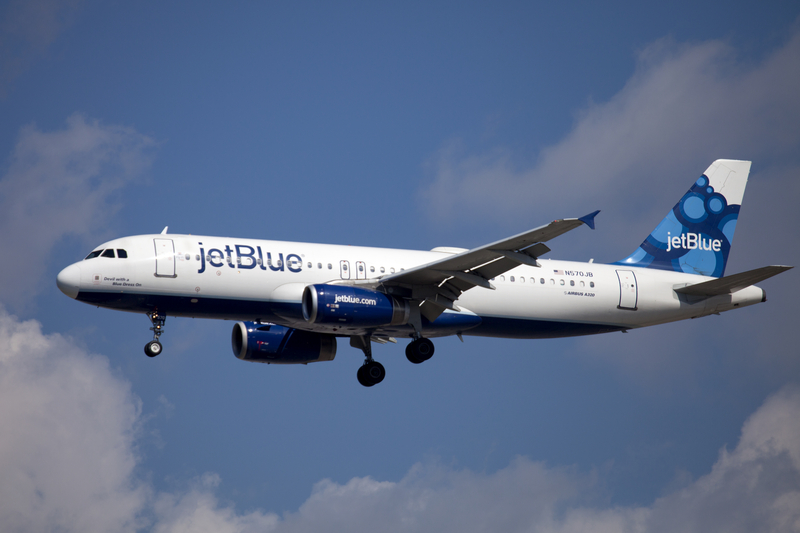
JetBlue says it plans to operate the route with the Airbus A320, a core aircraft type in the airline’s fleet. The A320 is a logical choice for a new market such as Caracas. It gives JetBlue enough capacity to serve strong visiting-friends-and-relatives demand without requiring the larger Airbus A321. It also preserves the airline’s standard onboard product, including seatback entertainment, free Fly-Fi, complimentary snacks, and drinks.
For passengers, that means the proposed Caracas route would feel like a typical JetBlue Latin America or Caribbean flight rather than a stripped-down international operation.

Why Fort Lauderdale Matters
The choice of Fort Lauderdale (FLL) is central to the route.
South Florida is the largest U.S. gateway region for Venezuela traffic, but JetBlue is not trying to duplicate American Airlines at Miami International Airport (MIA). Instead, it is using Fort Lauderdale (FLL), where it has long built a major focus city and where it is now expanding aggressively.
JetBlue expects to operate nearly 130 daily departures from Fort Lauderdale (FLL) this summer, making it one of the airline’s largest and most important gateways. The carrier recently announced 11 new destinations from FLL, including Barranquilla (BAQ), Cali (CLO), Baltimore (BWI), Charlotte (CLT), Columbus (CMH), Indianapolis (IND), Nashville (BNA), Detroit (DTW), Houston (IAH), Chicago O’Hare (ORD), and Ponce (PSE).
That expansion matters because Caracas (CCS) would not rely only on local Fort Lauderdale demand. JetBlue can also feed the route from its broader FLL network, including domestic U.S. cities, Caribbean points, and Latin American markets.

Fort Lauderdale (FLL) also gives JetBlue a different South Florida proposition. Miami (MIA) remains the region’s dominant Latin America hub, especially for American Airlines. But Fort Lauderdale has its own catchment area, lower-cost positioning, strong leisure traffic, and convenient access for many Broward, Palm Beach, and northern Miami-Dade travelers.
For Venezuelan families in South Florida, an FLL–CCS nonstop would be meaningfully different from having only Miami (MIA) available.
Caracas Demand Is Mostly About Families And Community
JetBlue is framing the proposed route around visiting-friends-and-relatives traffic, and that is the right way to understand the market.
South Florida has one of the largest Venezuelan communities in the United States. Years of political instability, economic hardship, and migration have deepened the ties between Venezuela and cities such as Miami, Doral, Weston, Fort Lauderdale, and other parts of the region. Many travelers in this market are not casual tourists. They are visiting parents, children, spouses, siblings, and extended family.
That demand behaves differently from ordinary leisure traffic.
Passengers traveling between South Florida and Caracas (CCS) may be more willing to pay for nonstop service because the alternative can involve long connections through Panama City (PTY), Bogotá (BOG), Santo Domingo (SDQ), Curaçao (CUR), or other third-country gateways. Nonstop flying reduces complexity, lowers missed-connection risk, and shortens a trip that is often emotionally and logistically important.
At the same time, Venezuela is not a simple commercial market. Documentation issues, currency controls, political risk, regulatory approvals, airport processes, and changing travel rules can all affect demand. That is why JetBlue’s cautious language matters. The airline sees opportunity, but the route still needs the necessary approvals and operational groundwork.
The Airbus A320 Is A Practical Starting Point
JetBlue’s planned Airbus A320 deployment is the right aircraft decision for this kind of route.
The A320 is the aircraft that built much of JetBlue’s network. It is efficient, familiar, and flexible, with enough range for Fort Lauderdale (FLL) to Caracas (CCS) and enough capacity to serve a large VFR market without overcommitting from the start.
JetBlue’s A320 fleet includes restyled aircraft with modern cabin interiors, in-seat power in every row, 10.1-inch high-definition seatback screens, free high-speed Wi-Fi, and the airline’s familiar single-class Core cabin with Even More Space seats available for purchase. Some older aircraft may have different interior details, but the airline’s A320 product is still one of the more passenger-friendly narrowbody products in the U.S. market.
For a South Florida–Caracas flight, that matters. This is not a long-haul route, but it is long enough that onboard product can influence customer choice. Free connectivity, seatback entertainment, and included snacks and drinks give JetBlue a clear product story against more basic competitors.
The A320 also allows JetBlue to keep operating complexity low. The airline already has crews, maintenance support, and scheduling experience with the type at Fort Lauderdale (FLL). Adding Caracas (CCS) with the A320 fits neatly into that structure.
U.S.–Venezuela Air Links Are Rebuilding
JetBlue’s proposal comes as U.S.–Venezuela commercial air service is being restored after years of suspension.
American Airlines has already returned to the Miami (MIA)–Caracas (CCS) market. The carrier resumed service on April 30, 2026, using Embraer 175 aircraft operated by Envoy Air. That route is a natural fit for American, which has long been the dominant U.S. airline in Miami and historically had a deep Venezuela presence before suspending service in 2019.
United Airlines has also announced plans to resume Houston Intercontinental (IAH) to Caracas (CCS) service on August 11, 2026, using the Boeing 737 MAX 8. Houston (IAH) is a logical gateway because of its energy-sector ties, large Latin America network, and United’s strong hub position there.
JetBlue would be different from both.
American is using Miami (MIA), the traditional U.S. gateway for Venezuela. United is using Houston (IAH), a business and energy-focused hub. JetBlue would use Fort Lauderdale (FLL), leaning into South Florida VFR demand and its growing focus-city network.
That gives the proposed route a distinct role rather than making it just a third copy of the same service.
Competition Will Be About Airport Choice And Product
If approved, JetBlue’s Fort Lauderdale (FLL) to Caracas (CCS) service would compete most directly with American’s Miami (MIA) to Caracas (CCS) operation for South Florida-origin passengers.
The difference between FLL and MIA should not be underestimated. Many travelers in Broward and Palm Beach counties prefer Fort Lauderdale (FLL) when schedules and fares are competitive. Miami (MIA) has the larger Latin America network and deeper connectivity, but FLL can be easier and faster for a large part of the South Florida market.
JetBlue will likely compete on convenience, fares, and onboard product. American will compete on frequency, Miami hub strength, AAdvantage loyalty, corporate contracts, and connections across Latin America and the U.S. United’s Houston (IAH) route will serve a different demand pool, especially travelers connecting through Texas and those tied to the energy sector.
For Venezuelan travelers, more U.S. carrier competition should be positive. More nonstop options can improve schedule choice, reduce reliance on third-country connections, and create more competitive pricing over time.
However, the market will remain sensitive to regulatory and political developments. U.S.–Venezuela travel can change quickly, and airlines will likely remain cautious until demand and operating conditions stabilize.
A Broader Fort Lauderdale Strategy
The Caracas proposal should also be viewed through the lens of JetBlue’s broader Fort Lauderdale strategy.
JetBlue has been rebuilding and expanding at Fort Lauderdale (FLL), adding domestic, Caribbean, and Latin America flying as it tries to strengthen one of its most important focus cities. The airline’s new and expanded FLL schedule is designed to increase relevance in South Florida, capture displaced demand in the market, and defend its position against larger competitors.
Caracas (CCS) fits that strategy because it is a natural South Florida route with limited U.S. nonstop competition and strong community ties. It also helps reinforce Fort Lauderdale (FLL) as more than a domestic leisure airport. For JetBlue, FLL is a gateway to the Caribbean and Latin America, and Venezuela would add another important country to that map.
The route would also complement JetBlue’s broader Latin America presence, which includes markets in Colombia, the Dominican Republic, Puerto Rico, Ecuador, Peru, Mexico, and the Caribbean. JetBlue has long been strongest in leisure and VFR markets rather than heavy corporate long-haul flying. Caracas fits that profile well.
Regulatory Approval Is The Key Milestone
The biggest caveat is government approval.
JetBlue has not yet loaded tickets for sale, and it has not published a detailed timetable. The airline has said tickets are expected to go on sale in the coming months, but that depends on receiving the necessary approvals and completing required processes to operate in Venezuela.
This matters because Venezuela is not a routine route-add environment. Airlines must account for bilateral permissions, airport handling, security requirements, financial settlement processes, local operating conditions, crew procedures, insurance, and government coordination.
A route announcement is an important signal, but it is not the same as a launch. Until flights are bookable and a firm schedule is published, the route should be described as planned or proposed.
For now, the proper framing is simple: JetBlue intends to launch Fort Lauderdale (FLL) to Caracas (CCS) before the end of 2026, but the service remains pending approval.
Why This Route Matters
If approved, JetBlue’s Caracas route would be significant for three reasons.
First, it would mark JetBlue’s first-ever service to Venezuela, adding a new country to the airline’s network and deepening its Latin America presence.
Second, it would give South Florida’s Venezuelan community another nonstop option, this time from Fort Lauderdale (FLL) rather than Miami (MIA). That is especially important for travelers who live closer to Broward or Palm Beach County and want to avoid Miami when possible.
Third, it would show how quickly U.S. airlines are testing Venezuela demand now that direct commercial air links are returning. American has already restarted Miami (MIA)–Caracas (CCS), United has announced Houston (IAH)–Caracas (CCS), and JetBlue now wants Fort Lauderdale (FLL)–Caracas (CCS).
That is a rapid shift for a market that had no scheduled U.S. carrier service for years.
Bottom Line
JetBlue plans to launch nonstop service between Fort Lauderdale (FLL) and Caracas (CCS), marking the airline’s first-ever route to Venezuela.
The proposed service would use JetBlue’s Airbus A320 aircraft and is expected to begin before the end of 2026, but it remains subject to government approval and completion of operating requirements in Venezuela. Tickets are not yet on sale, and JetBlue has not published a final schedule or frequency.
Strategically, the route makes sense. South Florida has a large Venezuelan community, Fort Lauderdale (FLL) is one of JetBlue’s most important focus cities, and the airline is already expanding heavily across Latin America, the Caribbean, and the U.S. from FLL.
If approved, JetBlue would join American and United in the rebuilding of U.S.–Venezuela air service, but with a distinct South Florida approach. American has Miami (MIA). United has Houston (IAH). JetBlue wants Fort Lauderdale (FLL).
For Venezuelan travelers in South Florida, that could mean more choice, better airport options, and a simpler path home. For JetBlue, it would be a targeted move into a politically complex but commercially meaningful market.