Qatar Airways Brings Ha’il Into the Fold With New DOH–HAS Nonstops
Qatar Airways has officially added Ha’il (HAS) to its Saudi Arabia map, launching three weekly non-stop flights from Doha Hamad International Airport (DOH) into Ha’il International Airport (HAS). The service, which began January 5, 2026, becomes the carrier’s 13th destination in the Kingdom—a meaningful expansion into north-central Saudi Arabia that’s as much about network geometry as it is about tourism headlines.
For Qatar Airways, Saudi Arabia isn’t a “nice-to-have” market; it’s one of the airline’s most strategically dense regional footprints. With Ha’il now online, the carrier says it’s operating more than 150 weekly flights to 13 Saudi destinations, reinforcing Doha’s role as a short-haul gateway that can feed long-haul banks in both directions.
Why HAS Matters: A New Catchment for North-Central Saudi Arabia
Ha’il Province has long been a domestic travel market, but its profile has risen as Saudi Arabia leans into wider tourism and regional development. The draw isn’t just desert scenery—it’s heritage. The province is home to UNESCO-listed “Rock Art in the Hail Region of Saudi Arabia,” with major sites at Jubbah and Shuwaymis, where prehistoric inscriptions and petroglyphs document thousands of years of human presence.
From an airline planning perspective, HAS is also a sensible spoke for narrowbody operations. The airport operates with a single runway 18/36 and published instrument infrastructure that supports reliable, year-round scheduling—useful when you’re trying to protect hub integrity at DOH.
Schedule and Connections: Built for the Hub Banks at DOH
Qatar Airways is operating the route on Mondays, Thursdays, and Saturdays, pairing a mid-afternoon departure from DOH with an early-evening return from HAS. That timing is not accidental: it’s designed to scoop up inbound connectivity at DOH and then return passengers to Doha in time for onward banks to Asia, Africa, and beyond.
The airline has published the following flight numbers and timings:
-
QR1228: DOH–HAS departing 14:20, arriving 16:30
-
QR1229: HAS–DOH departing 17:30, arriving 19:25
Early operational data also shows the sector is comfortably within narrowbody mission length—about 1 hour 40 minutes gate-to-gate under normal conditions—making it a clean fit for Qatar’s short-haul rotation patterns.
Aircraft Watch: A320-Operated Service With Familiar Short-Haul Economics
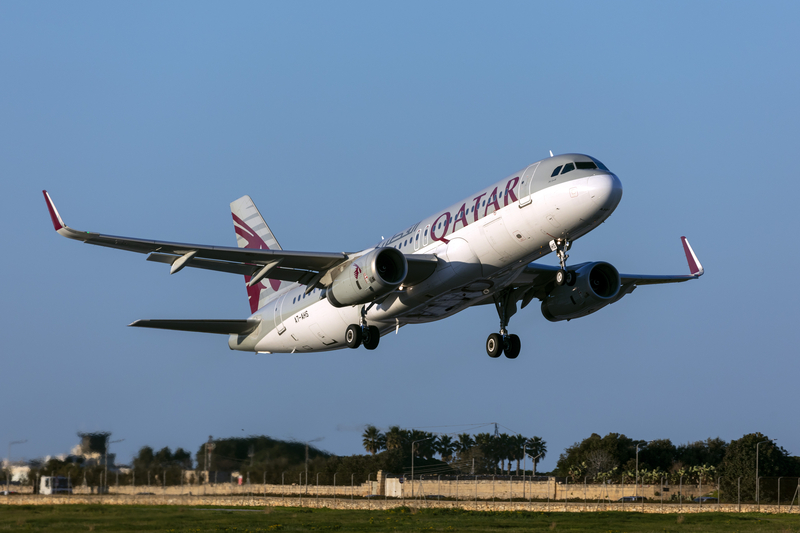
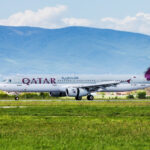
On day one, the flight operated with an Airbus A320—specifically A7-AHB, an A320-232—which is a classic tool for this kind of regional connectivity. In Qatar Airways service, this airframe type typically balances two priorities: premium cabin presence for business and government demand, and dense, efficient economy seating for price-sensitive leisure and VFR traffic.
A320s remain a workhorse across the industry for good reason. They’re optimized for short-to-medium sectors with:
-
strong dispatch reliability in high-frequency networks
-
efficient trip economics on stage lengths like DOH–HAS
-
flexible cabin sizing without the complexity of widebody utilization
From an airport-ops angle, HAS also lends itself to this aircraft category. Its runway and approach environment is well within the typical operating envelope for an A320 in Saudi conditions, while still leaving room for performance margins during hotter months when density altitude becomes a real consideration.
Qatar’s Saudi Scale: HAS Becomes Destination #13
Ha’il (HAS) is the latest addition to a Saudi network that has steadily broadened beyond the “big three” of Riyadh (RUH), Jeddah (JED), and Medina (MED). Qatar Airways now lists 13 destinations in the Kingdom, including:
Abha (AHB), AlUla (ULH), Dammam (DMM), Jeddah (JED), Medina (MED), NEOM (NUM), Qassim (ELQ), Riyadh (RUH), Tabuk (TUU), Taif (TIF), The Red Sea (RSI), Yanbu (YNB), and Ha’il (HAS).
This is also arriving alongside wider frequency growth. Qatar Airways previously outlined plans to increase service to Jeddah (JED) and Riyadh (RUH) from six to seven daily flights, a notable signal that the airline sees sustained demand—and wants to preserve connectivity breadth through DOH even as regional competition intensifies.
Bottom Line
Adding Ha’il (HAS) isn’t just another dot on Qatar Airways’ route map—it’s a practical network move that strengthens the airline’s Saudi coverage and opens a fresh catchment area into Doha (DOH). With A320 economics, hub-bank timing, and 13 Saudi destinations now in the portfolio, Qatar is clearly positioning its Saudi operation for depth, not just visibility—while giving north-central Saudi Arabia a one-stop pathway to a global network via DOH.