Etihad Pulled AUH-ALG Before Takeoff – And The A321LR Angle Matters
It’s not every day an airline announces a new long-haul narrowbody route, markets it aggressively, then removes it before the inaugural flight. But that’s exactly what just happened with Etihad Airways’ planned Abu Dhabi (AUH)–Algiers (ALG) service—an 8-ish-hour sector that was slated to be flown by the carrier’s new Airbus A321LR.
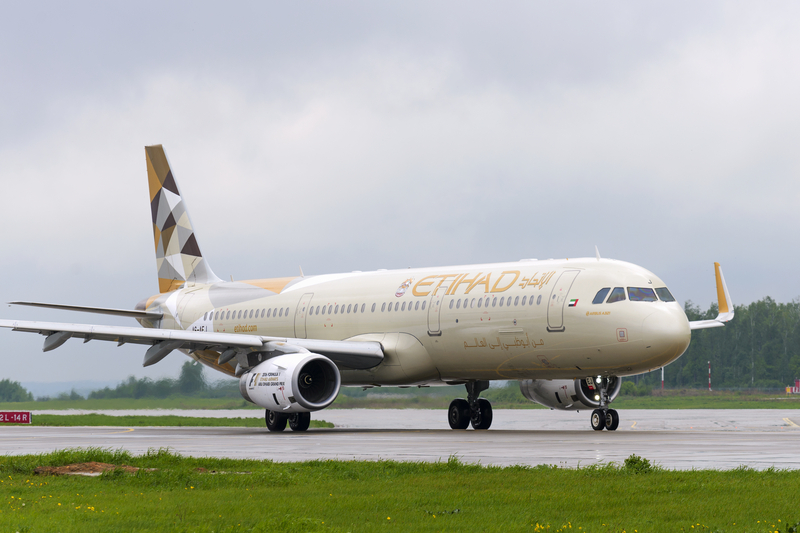
For route-watchers, the disappearance is notable. For avgeeks, it’s doubly interesting because AUH–ALG was positioned as an early showcase mission for Etihad’s three-cabin A321LR—one of the most premium-configured single-aisle aircraft flying today.
The AUH–ALG Route Is Now Off The Board
Etihad had filed AUH–ALG as flights EY737/EY738, with schedules that were designed to “bank” connections at its Abu Dhabi hub: a very early-morning departure out of AUH to reach North Africa mid-morning, and a late-morning return from ALG back into AUH in time for onward departures.
As filed for early 2026, the timings were:
-
EY737: Abu Dhabi (AUH) 02:30 → Algiers (ALG) 07:15 (local)
-
EY738: Algiers (ALG) 10:05 → Abu Dhabi (AUH) 19:20 (local)
Etihad had already delayed the launch once. Then, in the latest schedule update, the airline removed the route entirely—meaning it’s no longer showing as available for sale in the published schedules that route analysts track.
Why This Particular Cancellation Stands Out
Canceling (or “un-launching”) a route before the first flight usually points to one of a few pressure points:
-
Regulatory and operational readiness: traffic rights, station approvals, ground handling contracts, and local operational sign-offs can derail a launch late in the game.
-
Aircraft availability: a route may be built around a specific subfleet—like Etihad’s A321LRs—and any delivery/induction/training hiccup can force network triage.
-
Commercial reality: forward bookings can look fine on raw volume but weak on yield, premium mix, or seasonality—especially on a long, thin market where loads don’t automatically translate into profit.
-
Network reprioritization: a single A321LR frame can be worth more deployed on a route with stronger connectivity, higher premium uptake, or less station complexity.
Etihad hasn’t publicly offered a detailed explanation for the removal, but the airline had previously described the delay as being due to reasons “beyond our control.” In other words: don’t assume this was only about demand. It could just as easily be about execution.
The Competitive Context: Dubai (DXB) Already Has ALG Nonstops
Another reality check: while AUH–ALG would have been a fresh nonstop, Algiers (ALG) already has nonstop service to Dubai (DXB)—including Emirates’ Boeing 777 operation on the city pair. That matters because North Africa–Gulf demand often skews heavily toward VFR traffic and onward connections, and Dubai’s global connectivity can be a tough benchmark.
AUH–ALG could still work, of course—Etihad’s value proposition is different (and increasingly premium-forward on the A321LR). But when nearby DXB is already in the market, the bar for “new route success” rises quickly.
Why Etihad’s A321LR Is A Big Deal On A Route Like This
On paper, AUH–ALG is ~5,000 km / ~2,700+ nautical miles—a distance that sits comfortably inside the A321LR’s advertised capability. The A321LR was built precisely for missions like this: long-range flying with narrowbody economics, opening routes that are too thin for a widebody but too long for a standard A321neo without compromises.
Airbus markets the A321LR at up to 4,000 nautical miles of range, along with meaningful efficiency improvements versus prior-generation single-aisle jets. In airline terms, that’s the difference between “this route is a seasonal experiment” and “this route can be a sustainable year-round performer”—if the revenue side cooperates.
Etihad’s Cabin Layout Is Unusually Premium For A Single-Aisle Jet
Etihad didn’t just buy range—it built a product. The airline’s A321LRs are configured with 160 seats across three cabins:
-
2 First Suites
-
14 Business Class seats (lie-flat, direct aisle access)
-
144 Economy seats
That’s a striking configuration for a narrowbody. For a market like AUH–ALG, it signals Etihad wasn’t merely chasing volume—it was aiming for higher-yield traffic: premium leisure, corporate, and connecting passengers who care about the onboard experience.
Under The Wing: LEAP Power And Long-Leg Economics
Etihad’s A321neo-family aircraft are tied to CFM LEAP-1A power selections across its narrowbody strategy. On long sectors, that matters: you’re buying a package of fuel burn, maintenance economics, and performance margins that can make or break a route once you factor in alternates, reserves, seasonal winds, and operational constraints.
So Where Does The A321LR Capacity Go Now?
This is the part route geeks should watch next: when a long sector like AUH–ALG disappears, the aircraft time doesn’t vanish—it gets redeployed.
Etihad has been rolling the A321LR into routes that mix hub connectivity with premium experience—think leisure-heavy flying, business markets that can sustain lie-flats, and city pairs where a widebody is simply too much airplane. The airline has already been using the type to open and reinforce service on routes spanning Europe, Asia, and North Africa.
In plain terms: if AUH–ALG didn’t clear the hurdle—commercially or operationally—that capacity will almost certainly be reassigned to a route with cleaner execution and better upside.
Bottom Line
Etihad’s planned Abu Dhabi (AUH)–Algiers (ALG) route—intended for the Airbus A321LR—has been pulled before the inaugural flight after a prior postponement. The move is noteworthy not just because pre-launch cancellations are uncommon, but because AUH–ALG was a marquee mission for Etihad’s uniquely premium three-cabin A321LR. Whether the culprit was demand, deliverability, or operational complexity, the more important takeaway is what comes next: where Etihad chooses to deploy that long-range narrowbody capacity instead.