Emirates A380 Diverts to Accra After Cargo Smoke Alert, Turning Ghana Into an Unplanned Superjumbo Hub
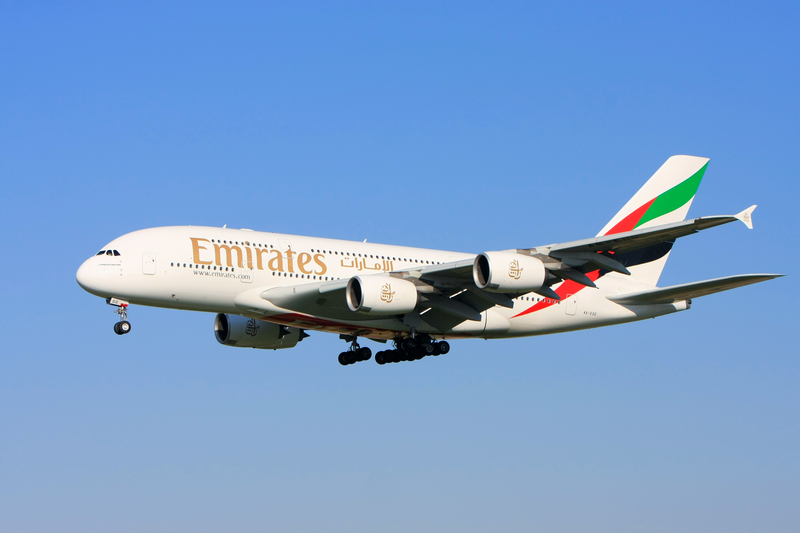
Emirates flight EK261 left Dubai International Airport (DXB) bound for São Paulo/Guarulhos (GRU) as just another long-haul rotation on one of the carrier’s marquee “ultra-long” city pairs. Instead, the Airbus A380-800 ended up touching down in West Africa at Accra’s Kotoka International Airport (ACC) after the crew received a smoke indication linked to the aircraft’s cargo compartment.
For passengers, it was an unexpected stop and a long delay. For operators, it was a reminder of two realities that never change: smoke warnings are treated as time-critical until proven otherwise, and the world’s largest passenger aircraft dramatically narrows your list of practical alternates—especially once you’re staring down an Atlantic crossing.
Why a Cargo Smoke Indication Forces Fast, Conservative Decisions
A cargo smoke message is one of those alerts that leaves little room for “let’s see how it develops.” On widebody aircraft—A380 included—lower-deck cargo holds are protected by smoke detection and integrated fire-suppression architecture. The philosophy is straightforward:
-
Assume it’s real until you can confirm it isn’t.
-
Get the aircraft on the ground at the nearest suitable airport.
-
Avoid committing to long stretches with limited diversion options.
That last point matters on DXB–GRU. Emirates typically routings run west/southwest across Africa before stepping off across the South Atlantic. Once the aircraft passes the point where viable alternates thin out, a warning that might be manageable over continental airspace becomes a much bigger problem. A380 crews will still have alternates planned—four engines don’t eliminate the need for contingency planning—but the operational calculus changes quickly when you’re hours from a suitable runway, suitable pavement, suitable rescue category, and suitable handling.
In short: if you’re going to divert, do it while the diversion options are still abundant.
Why Accra Was the “Right-Sized” Alternate for an A380
Plenty of airports can accept a 737 diversion. Far fewer can take an A380 without creating a second incident on the ground.
ACC is not a routine A380 station, but it can accommodate the aircraft when required—runway performance, airfield geometry, and rescue/fire capability are the gating items, and Kotoka has demonstrated it can handle the type.
And that “demonstrated” part is key. Superjumbo diversions aren’t just about landing distance. They’re about everything that happens next:
-
Parking: Can the airport put an A380 somewhere it won’t block multiple stands?
-
Passenger handling: Can it move 400–500+ people through a terminal, even if only temporarily?
-
Equipment: Stairs, buses, catering access, and tow capability all become real constraints with a double-decker.
-
Safety services: A380 operations require the top-tier response category and appropriate airfield readiness.
When an A380 diverts, the “nearest” airport isn’t always the “best” airport. In this case, ACC checked enough boxes to make it a sensible choice.
The Aircraft: A6-EUG and What It Means Operationally
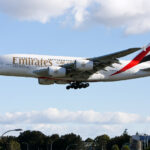
The diverted jet, registered A6-EUG, is an Emirates Airbus A380-861—part of the backbone fleet that the airline has leaned on for high-density, slot-constrained long-haul flying for more than a decade. In practical terms, the A380 remains a scheduling weapon: massive seat capacity, strong cargo volume in the belly, and the ability to consolidate demand into fewer movements.
But that same scale is exactly why disruptions are so expensive.
An A380 diversion is never “just” a diversion:
-
Crew duty time risk spikes, because the recovery timeline is longer—more passengers, more bags, more coordination.
-
Connections cascade harder through a hub bank once an A380 arrives late.
-
Reaccommodation is tougher, because you’re trying to re-seat an entire A380 worth of passengers into already-full long-haul flows.
Even if the technical warning proves intermittent or benign, the decision-making logic remains sound: crews don’t get credit for “pressing on,” they get credit for landing safely with margin.
A Rare A380 Day for Ghana
For ACC and Ghana’s aviation community, the arrival was notable for another reason: A380 visits are extremely uncommon. Accra has seen the type before—including a high-profile Emirates A380 visit tied to infrastructure capability—yet it remains a rare enough event that it reliably draws attention well beyond the terminal.
That rarity underscores a broader point that network planners and ops controllers know well: when something goes sideways on a superjumbo, your alternates are constrained not by geography but by infrastructure.
What Happens Next in These Events
Airlines typically keep public technical specifics close until maintenance has completed inspections and reporting pathways are clear. What matters operationally is the sequence:
-
Land quickly at a suitable alternate (ACC)
-
Stabilize the situation on the ground (inspection, coordination with local services, passenger management)
-
Decide whether to continue, swap aircraft, or cancel based on findings, crew legality, and downstream network impact
Even in the best-case scenario—no fire, no heat damage, no cargo issue—an A380 stopover can still snowball into missed connections, crew timeouts, and a knock-on delay for the return sector.
Bottom Line
An Emirates Airbus A380 diversion is never routine, and EK261’s unscheduled stop at Accra (ACC) shows why. A cargo smoke indication is treated as time-critical until proven otherwise, and the closer you get to an oceanic crossing, the more conservative the decision tree becomes. ACC may not be a regular A380 destination, but it’s one of the airports in the region capable of taking a superjumbo safely—exactly what you want when a warning light turns a long-haul crossing into an immediate operational problem.