Alaska Airlines Adds Boston-Anchorage Nonstop
Alaska Airlines has launched a new nonstop route between Ted Stevens Anchorage International Airport (ANC) and Boston Logan International Airport (BOS).

The seasonal service began on June 13, 2026. It will operate once weekly on Saturdays through August 15.
The route gives New England travelers a direct link to Alaska during the peak summer travel season. It also gives Alaska Airlines another long-range domestic market for its Boeing 737 MAX 8.
The westbound Boston (BOS)–Anchorage (ANC) sector is scheduled at up to 7 hours and 53 minutes. That makes it one of Alaska’s longest narrowbody flights this summer.
A New Nonstop Link To Alaska
Boston (BOS) to Anchorage (ANC) is not a typical domestic route.

The two cities sit more than 3,300 miles apart. Until now, most passengers traveling between them had to connect through another airport.
Seattle (SEA) was the most obvious option. Other routings could involve Minneapolis/St. Paul (MSP), Chicago O’Hare (ORD), Denver (DEN), or other large hubs.
The new nonstop removes that extra step.
That matters most during the summer, when Alaska sees strong visitor demand. Travelers heading to cruises, national parks, fishing trips, wildlife tours, and outdoor vacations can now fly directly from New England to Anchorage.

For Alaskans, the route also adds a direct East Coast option beyond the airline’s New York (JFK) service.
The Route Runs Only Once Weekly
Alaska is taking a cautious approach.
The route operates only once per week. It is also limited to the peak summer period.
That makes sense.
Boston–Anchorage is a long route with clear seasonal appeal. But it is not the same as a daily trunk route between major business markets.
A weekly summer schedule lets Alaska test the market without tying up too much aircraft time.
If demand performs well, the route could return in future summers. It could also be expanded later. For now, this is a targeted seasonal play.
The Boeing 737 MAX 8 Makes It Possible
The aircraft choice is important.
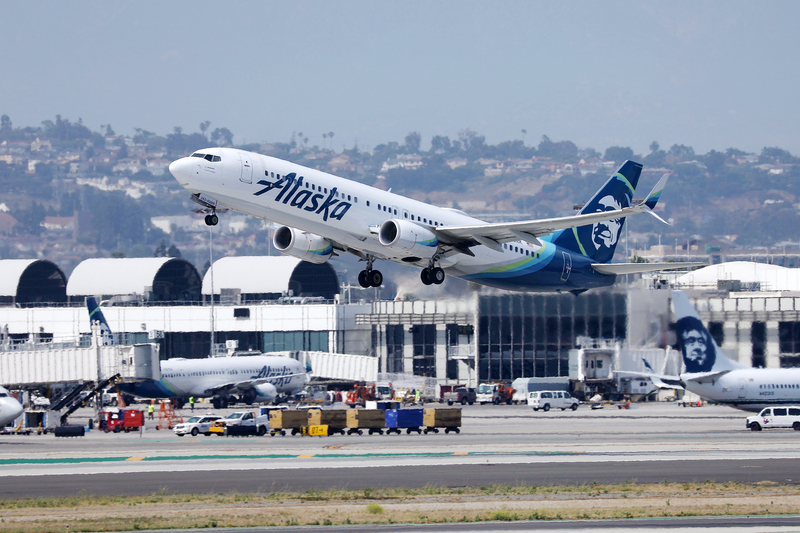
Alaska is using the Boeing 737 MAX 8 on the route. The airline calls the type its most range-capable aircraft.
Alaska lists the 737-8 MAX with a range of 3,500 nautical miles, a typical cruise speed of 530 mph, and a wingspan of 117 feet 10 inches.
That range is what makes a route like Boston (BOS)–Anchorage (ANC) possible with a single-aisle jet.
The aircraft also has lower fuel burn than older-generation 737s. That helps on long, thin routes where a larger widebody would be too much aircraft.
For Alaska, the MAX 8 is a network tool. It can open routes that are too long for older narrowbodies but too small for a widebody business case.
A Long Flight In A Narrowbody Cabin
Passengers should understand what this route is.
It is nearly eight hours westbound, but it is still a single-aisle aircraft.
Alaska’s 737-8 MAX has First Class, Premium Class, and Main Cabin seating. The pre-retrofit version has 12 First Class seats, 36 Premium Class seats, and 117 Main Cabin seats. The post-retrofit version has 16 First Class seats, 36 Premium Class seats, and 115 Main Cabin seats.
The aircraft includes power, streaming entertainment, and redesigned seats. Alaska also notes that some 737-8 MAX aircraft may fly without Wi-Fi for a period while installations continue.
For a flight this long, seat choice matters.
First Class and Premium Class will be the most comfortable options. Main Cabin passengers still get nonstop convenience, but they should expect a long narrowbody experience.
One Of Alaska’s Longest MAX Routes
Boston (BOS)–Anchorage (ANC) sits near the top of Alaska’s long-haul 737 MAX network.
The scheduled westbound time of 7 hours and 53 minutes is only slightly shorter than some of the carrier’s longest MAX flights, including New York (JFK)–Anchorage (ANC) and Reykjavik/Keflavík (KEF)–Seattle (SEA).
That shows how Alaska is using the aircraft.
The airline is no longer using 737s only for West Coast, Alaska, Hawaii, and short-haul domestic flying. It is also using them for long, seasonal, and niche markets.
This is part of a wider industry trend.
Modern narrowbodies such as the 737 MAX and Airbus A321neo family have changed what airlines can do. They allow carriers to serve long routes with fewer seats and lower risk than a widebody.
Anchorage Is Growing As A Summer Gateway
The Boston route is part of a larger Anchorage expansion.
Alaska says it will fly from Anchorage (ANC) to 17 nonstop destinations in the Lower 48 and Hawaii during the summer peak. Its cargo division says the wider summer network reaches 18 nonstop destinations from Anchorage.
New summer routes include Boston (BOS), Boise (BOI), and Spokane (GEG).
Alaska is also adding more frequency from Anchorage to Sacramento (SMF) and San Diego (SAN) due to strong demand.
That matters for Anchorage.
ANC is not only a local airport. It is Alaska’s main air gateway, a major cargo hub, and a key link between the state and the rest of the country.
More nonstop passenger routes give the state better access to major U.S. markets during its most important travel season.
Boston Adds A New Kind Of Demand
Boston is a strong addition for several reasons.
It has a large population base. It has strong leisure demand. It also has many travelers interested in outdoor, cruise, and adventure destinations.
Anchorage fits that profile well.
The route also gives Alaska Airlines more relevance in the Northeast. The airline already serves Boston from several West Coast points. Adding Anchorage gives it a more distinctive summer offering.
This is not a route where Alaska needs massive daily business demand.
It needs enough high-season traffic to support a weekly nonstop. That is a very different test.
Connections Still Matter
Even with the nonstop, connecting traffic will still matter.
Anchorage (ANC) is the gateway to many Alaska destinations. Passengers can continue onward to communities across the state, including Fairbanks (FAI), Juneau (JNU), and other points in Alaska’s network.
Boston (BOS) also gives Alaska access to a large East Coast market.
The route works best when it combines several types of demand: New England leisure travelers, cruise traffic, Alaska residents, connecting passengers, and seasonal tourism.
That mix is what makes a weekly summer route viable.
Alaska’s Wider Strategy Is Changing
The route also fits Alaska Air Group’s broader growth story.
Alaska Airlines and Hawaiian Airlines are now under the same parent company. The combined group is building a larger network across North America, Hawaii, Asia, and the Pacific.
Alaska is also expanding internationally from Seattle (SEA), including new long-haul service to Europe.
At the same time, the airline continues to grow from Anchorage.
The Boston route is small compared with the group’s biggest network moves. But it shows the same idea: use the right aircraft to connect markets that were not obvious before.
A Useful Test For Future Summers
This first season will be important.
Alaska will likely watch bookings, fares, load factors, cargo demand, and connection patterns.
A weekly route can be successful without becoming daily. It can also work as a recurring seasonal service.
That may be the most realistic path for Boston–Anchorage.
The route does not need to become year-round to be valuable. It simply needs to perform during the period when demand is strongest.
If it works, Alaska could bring it back in summer 2027. It could also consider more frequency or a longer season.
Bottom Line
Alaska Airlines has launched a new seasonal nonstop route between Anchorage (ANC) and Boston (BOS).
The service began June 13, 2026, and runs once weekly on Saturdays through August 15. It is operated with Boeing 737 aircraft, with the 737 MAX 8 providing the range and economics needed for the nearly eight-hour westbound sector.
The route gives New England travelers a direct summer link to Alaska. It also gives Alaska Airlines another long, niche market where the 737 MAX can replace the need for a connection.
This is not a large daily route. It is a focused summer experiment.
But that is what makes it interesting. With the right aircraft, Alaska can serve a market that previously depended on connections through Seattle and other hubs. For passengers, the benefit is simple: Boston to Anchorage in one flight, during the season when Alaska demand is at its peak.