Hainan Slams the Door on Qingdao Airlines Talk – For Now
Market chatter about Chinese airline consolidation found a new target this week: Qingdao Airlines (QW), the Qingdao Jiaodong-based operator at Qingdao Jiaodong International Airport (TAO). But when investors pressed Hainan Airlines Holding for clarity, the response was blunt. On January 7, 2026, the company said it has “no plans” to acquire Qingdao Airlines.


It’s a tidy denial—yet the fact the question keeps resurfacing says plenty about where pressure is building in China’s domestic market: thin margins, uneven regional demand, and the outsized operational hit from Pratt & Whitney PW1100G engine disruptions on Airbus A320neo-family fleets.
A denial that reads like a message to the market
Hainan Airlines Holding’s statement came through a familiar channel for listed Chinese companies: investor Q&A on Tonghuashun (10jqka). These platforms matter because they’re where rumors quickly turn into on-the-record commitments—or refusals.
In this case, the wording was unambiguous. No hedging about “ongoing evaluation,” no “strategic options.” Just no plan.
For airline watchers, that doesn’t automatically mean “never.” It does mean nothing is currently in motion that management is willing—or required—to disclose. And that distinction matters in a market where deal talk can move sentiment faster than schedules.
Why Qingdao Airlines keeps showing up in acquisition rumors
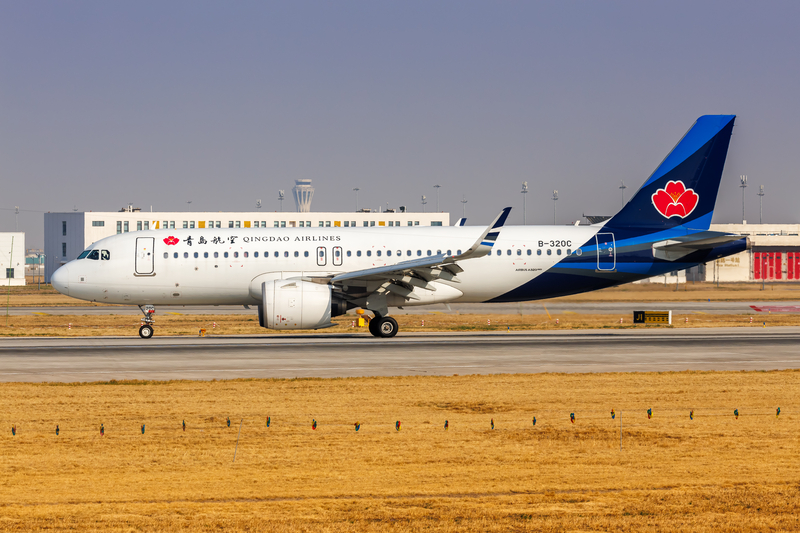
Qingdao Airlines is not a fringe carrier. It’s a TAO-based, Airbus narrowbody operator flying the sort of domestic network that can look attractive on paper—dense city pairs, quick turns, and a cost structure designed for high utilization.
But the story around Qingdao Airlines has been complicated for years:
-
Ownership has shifted into state hands, tied to Qingdao municipal state-asset entities—moves aimed at stabilizing the airline and anchoring aviation capacity around TAO.
-
Despite that support, profitability has been a recurring challenge, and the carrier has faced the same structural headwinds many second-tier Chinese airlines know well: intense price competition, seasonal demand swings, and rising costs where yield doesn’t always follow.
That cocktail is exactly what fuels rumors of a sale, merger, or “strategic cooperation.”
The fleet reality: PW1100G problems bite harder at A320neo-heavy airlines
One reason Qingdao Airlines sits in the spotlight is mechanical, not commercial.
Qingdao Airlines operates a mix of A320ceo aircraft (classic A320-200) and a substantial number of A320neo-family jets, including A320neos and A321neos. The A320neo program is built around efficiency—new engines, aerodynamic tweaks, and cabin enhancements that together deliver a meaningful reduction in fuel burn versus older models.
But if your A320neo-family fleet is powered by the Pratt & Whitney PW1100G-JM geared turbofan (GTF), you also inherit the industry’s biggest narrowbody maintenance disruption of the past two years.
The PW1100G’s architecture—using a reduction gearbox so the fan and low-pressure spool can run at their optimal speeds—drives excellent efficiency and lower noise. The trade-off has been complexity, and the current pain point is severe: accelerated inspections and shop visits tied to powder-metal manufacturing issues on certain life-limited parts, compounded by constrained MRO capacity and spare engine availability.
When that hits, it doesn’t just ground airplanes. It breaks the rhythm of a short-haul carrier:
-
utilization drops, which spreads fixed costs across fewer block hours
-
schedule resilience weakens, because spare aircraft are already thin
-
wet-lease and short-term lift becomes expensive—or unavailable
Reports tied to Qingdao Airlines suggest around a third of its fleet has been affected by PW1100G-related groundings, which is operationally brutal for a carrier that lives on frequency and aircraft turns.
Why Hainan would be a logical—but messy—buyer
If you’re wondering why Hainan’s name keeps coming up in these rumors, it’s simple: scale and access to capital. Hainan Airlines is a large national player with a broader fleet mix and network reach from major mainland hubs—most notably Beijing Capital (PEK) and Haikou Meilan (HAK)—and its post-restructuring era has kept it firmly on the industry’s radar.
But an acquisition of Qingdao Airlines wouldn’t be a plug-and-play move:
-
Fleet integration: Qingdao Airlines is Airbus narrowbody-heavy; Hainan’s core is heavily Boeing-focused on domestic trunk flying, with widebodies for long-haul. You can operate mixed fleets, but the economics only work if you’re deliberate about where each aircraft type sits.
-
Maintenance and engines: taking on PW1100G exposure means taking on the spare-engine problem, shop-visit queues, and operational uncertainty—unless the deal structure isolates that risk.
-
TAO strategy: Qingdao is a serious aviation market, but it’s also a competitive one. Any buyer would need a clear thesis on whether TAO becomes a growth platform, a feeder node, or simply maintained capacity.
That’s why denials like this one are credible: even if consolidation is the long-term direction, this specific pairing has real complexity.
What to watch next at TAO
If this story develops further, the earliest clues likely won’t be press releases. They’ll show up in operational signals:
-
A320neo utilization at TAO: watch for how many neos are actually flying versus parked, and whether capacity is being rebuilt with subcharter lift or frequency cuts.
-
Aircraft substitutions: if A320ceos increasingly cover routes that were planned for neos, it’s a sign the engine situation remains constraining.
-
Shareholder and governance moves: changes in board composition, asset transfers between municipal entities, or restructuring language often precede any larger strategic decision.
Bottom Line
Hainan Airlines Holding has formally denied any plan to buy Qingdao Airlines—an important statement because it shuts down (for now) the most direct form of consolidation speculation around Qingdao Jiaodong (TAO).
But the rumor itself isn’t random. Qingdao Airlines sits at the intersection of two pressure points: the economics of China’s fiercely competitive domestic market and the hard operational reality of PW1100G-powered A320neo-family groundings. Even without a deal, those forces will keep shaping what QW looks like in 2026—on the ramp at TAO and on the schedule board.