Tetouan Gets Its Wings: Royal Air Maroc Plants a Northern Morocco Base With Six New Europe Links
Royal Air Maroc (RAM) is making a direct play for northern Morocco with a newly opened base at Tetouan Sania Ramel Airport (TTU) and a slate of six nonstop routes into Europe. It’s a notable move for a carrier whose network logic has long revolved around its Casablanca Mohammed V hub (CMN): instead of forcing northern traffic to backtrack south, RAM is putting lift closer to the catchment—then using Casablanca (CMN) as the network glue when point-to-point demand isn’t enough on its own.
For Tetouan and the wider Tangier–Tetouan corridor—roughly an hour by road from Tangier Ibn Battouta (TNG)—this is more than “new flights.” It’s a structural upgrade in accessibility, aimed squarely at inbound tourism, diaspora/VFR traffic, and short-break leisure flows from core European origin markets.
A base, not just a route launch
Airlines don’t use the word “base” lightly. Even when the aircraft is the same and the stage lengths are familiar, basing changes the operating posture: earlier departures, later arrivals, more resilient recovery when the day goes sideways, and—critically—local crew and maintenance planning that doesn’t depend on perfectly timed inbound aircraft from a distant hub.
In Tetouan’s case, the base is designed to complement RAM’s established footprint in Tangier (TNG) rather than replace it. The airport catchments overlap, but their demand profiles don’t always. TNG is a larger, more visible gateway with broader airline competition, while TTU can be tailored for thinner, high-intent markets where 2–3 weekly service can stimulate demand without the economics of a larger narrowbody.
The six new European city pairs, as filed
RAM’s Tetouan (TTU) rollout is timed around the northern summer schedule change, with start dates clustered at the end of March. For airline watchers, the details matter because they show how RAM is shaping bank structure and aircraft utilization.
-
Tetouan (TTU) – Barcelona (BCN): starts March 27, 2x weekly
-
Tetouan (TTU) – Brussels (BRU): starts March 27, 2x weekly
-
Tetouan (TTU) – Madrid (MAD): starts March 28, 3x weekly
-
Tetouan (TTU) – Málaga (AGP): starts March 28, 2x weekly
-
Tetouan (TTU) – London Gatwick (LGW): starts March 29, 2x weekly
-
Tetouan (TTU) – Paris Charles de Gaulle (CDG): starts March 29, 2x weekly

That route mix reads like a deliberate blend of diaspora-heavy markets (BRU, CDG, MAD), high-volume leisure city breaks (BCN), and Mediterranean sun traffic (AGP), with LGW adding a London basin anchor that can pull both point-to-point UK demand and some onward self-connect flows.
Why the Embraer 190 is the right tool for TTU
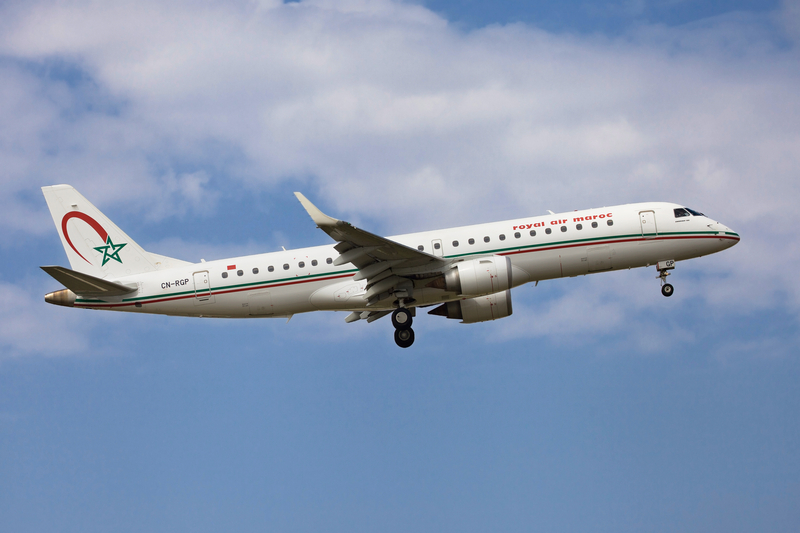
Every route decision is also an aircraft decision, and RAM is standardizing Tetouan’s European build-out on the Embraer E190.
For short-to-medium European sectors, the E190 is a strong “precision capacity” instrument: a two-by-two cabin with no middle seats, right-sized for routes that may need stimulation, and a range profile built for exactly this kind of flying (think mid-2,000-nm class capability, depending on variant and payload). In other words, it can serve a market like TTU–CDG without forcing the airline to gamble on a larger aircraft just to maintain schedule relevance.
RAM has historically configured its E190s for a true two-cabin product (business + economy), which is important here. On routes like TTU–BRU or TTU–CDG, the premium cabin isn’t about lie-flats—it’s about schedule convenience, flexibility, and a differentiated front-cabin experience for business travelers and higher-yield VFR. For a regional-jet-sized operation, that matters to unit revenue more than glossy marketing ever will.
Casablanca feed: the quiet enabler
Alongside the European adds, RAM is also strengthening Tetouan’s domestic connectivity with additional flying to Casablanca (CMN). Practically, that CMN link is what turns TTU from a set of standalone flights into something closer to a network node—because CMN is where RAM can redistribute passengers across Africa, the Gulf, and long-haul corridors.
The Casablanca (CMN) increase is best read as a connectivity lever. It gives northern Morocco travelers a one-stop path into RAM’s broader system without the friction of ground transfers to Tangier (TNG) or other airports, and it gives inbound European passengers arriving TTU a same-airline pathway deeper into Morocco or beyond.
What to watch as the summer season matures
A Tetouan base (TTU) with six European spokes will stand or fall on three operational realities:
-
Reliability and recovery: smaller stations win trust quickly when they run on time and handle disruption cleanly. A base structure helps, but it has to be supported with local processes that can keep turns tight and delays contained.
-
Frequency discipline: 2x weekly can work when it’s targeted and well timed. If demand proves stronger, RAM’s next move is usually either a frequency bump (to protect market share) or a gauge change (to protect unit costs). The E190 gives it flexibility on both fronts.
-
Network coherence with TNG and CMN: success here isn’t about cannibalizing Tangier (TNG). It’s about segmenting: letting TTU specialize in certain European origin markets while CMN remains the intercontinental and Africa connective engine.
Bottom Line
Royal Air Maroc’s decision to open a base at Tetouan (TTU) and launch six European routes is a smart capacity-matching move: put the right-sized Embraer E190 into markets that can sustain nonstop flying without overexposure, then reinforce the whole structure with added connectivity into Casablanca (CMN). For northern Morocco—positioned close to the Strait of Gibraltar and within easy reach of Tangier (TNG)—it’s the kind of network shift that can change travel behavior, not just timetables.