Schiphol’s Snowbound Gridlock: KLM’s A321neo Taxies for Two Hours, Then Returns to the Gate
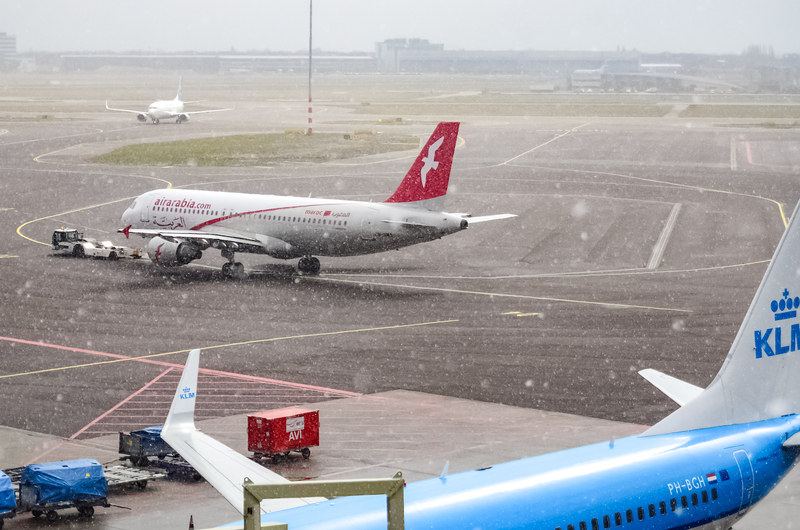
Amsterdam Schiphol (AMS) doesn’t need many snow days to feel the strain. As winter weather tightened its grip on the Netherlands in early January, Schiphol’s normally high-tempo operation slowed to a crawl—runway throughput dropped, de-icing queues ballooned, and the airport’s famously efficient surface movement turned into a parking lot with wings.
One KLM (KL) short-haul rotation captured the moment perfectly: a routine hop from AMS to London Heathrow (LHR) that never even made it to the runway. Instead, it became a case study in what happens when departure metering, de-icing capacity, and stand availability all hit their limits at the same time.
A “Flight” That Never Left AMS
KLM flight KL1003 is a staple business shuttle linking Amsterdam Schiphol (AMS) with London Heathrow (LHR), scheduled for an 08:35 local departure from AMS. On January 5, the service pushed back in the 09:00 hour as conditions deteriorated, joining a growing procession of aircraft inching along congested taxiways.
The aircraft assigned wasn’t an old workhorse—it was one of KLM’s newest narrowbodies, an Airbus A321neo (A21N) registered PH-AXA. KLM has been steadily introducing the type as part of its narrowbody modernization, shifting segments away from older Boeing 737 variants. In KLM’s configuration, the A321neo can carry up to 227 passengers, giving the airline a meaningful capacity step-up on intra-European trunk routes without jumping to widebody economics.

The A321neo is also built for exactly this kind of high-cycle network flying: it features Airbus’ “neo” efficiency package and new-generation engines, aiming for lower fuel burn and a significantly reduced noise footprint versus earlier single-aisle designs—advantages that matter at slot- and noise-sensitive airports like AMS and LHR.
But efficiency doesn’t help when the surface operation is saturated. After taxiing around the airfield for more than two hours—circling twice in a slow loop of stop-and-go ground movement—PH-AXA returned to a gate at AMS. KL1003 and its return sector were ultimately canceled, turning an hour-ish sector into a two-hour taxi followed by a trip back to the terminal.
Later that same day, PH-AXA finally did get airborne—operating a heavily delayed AMS–Dublin (DUB) rotation—illustrating how airlines try to salvage aircraft utilization once the worst of the peak disruption eases.
Why a Two-Hour Taxi Happens in the First Place
To airline ops professionals, “long taxi” is rarely just about snow on pavement. At a hub like Amsterdam Schiphol (AMS), it’s usually the compound effect of several constraints stacking up:
De-icing becomes a pacing item. Every departure must be clean and compliant before it can go. When snowfall persists, aircraft may need additional treatment, and queues can outlast holdover times—forcing repeat de-icing or returns to stand.
Runway capacity shrinks even if runways are “open.” Snow clearance cycles, braking action considerations, and wind-driven runway configuration changes can reduce departure and arrival rates. When the airport must repeatedly switch between clearing and operating, the schedule quickly becomes theoretical.
Stands and pushbacks get boxed in. If arrivals can’t get onto gates (or remote stands), departures can’t push, and aircraft already out can’t be staged efficiently. The result is surface gridlock: aircraft occupy taxi lanes that would normally be used to feed the departure sequence.

Network knock-on compounds instantly. A morning AMS–LHR cancellation isn’t just one lost sector. It can break down an aircraft’s full-day sequence, disrupt crew legality, and remove seats from multiple later flights—especially painful on dense shuttle routes where re-accommodation options are already constrained by weather and ATC flow programs.
Schiphol itself acknowledged the operational squeeze, warning that only limited air traffic was possible and that disruptions could continue for days as crews worked to keep runways usable and aircraft safely de-iced.
KLM’s De-Icing Reality: Volume, Trucks, and Supply Pressure
KLM isn’t just another airline at AMS—it’s the operator that effectively sets the pulse of the hub. During the disruption, KLM reported canceling hundreds of flights over multiple days, including 300 KLM flights canceled on January 5 and nearly 300 more on January 6, with further large-scale cancellations planned as forecasts stayed unfavorable.
Just as telling was the airline’s detail on de-icing capacity and supply: KLM stated it is responsible for de-icing most aircraft at Schiphol (AMS), running a de-icing team of more than 100 employees and operating 25 de-icing trucks. The airline said those teams had been using roughly 85,000 liters of de-icing fluid per day, and that supply was under pressure due to weather-driven logistics and delays from a Germany-based supplier—enough that KLM began arranging to collect additional fluid itself.
That’s an important operational nuance. When disruptions stretch beyond a single snow burst into multiple consecutive days, the limiting factor can shift from trucks and manpower to consumables and replenishment. And once the supply chain becomes a constraint, the airport’s recovery curve flattens—even if snowfall rates ease—because the system can’t instantly “catch up” on a backlog of departures requiring treatment.
Not Just KLM: Even an A380 Can End Up Waiting for Parking
Surface congestion doesn’t discriminate by aircraft size. Among the more striking secondary impacts at Amsterdam Schiphol (AMS) was Emirates flight EK147 from Dubai (DXB), operated by the Airbus A380. After landing at AMS, the superjumbo reportedly remained on the ground for roughly three hours before it could reach an A380-capable gate—an unusually long taxi-in/stand-wait scenario that underscores how gate constraints can become a bottleneck when the arrival bank keeps coming but stands aren’t turning.
For widebody operators, that kind of delay isn’t just inconvenient—it’s expensive. It can trigger passenger misconnections, disrupt minimum rest windows, and erode schedule integrity on long-haul rotations where spare aircraft are scarce. And when the return leg (AMS–DXB) must also queue for de-icing and an orderly departure slot, the downstream delay can stretch deep into the network.
Bottom Line
KLM’s KL1003 “taxi to nowhere” at Amsterdam Schiphol (AMS) wasn’t an oddity—it was a visible symptom of a hub operating at the edge of winter capacity. Put persistent snow, reduced runway rates, de-icing pacing, and stand constraints into the same box, and even a simple AMS–London Heathrow (LHR) shuttle can burn hours on the ground and still end up back at the gate.
For airlines, the operational lesson is blunt: in multi-day winter events, recovery isn’t just about reopening runways. It’s about restoring the entire production chain—de-icing fluid supply, truck cycles, gate availability, and departure sequencing—fast enough that aircraft can actually leave the blocks and reach the runway before the plan collapses again.