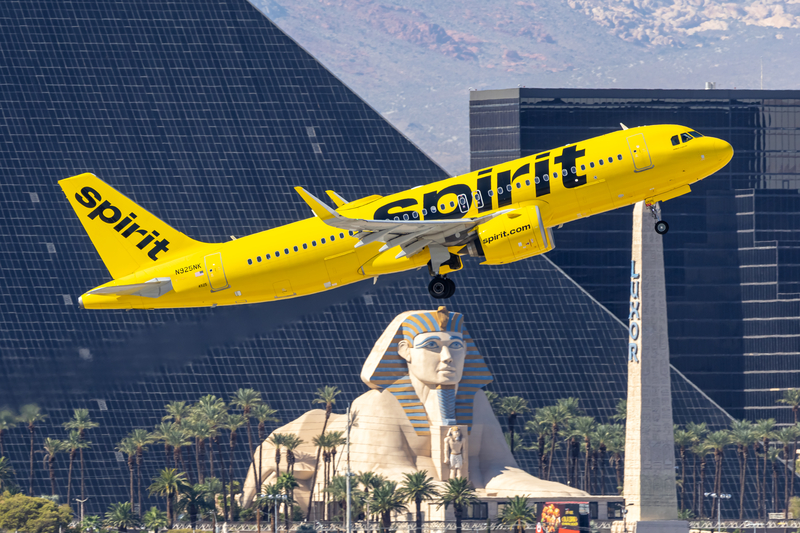
Is a Spirit Airlines shutdown imminent? Why the Dec. 13 funding milestone has rivals on edge
For weeks, the story around Spirit Airlines (NK) has been a familiar one: Chapter 11, fleet cuts, route trims, and a business model trying to outrun a bruising domestic fare environment. What’s different now is the calendar.
December 13 isn’t just another court date—it’s a cash-access checkpoint tied to Spirit’s debtor-in-possession (DIP) financing. Industry talk suggests some competitors are treating this weekend as a potential “lights out” scenario, even as Spirit insists it’s operating normally.
The Dec. 13 tripwire: how DIP funding can dictate the pace of operations
Spirit’s DIP facility is structured in tranches—cash that becomes available only if the airline clears specific milestones. In plain language: the airline doesn’t just have the money, it has to earn the right to draw it.
The math that matters:
-
Spirit’s DIP totals up to $475 million.
-
$200 million was the initial funded amount.
-
Additional draws include $75 million (already scheduled earlier in the process) and $100 million on Dec. 13, with another $100 million slated for a later date.

The Dec. 13 piece is the headline because it’s a binary moment: if Spirit can’t satisfy the conditions to draw that tranche—or elects not to—then the commitment can effectively evaporate. That doesn’t automatically mean planes stop mid-taxi, but it can compress the airline’s financial “runway” from weeks into days, especially in an operation with heavy daily cash needs (fuel, airport fees, ground handling, and the constant churn of refunds and rebookings during disruptions).
What do lenders want to see by Dec. 13? A credible path forward—typically framed as either:

-
meaningful progress toward a strategic transaction (sale/merger-style outcomes), or
-
the outline of an acceptable reorganization plan that would actually get Spirit out of court with a viable, fundable business.
That’s why this milestone is being viewed less like paperwork and more like an operational heartbeat.
Where a shutdown would hit hardest: the Spirit map is airport-specific
Spirit isn’t a hub-and-spoke legacy carrier; it’s a high-utilization, A320-family machine that concentrates heavily in certain markets. If you want to understand disruption risk, start with crew bases and high-volume stations—the places where aircraft and crews are positioned to keep the schedule tight.
Spirit’s crew-base footprint includes (among others):
-
Fort Lauderdale (FLL) – Fort Lauderdale–Hollywood International Airport
-
Orlando (MCO) – Orlando International Airport
-
Las Vegas (LAS) – Harry Reid International Airport
-
Detroit (DTW) – Detroit Metropolitan Wayne County Airport
-
Chicago (ORD) – O’Hare International Airport
-
Miami (MIA) – Miami International Airport
-
Newark (EWR) – Newark Liberty International Airport
-
Atlanta (ATL) – Hartsfield–Jackson Atlanta International Airport
-
Dallas/Fort Worth (DFW) – Dallas Fort Worth International Airport
-
Houston (IAH) – George Bush Intercontinental Airport
Why those codes matter: these are the airports where you’d most expect same-day cascading cancellations if operations stop—because that’s where aircraft rotations, reserve staffing, and maintenance positioning tend to be anchored.
And remember: Spirit’s cancellations are “high passenger count” events. A single Airbus A321 flight at 228 seats is not the same disruption as a 76-seat regional jet canceling at a legacy—especially at leisure-heavy airports like MCO and FLL where multiple full flights can be packed with families, cruise connections, and nonrefundable hotel nights.
The airplane factor: Spirit’s all-Airbus fleet is simple—until it isn’t
Spirit’s fleet strategy has long been straightforward: one narrowbody family, maximum commonality, and high-density seating to drive unit costs down.
Airbus A320ceo / A320neo
These are the workhorses. Spirit’s A320s are typically configured around 178–182 seats, depending on sub-variant and interior layout. The A320neo adds newer engines and aerodynamic improvements designed to reduce fuel burn and improve range—great on paper for a ULCC that lives and dies by CASM.
Airbus A321ceo / A321neo
This is where Spirit quietly gets its “widebody economics” on a single aisle. The A321 is commonly configured at 228 seats in Spirit’s layout, and in some configurations the A321neo can go even higher. That’s a lot of revenue potential when loads are strong—and a lot of stranded passengers when flights cancel.
The engine wrinkle avgeeks care about
A meaningful portion of Spirit’s A320neo-family operation has been tied up in the industry’s broader geared turbofan (GTF) inspection and shop-visit backlog. When you’re trying to run a lean schedule with maximum utilization, unexpected ground time is poison: fewer available tails means fewer options to swap aircraft, fewer spare rotations, and a brittle network that breaks faster during irregular operations.
Fleet commonality is still an advantage—but only when your “common” fleet isn’t constrained by supply-chain bottlenecks, shop capacity, or lease returns happening on a court timeline.
Chapter 11 doesn’t mean shutdown—until it suddenly does
Airlines can (and often do) keep flying through Chapter 11. Tickets still sell, crews still work, and passengers may never notice—right up to the moment when something essential seizes up.
In a stressed airline, the failure modes tend to be very specific:
-
Liquidity compression (a missed draw, an accelerated collateral requirement, or unexpected cash leakage)
-
Vendor tightening (fuel and handling vendors shortening payment terms)
-
Aircraft availability shocks (lease rejections/returns clustering faster than the network can shrink)
-
Operational staffing instability (attrition rises when employees doubt the airline’s future)
Spirit has already been shrinking and reshaping—cutting capacity, shedding aircraft commitments, and monetizing assets. Moves like gate and lease changes at major airports (ORD, for example) are normal tools in restructuring, but they also signal how aggressively the airline is trying to re-size the business.
That’s why competitors aren’t just watching filings; they’re watching whether Spirit can keep the schedule intact.
If the worst happens: what travelers should do at FLL, MCO, LAS, and beyond
If Spirit continues operating, this weekend becomes just another tense milestone in a long restructuring.
If it doesn’t, the passenger experience will look different from a legacy-carrier meltdown because Spirit’s model is built with limited interline protection. In practical terms, that can mean fewer automatic rebookings onto other airlines—and more self-help.
If you (or your readers) are flying Spirit in the next few days:
-
Favor morning departures where possible (more recovery options if the day unravels).
-
Avoid tight same-day cruise or resort connections out of FLL or MCO.
-
Keep a backup plan from the same airport—especially at Spirit-heavy stations like LAS, DTW, and MIA.
-
Monitor for schedule changes early and be ready to pivot; the earlier you move, the more inventory still exists.
Airports should also be thinking tactically: if Spirit capacity disappears at a station like MCO or FLL, competitors can backfill only so fast—especially around weekend peak demand. Expect higher last-minute fares and fuller cabins systemwide.
Bottom Line
Spirit’s Dec. 13 DIP milestone is a real pressure point—not because a missed tranche automatically grounds airplanes, but because it can rapidly shrink the airline’s cash runway and force hard decisions in hours, not weeks. Competitors appear to be modeling a worst-case scenario at key Spirit airports like Fort Lauderdale (FLL), Orlando (MCO), and Las Vegas (LAS), while Spirit maintains it’s operating normally.
Either way, this is one of those moments where finance and ops collide: the next $100 million isn’t just money—it’s time.