Fancy Being On This Bizarre, Multi-Stop Boeing 777 Route?
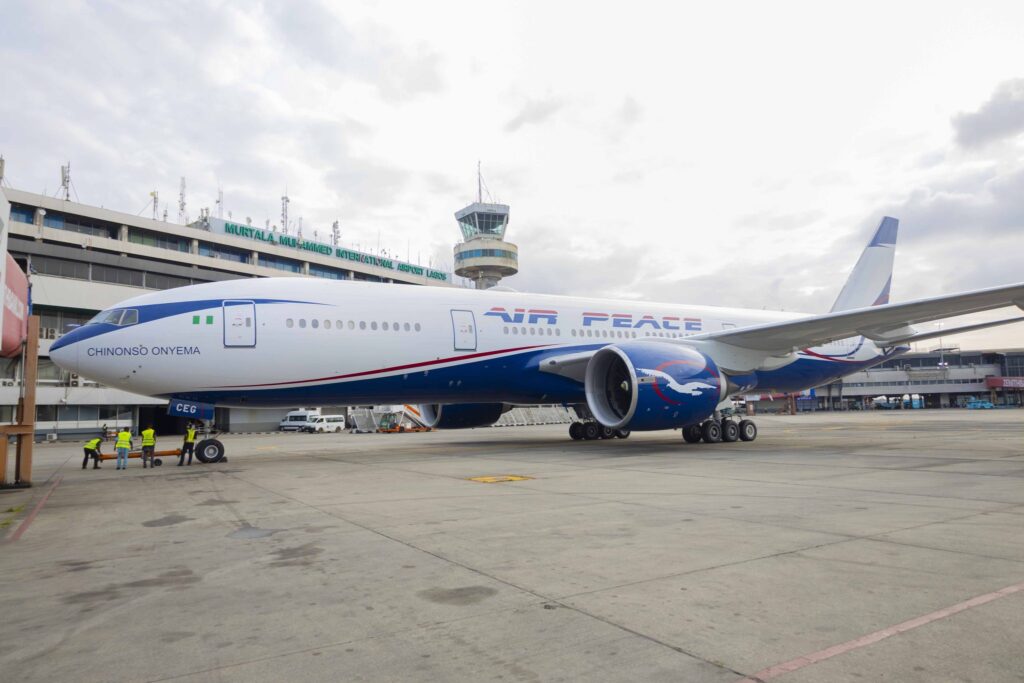
Air Peace may be best known for dense West African flying—and, increasingly, for its UK expansion from Abuja (ABV) to London Heathrow (LHR) and London Gatwick (LGW). But for a handful of days around Christmas, the Lagos-based carrier is trying something you don’t see every season: a Boeing 777 “island-hop” service linking West Africa to the Caribbean via multiple stops.
On the surface, it looks like the kind of route map you’d sketch on a napkin after one too many coffees. In reality, it’s closer to a tour-driven charter concept: Air Peace is leaning on travel partners in Nigeria and Ghana to bundle flights with packaged holidays, effectively creating demand rather than relying on a deep pool of existing point-to-point traffic.
The Route: ACC To The Caribbean—Via LOS And A String Of Island Stops
The holiday operation is built around Accra (ACC) at Kotoka International Airport and Lagos (LOS) at Murtala Muhammed International Airport. From there, the aircraft heads west into the Caribbean, touching down at a mix of leisure and regional gateways—each perfectly capable of handling widebodies, but rarely seeing a 777 arrive straight from West Africa.
The filed routing for the most eye-catching version of this service is:
-
Accra (ACC) → Lagos (LOS)
-
Lagos (LOS) → St. John’s, Antigua (ANU) — V.C. Bird International Airport
-
Antigua (ANU) → Bridgetown, Barbados (BGI) — Grantley Adams International Airport
-
Barbados (BGI) → Port of Spain, Trinidad (POS) — Piarco International Airport
-
Port of Spain (POS) → Kingston, Jamaica (KIN) — Norman Manley International Airport

A full run like that covers roughly 5,500 nautical miles (~10,260 km) in one direction (great-circle), with the single longest jump being LOS–ANU at about 3,860 nm—well within Boeing 777 territory, even for non-ER variants.
One important technicality: even if the aircraft physically flies island to island, Air Peace shouldn’t be expected to sell tickets for intra-Caribbean segments like ANU–BGI or BGI–POS as standalone flights. Without fifth-freedom traffic rights, those legs are typically just parts of a through itinerary that originates in West Africa.
The Schedule Is… Fluid (And That’s Part Of The Story)
Here’s where airline fans should lean in: the Caribbean operation has shown meaningful inconsistencies depending on where you look.
Air Peace’s own Caribbean marketing emphasizes service between Lagos (LOS) / Accra (ACC) and Antigua (ANU) plus Barbados (BGI), presented as a clean, tourism-friendly “direct” concept (in practice, a direct service can still include intermediate stops). Meanwhile, schedule filings for the peak-holiday dates have, at times, shown the aircraft continuing beyond Barbados to Port of Spain (POS) and Kingston (KIN).

That doesn’t automatically mean anything is “wrong”—charter-style operations are often tweaked late based on hotel blocks, tour group sizes, and ground handling arrangements. But it does mean one thing for readers: treat the exact stop pattern as subject to change until the day-of-operation.
The Airplane: Why A Boeing 777 Makes This Work At All
A multi-stop routing like ACC–LOS–ANU–BGI–POS–KIN is only plausible because Air Peace is using a Boeing 777—a twin-engine widebody designed for long overwater sectors, high payload capability, and strong dispatch reliability.
A few 777 nerd-notes that matter here:
-
Range & reserves: Even a baseline 777-300 has enough legs to handle LOS–ANU with appropriate fuel planning, alternates, and seasonal wind considerations. A 777-200ER offers additional flexibility and is commonly used for long-haul missions.
-
Cabin economics: A 777 doesn’t need a thick premium market to work on charters. What it needs is volume—exactly what tour operators are paid to deliver.
-
Operational flexibility: With multiple Caribbean stops, the airline can effectively “distribute” passengers—dropping groups where their packages start—rather than needing one destination to fill the entire aircraft.
Which 777 Will It Be? The Tail And Seat-Count Mystery
One of the most interesting wrinkles is that Air Peace’s 777 subfleet isn’t a cookie-cutter operation. The airline has brought in multiple 777s with different cabin layouts, which is unusual for such a small widebody group and complicates everything from seat maps to revenue management.
Some data sources have tagged the Caribbean flights as a high-density 777. But publicly available airframe information for the airline’s best-known 777-300, 5N-BWI, points to a cabin closer to ~284 seats (with a premium-heavy layout by charter standards), and it’s an older airframe—first flying in 2005—originally delivered to Singapore Airlines as 9V-SYK.
Separate from that, Air Peace has also highlighted a newer 777 delivery configured at 312 seats (26 in business and 286 in economy), underlining the broader point: seat counts vary by tail, and a “319-seat 777” claim should be treated as schedule-feed shorthand until the actual aircraft assignment is visible.
For enthusiasts, this becomes the watch item: what actually shows up at LOS the morning the aircraft heads for ANU. If it’s 5N-BWI, you’re likely looking at a 777-300 with Rolls-Royce Trent power. If it’s another frame, the cabin (and even variant) could differ.
Does This Caribbean Experiment Make Sense?
In pure O&D terms, West Africa–Caribbean demand isn’t exactly a tidal wave. That’s why this is best understood as market creation, not market capture.
The logic is straightforward:
-
Christmas timing raises the ceiling for discretionary travel.
-
Tour bundles reduce the airline’s risk by turning seats into packaged inventory.
-
Multiple stops allow the airline to serve several leisure markets with one aircraft rotation, rather than betting the farm on a single destination.
The risks are also obvious:
-
Station complexity multiplies with every additional stop (handling, catering, irregular ops recovery, crew duty considerations).
-
Schedule volatility makes it harder for passengers to plan onward connections—especially if the carrier adjusts the stop pattern.
-
No intra-Caribbean sales means those short hops don’t generate local revenue; they’re purely there to position the same set of passengers.
If Air Peace can reliably fill the jet with tour traffic out of ACC and LOS, it’s a clever way to put a 777 to work outside the airline’s more “normal” long-haul missions to LHR/LGW. If it can’t, the operation becomes an expensive novelty very quickly.
Bottom Line
Air Peace is set to run a genuinely unusual Christmas-period Boeing 777 operation linking Accra (ACC) and Lagos (LOS) with Caribbean stops including St. John’s (ANU), Bridgetown (BGI), and—depending on the final version of the schedule—possibly Port of Spain (POS) and Kingston (KIN). It’s less a conventional airline route and more a tour-operator-backed experiment designed to manufacture demand.
For airline fans, the real intrigue is in the details: which 777 shows up, what cabin it carries, whether the multi-stop pattern holds, and if this evolves into the “monthly” concept the airline has hinted at.