Back on the Map: Oman Air Brings Singapore Back With a 737 MAX Nonstop
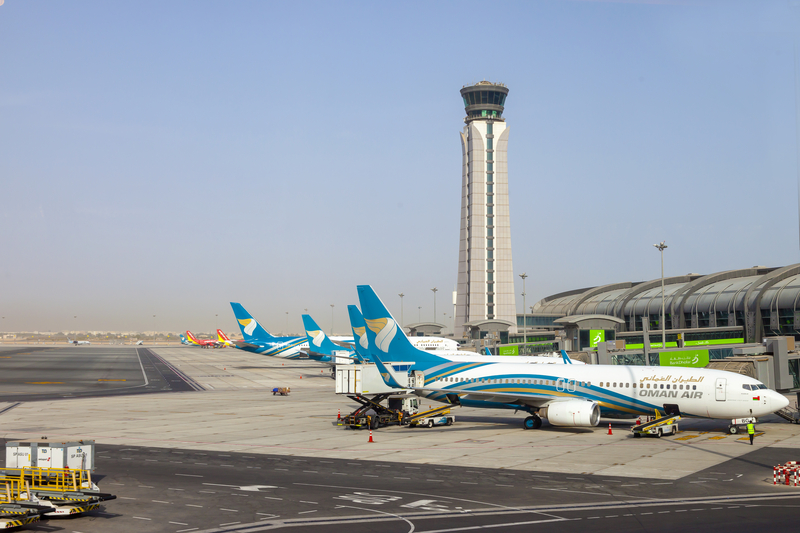
After nearly a decade away, Oman Air is returning to Singapore Changi Airport (SIN) with a nonstop link to its Muscat hub at Muscat International Airport (MCT). The service is scheduled to begin on July 2, 2026, restoring a city-pair that has been without direct flights since 2017—and doing it with a modern narrowbody that’s increasingly redefining what “long-haul” can look like.
This isn’t just another route announcement. A 4x-weekly MCT–SIN operation sits at the intersection of two big themes reshaping Oman Air: a deliberate pivot toward higher-quality point-to-point demand, and the growing role of long-range narrowbodies in markets that historically required widebodies to make the economics work.
Route Snapshot: MCT–SIN, Four Weekly From July 2026
Oman Air plans to operate four flights per week between Muscat (MCT) and Singapore (SIN) starting July 2, 2026. The sector is roughly 2,980 nautical miles—long enough to sit firmly in “serious flying” territory for a single-aisle aircraft, yet still within the performance envelope of today’s narrowbody workhorses.
For Oman Air, that distance matters: it positions Singapore as the carrier’s longest narrowbody route and a clear statement that the airline sees value in using a right-sized aircraft to rebuild Asian coverage without taking on widebody risk.
Why a Boeing 737-8 MAX Makes Sense Here
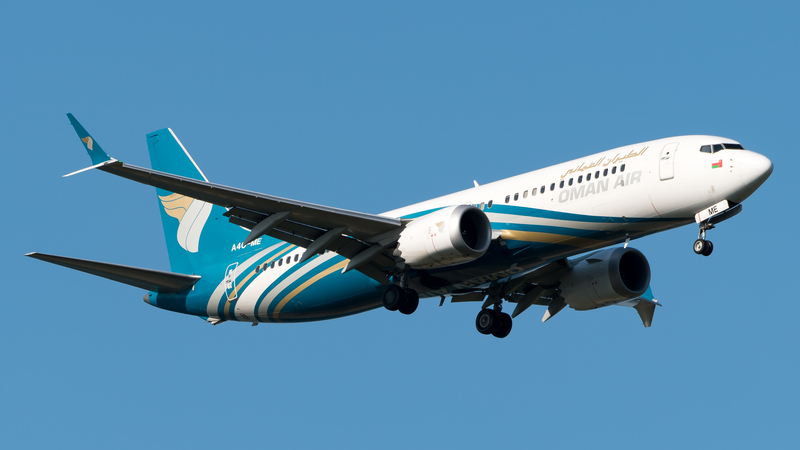
A Muscat–Singapore nonstop on a Boeing 737-8 (737 MAX 8) would have sounded ambitious a generation ago. Today, it’s increasingly conventional—because the MAX 8 is built for exactly this kind of mission profile:
-
Range to spare (on paper): Boeing lists the 737-8 with a published range of about 3,500 nautical miles. That gives the route a workable cushion over the ~2,980-nm great-circle distance, though real-world payload, winds, and routing will always dictate final performance.
-
Right-sized capacity: Oman Air’s 737-8s are configured with 162 seats (12 in Business, 150 in Economy). That’s a meaningful advantage in thinner long-haul markets where a widebody can be too much airplane, too many days per week.
-
Product that still feels “mainline”: This is not a stripped-down subfleet. The 737-8 cabins are positioned as a premium narrowbody offering—important on a flight that can push close to eight hours gate-to-gate.
Long-range narrowbody economics don’t just help airlines launch routes; they help them keep routes. A 4x-weekly pattern can build awareness, capture time-sensitive traffic, and still leave room to scale—either with added frequencies or, eventually, an upgauge—if demand proves durable.
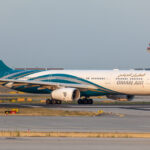
Cabin and Passenger Experience: What to Expect on an 8-Hour Narrowbody
An eight-hour flight on a single-aisle jet lives or dies by the onboard experience—and Oman Air knows that. Its 737-8 layout is designed to feel closer to a long-haul product than a regional hop:
-
Business Class: 12 recliner-style seats in a 2-2 layout, with generous pitch for a narrowbody premium cabin and seatback IFE.
-
Economy Class: 3-3 seating, with seatback screens and USB power that help take the edge off a longer mission.
Is it lie-flat? No—and that’s a key distinction versus what travelers might associate with Gulf-region premium cabins on widebodies. But on a route where the alternative is often a one-stop itinerary via another hub, a well-executed nonstop can be more valuable than a flatter seat.

The Demand Story: Indirect Traffic Has Been Growing Without a Nonstop
What makes MCT–SIN intriguing is that demand has been building even without nonstop service. Recent market data indicates that Oman–Singapore passenger volumes rose sharply year-over-year, despite all travelers having to connect—typically over the larger Gulf hubs.
That’s the kind of demand curve airlines like to see before launching a nonstop: if people are already making the trip via connecting itineraries, a direct flight can capture time savings, reduce total journey friction, and pull travelers who previously defaulted to the biggest networks.
And Singapore (SIN) isn’t just a destination—it’s a premium-origin market with high connectivity, strong corporate travel infrastructure, and reliable onward options. For Oman Air, this route can win both local traffic (Oman–Singapore point-to-point) and connectors through Muscat (MCT).
Competitive Context: The Gulf Is Crowded, but Muscat Isn’t Doha
Let’s be clear: the Oman–Singapore market sits in a brutally competitive neighborhood. Travelers between Southeast Asia and the Middle East already have abundant options via major hubs, with multiple daily frequencies, widebody capacity, and deep alliance networks.
Oman Air’s play here is different. It’s not trying to out-frequency the mega-hubs. Instead, it’s leaning into:
-
A more boutique hub proposition at MCT, where connections can be less chaotic than the region’s largest transfer complexes.
-
A narrower, more deliberate network focus, which aligns with an airline attempting to improve profitability rather than chase scale.
-
Alliance relevance: Now that Oman Air is integrated into oneworld, the carrier can market smoother partnership connectivity in both directions—particularly valuable in Singapore, where alliance logic can influence corporate buying and frequent flyer behavior.
Singapore’s traveler base is also highly schedule-sensitive. If Oman Air times MCT–SIN banks to connect efficiently to key Europe flows and select regional points, it doesn’t need to dominate—just to be meaningfully convenient.
Network Strategy: A Route That Matches Oman Air’s Transformation
Oman Air has been explicit about shifting away from a heavily transit-dependent model and growing higher-quality point-to-point traffic. A 737-8 route to Singapore is consistent with that strategy in three ways:
-
It’s a measured bet. Four flights per week limits exposure while testing the market properly.
-
It’s right-sized. A 162-seat narrowbody reduces the pressure to “fill the airplane at any cost.”
-
It supports Muscat (MCT) as a credible link between regions without forcing the airline into an all-or-nothing widebody deployment.
This route also lands amid a broader pattern of network tuning—adding, resuming, or re-shaping service to prioritize markets that can sustain yields and consistency, rather than simply painting the map.
Operational Reality: Long Narrowbody Flying Isn’t “Set and Forget”
A 2,980-nm sector is well within modern narrowbody capability, but it’s not a trivial assignment. Airlines planning these routes need to account for:
-
Seasonal winds that can meaningfully alter block times (particularly westbound versus eastbound patterns).
-
Payload-performance tradeoffs during hot Gulf summers, where high temperatures can impact takeoff performance.
-
Dispatch reliability expectations in Singapore (SIN), where premium passengers and corporate accounts tend to be less tolerant of irregular ops.
Still, the 737-8 is a proven platform on longer sectors worldwide, and the MCT–SIN mission is precisely the sort of “long thin” flying that long-range narrowbodies were built to unlock.
Bottom Line
Oman Air’s return to Singapore Changi (SIN) from Muscat (MCT) on July 2, 2026 is more than a route comeback—it’s a strategic signal. Using a Boeing 737-8 to fly nearly 3,000 nautical miles, four times weekly, gives Oman Air a right-sized way to rebuild Southeast Asia presence while staying aligned with its broader profitability-driven transformation. If the airline can execute the schedule well and sell the nonstop advantage in a market long dominated by one-stop hub options, MCT–SIN could become a quiet but meaningful win.