Airlines Add Lift Fast After FAA Eastern Caribbean Curbs Expire
A peak winter travel weekend in the Eastern Caribbean and northern Latin America turned into a network-recovery test almost overnight. Following U.S. military action in Venezuela, the Federal Aviation Administration (FAA) issued temporary airspace restrictions that forced widespread cancellations and left aircraft and crews out of position across island stations that aren’t built for surge operations.
The directive has since expired, and flights are moving again. But anyone who runs an airline ops desk knows the hard part isn’t the reopening—it’s the unwind. Once a tightly-timed Caribbean schedule breaks, the backlog doesn’t clear just because the airspace does. Airlines have to rethread aircraft rotations, rebuild crews within duty-time limits, and re-accommodate passengers across airports where gate space, holding rooms, baggage systems, and even hotel inventory are finite.
What’s notable this time: the speed at which U.S. carriers pivoted from cancellations to capacity injections—using every lever available, from upgauging aircraft to launching “island hopper” shuttles to funnel stranded travelers into bigger departure points like San Juan (SJU) and Miami (MIA).
Why a One-Day Airspace Disruption Becomes a Multi-Day Recovery
Airline recovery is a sequencing problem, not a single restart button. A short shutdown cascades because:
-
Aircraft positioning breaks the rotation. A narrowbody that was supposed to sleep in San Juan (SJU) may have ended up back in Atlanta (ATL) or Miami (MIA)—or never left the mainland at all.
-
Crew legality becomes the gating factor. Even if the airplane is available, pilots and flight attendants may time out, especially when diversions and delays stack.
-
Island infrastructure magnifies the crunch. Many Caribbean terminals can’t comfortably absorb mass rebookings, irregular ops lines, and multiple recovery departures at once.
-
Misconnects multiply. A canceled short hop from Anguilla (AXA) or St. Thomas (STT) doesn’t just strand passengers locally—it severs onward connections to U.S. hubs where reaccommodation capacity is already tight post-holiday.
That’s why the largest carriers—those with fleet depth and spare crews—tend to look “fastest” in recovery. They aren’t immune to disruption; they simply have more options.
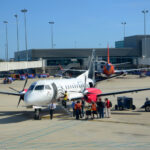
Delta’s Rapid Capacity Add: 2,600+ Seats and a Tight Reaccommodation Window
Delta Air Lines moved quickly to stabilize its Caribbean operation, leaning on its scale and hub connectivity—particularly out of Hartsfield-Jackson Atlanta International Airport (ATL), plus large coastal gateways like New York (JFK) and Boston (BOS) that feed Caribbean leisure demand.
Delta stated it added more than 2,600 seats via extra flights across its Caribbean network for Monday, January 5, with teams working to have affected customers reaccommodated by Tuesday, January 6. Operationally, that timeline matters: it signals Delta wasn’t just adding “nice to have” sections—it was building a two-day recovery plan designed to clear the highest-risk stranded passenger pools before the midweek schedule normalized.
The airline also advised customers with confirmed or rebooked tickets to arrive at least three hours early at affected Caribbean airports—an unusually blunt instruction, but one that reflects realities on the ground. When multiple carriers push recovery lift through the same constrained terminals, check-in queues, TSA/secondary screening, and baggage flows can become the day’s bottleneck long before the runway does.
From an aircraft perspective, Delta’s Caribbean flying is typically narrowbody-heavy, and that’s a feature in recovery: aircraft like the Boeing 737-900ER and Airbus A321-family can be retimed, swapped, and re-crewed more flexibly than widebodies. When a carrier does “upgauge” during irregular ops, it’s often to aircraft with higher seat density and strong short-to-medium-haul economics—think Boeing 757-200s (where available) or larger-gauge A321 variants—because you can add seats without adding new airport slots.
American’s Eastern Caribbean Bridge: Island Hoppers to SJU, Widebody Lift to MIA
American Airlines’ recovery strategy was the most structurally interesting—because it combined added seats with a deliberate funneling operation through San Juan (SJU), a natural collection point for the northeastern Caribbean.
American reported nearly 7,000 additional seats across 43 extra flights as airspace access returned. The centerpiece was a rare move: limited interisland flying operated with wholly owned regional carrier Envoy Air, connecting:
-
Anguilla Wallblake Airport (AXA) → Luis Muñoz Marín International Airport (SJU)
-
Terrance B. Lettsome International Airport on Beef Island (EIS) → Luis Muñoz Marín International Airport (SJU)
This kind of ad-hoc interisland service isn’t about profitability—it’s about restoring connectivity. When travelers are stranded at smaller stations like AXA and EIS, adding a direct flight to the mainland may be constrained by aircraft availability, runway performance, or airport handling limits. But a short repositioning flight into SJU can unlock access to a much larger bank of departures.
American then layered in high-capacity lift between San Juan (SJU) and Miami (MIA) using the Boeing 777-300ER (American often short-hands it as the “777-300”), the airline’s largest aircraft type. For airline pros, that choice is telling:
-
The 777-300ER brings well over 300 seats in a typical three-cabin long-haul layout—often approaching two narrowbodies’ worth of capacity in a single departure.
-
It’s powered by GE90-series engines and designed for long-range missions, but in recovery it becomes a seat-mover: high volume, fewer frequencies, faster backlog relief.
-
Widebody deployment also reduces pressure on constrained departure banks—one big push can be easier than multiple smaller pushes when gates and staffing are stretched.
Beyond SJU–MIA, American also scheduled added flying from Miami (MIA) to a set of Eastern Caribbean points, including Bridgetown, Barbados (BGI), Bonaire (BON), Grenada (GND), St. Kitts (SKB), and Dominica (DOM). (A quick note for the detail-minded: DOM is widely known today as Douglas-Charles Airport, though it’s still sometimes referenced by the island’s older “Melville Hall” naming in operational contexts.)
American’s broader hub structure mattered here, too. With large-scale operations through Miami (MIA), Charlotte (CLT), and Chicago O’Hare (ORD), the carrier could reroute flows and rebuild connections without relying on a single gateway.
United, JetBlue, and Southwest: Recovery Levers Without Widebody Overkill
Not every carrier can—or should—throw a 777 at the problem. For other U.S. airlines, the recovery toolkit is more about extra sections, retimings, and customer flexibility, paired with fleets optimized for high-frequency short-haul flying.
United Airlines focused on schedule restoration and recovery lift from major hubs like Newark (EWR), Houston (IAH), and Washington Dulles (IAD). Operationally, United’s Caribbean network is well-suited to irregular ops recovery because it leans on narrowbodies (Boeing 737 and Airbus A320-family), which can be rotated quickly and scaled through additional frequencies when crews and gates allow.
JetBlue, a major Caribbean player out of New York (JFK) and Boston (BOS), had a large volume of cancellations during the shutdown and then worked through rebooking and added flying as airspace access returned. JetBlue’s fleet mix—Airbus A320/A321-family and A220-300—also supports rapid recovery because the airline can add sections with aircraft that are already optimized for stage lengths common to SJU (San Juan), STT (St. Thomas), AUA (Aruba), CUR (Curaçao), and similar markets.
Southwest Airlines, operating an all-Boeing 737 fleet, leaned on added lift to key leisure markets including San Juan (SJU) and Aruba (AUA). An all-737 operation simplifies recovery in one important way: aircraft and crews are more interchangeable, which helps when you’re rebuilding rotations quickly across multiple stations.
The Next Constraint: Advisories, Routing, and Fuel Planning
Even after a restriction expires, airlines don’t instantly revert to “normal.” Carriers will continue to manage risk and reliability through:
-
Conservative routing choices around Venezuelan airspace, which can add track miles and pressure block times.
-
Fuel and alternate planning for island destinations where alternates may be limited and weather volatility is routine.
-
Airport-side crowding at the most impacted stations—especially when multiple airlines surge capacity on the same day.
For travelers, that translates to a reality ops teams know well: the airspace may be open, but recovery performance is measured in days, not hours.
Bottom Line
The FAA’s temporary Eastern Caribbean curbs may have been short-lived, but the operational hangover is exactly the kind that stresses a network: constrained airports, peak-season loads, mispositioned assets, and a large pool of disrupted itineraries.
Delta’s approach emphasized rapid seat injection and disciplined reaccommodation targets. American’s playbook stood out for its “bridge” strategy—using interisland flights into San Juan (SJU) to feed a widebody lift out to Miami (MIA). Meanwhile, United, JetBlue, and Southwest leaned on the narrowbody flexibility that makes Caribbean networks resilient when things go sideways.
In airline terms, this was a reminder that the reopening headline is only the start. The real story is how quickly a carrier can rebuild the machine—aircraft, crews, gates, and connections—without breaking the rest of the schedule.