AirAsia X Becomes “AirAsia” on January 19: What the One-Brand Consolidation Really Means for the Group
AirAsia’s long-haul arm is preparing for one of the biggest branding and corporate resets in the group’s history. AirAsia X (D7) says it will rebrand as AirAsia on January 19, 2026, aligning with a broader consolidation that brings the group’s short-haul and long-haul airline businesses under a single listed aviation entity.
For an airline group built on a clear split—short-haul “AirAsia” versus long-haul “AirAsia X”—this is more than a coat of paint. It’s a structural move designed to simplify the story for customers, investors, and lessors while parent company Capital A attempts to close the book on its financially distressed status and reposition itself as a non-aviation holding company.
What changes on January 19 and why it matters
The headline is simple: AirAsia X rebrands to AirAsia. The mechanics behind it are the real story.
The group is in the final stages of transferring Capital A’s aviation assets into AirAsia X via a MYR 6.8 billion transaction. Once that consolidation completes, the airline group intends to operate as one brand with “global ambitions,” rather than maintaining two public-facing airline identities.
Operationally, passengers should not expect an overnight reinvention of networks or onboard product. The near-term impact is mostly “front-end”: brand alignment, corporate structure, and (eventually) a cleaner way to sell connecting itineraries and present schedules through a single airline umbrella originating heavily from Kuala Lumpur International Airport (KUL).
Investor-facing, however, the date is pivotal. Capital A is timing the rebrand alongside steps tied to its restructuring roadmap, including share-related milestones and its attempt to lift the PN17 classification (Malaysia’s financially distressed designation).
PN17, in airline terms
Airlines are used to operating with complexity—multiple AOCs, aircraft leases, sale-and-leasebacks, joint ventures, and shifting capital structures. PN17 is different: it’s a public label that signals a company is in distress and must execute a corrective plan.
For Capital A, removing PN17 isn’t just reputational. It affects capital access, investor confidence, and the group’s ability to place aircraft orders on favorable terms—particularly critical for a low-cost airline trying to win the next cycle on unit costs and fleet efficiency.
Why consolidate long-haul and short-haul under one airline group
AirAsia historically split the business because the long-haul operation behaves differently:
-
Longer stage lengths and higher exposure to fuel and currency swings
-
More complex crew duty patterns and disruption recovery
-
Greater sensitivity to seasonality and yield volatility
-
Different fleet economics versus short-haul narrowbody flying
By bringing short-haul and long-haul aviation assets into one listed airline group and standardizing the brand, AirAsia can sell a simpler proposition to the market: one airline identity, one network narrative, one set of growth ambitions.
In practical terms, this kind of consolidation typically targets three outcomes:
-
Lower overhead duplication (brand, distribution, corporate functions)
-
Tighter fleet planning (one group optimizing gauge and deployment)
-
More credible global connectivity (a single “AirAsia” presented to customers)
The group’s leadership has also framed it as a platform for expansion beyond the traditional Asia-Pacific low-cost footprint.
Fleet reality today and where the cost curve is headed
AirAsia is still defined by Airbus narrowbodies in short-haul flying—A320-family aircraft that are optimized for high cycle utilization, fast turns, and dense seating layouts.
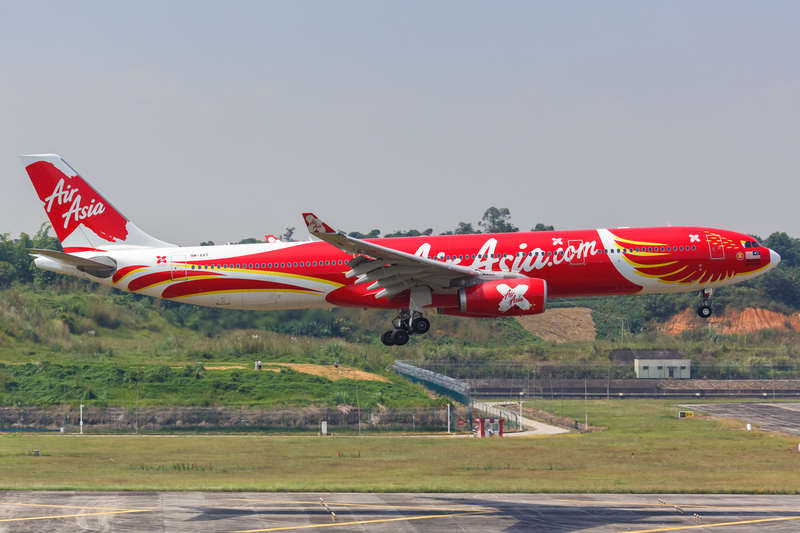
AirAsia X, meanwhile, has been associated with widebody flying, notably the Airbus A330-300, which has historically been the backbone of its longer sectors out of Kuala Lumpur International Airport (KUL). The A330-300 remains a proven high-density platform for medium-to-long haul LCC flying, but it carries two structural challenges for a price-led airline:
-
Widebody trip costs can be unforgiving when yields soften
-
Long-haul demand is highly seasonal, which punishes utilization
That’s why the group’s stated direction has been increasingly focused on single-aisle long-range flying—aircraft like the Airbus A321neo family and A321XLR. For airline professionals, the appeal is obvious: lower trip costs than a widebody, better right-sizing for thinner long sectors, and more flexibility to redeploy aircraft when demand shifts.
If AirAsia’s next aircraft order leans heavily into this narrowbody long-range strategy, it supports a network vision that looks less like “classic long-haul low-cost” and more like a high-frequency, long-range narrowbody network that can bridge regions with more consistent economics.
The Bahrain hub talk: big ambition, big execution burden
One of the most strategically intriguing elements is AirAsia’s repeated signaling around a Middle East hub concept at Bahrain International Airport (BAH)—framed as a way to build a low-cost network bridging Asia, Europe, and beyond, while drawing comparisons to the connectivity powerhouses at Dubai International Airport (DXB) and Doha Hamad International Airport (DOH).
A Bahrain (BAH) hub could make network sense on paper for a few reasons:
-
Geography that supports connecting flows between South/Southeast Asia and Europe
-
Potential to diversify away from purely Asia-centric demand cycles
-
A middle “transfer point” that could enable long-range narrowbody routings in both directions
But the execution hurdles are material. A viable hub requires bank structure, operational resilience, ground handling capability, bilateral traffic rights, and competitive connecting product logic. For a low-cost group, it also must work without the premium-yield cushion that carriers like Emirates and Qatar Airways can rely on.
In other words: Bahrain (BAH) could be an accelerant, but only if the fleet, connectivity design, and cost base are aligned—and if the regulatory and commercial scaffolding is solid.
What passengers should actually expect in 2026
This rebrand is best viewed as a foundation move, not a sudden network revolution.
Near-term expectations should be realistic:
-
Branding will unify first—names, marketing, and the way the airline group presents itself.
-
Schedules won’t instantly change simply because the name does.
-
Interline/codeshare depth may improve over time, but passengers shouldn’t assume immediate alliance-like benefits.
-
Fleet optimization will be gradual, driven by deliveries, lease transitions, and retrofit cycles.
The travel experience impact—connectivity, baggage processes across partner airlines, loyalty mechanics, and product segmentation—tends to arrive in phases after the corporate structure is stabilized.
Bottom Line
AirAsia X’s move to rebrand as AirAsia on January 19, 2026 is the visible tip of a broader consolidation designed to place the group’s short-haul and long-haul aviation assets under one listed airline entity, simplify the brand, and strengthen the business case for fresh fleet investment. With Kuala Lumpur International Airport (KUL) as the core anchor and Bahrain International Airport (BAH) being talked up as a future global connector, the ambition is clear—but the outcome will hinge on disciplined fleet choices, credible hub execution, and whether the post-restructuring balance sheet can support sustained expansion.