Air France Sends Its Densest 472-Seat Boeing 777 To Phuket
Air France Adds Phuket To Its Thai Network
Air France has officially launched flights between Paris Charles de Gaulle (CDG) and Phuket (HKT), doubling its presence in Thailand. Phuket is the main gateway to Thailand’s southern beach resorts and one of Europe’s favorite winter-sun destinations.
Over the 12 months to September, more than 2.5 million people flew between Europe and Phuket – over 6,800 passengers per day. Yet almost all Western European travelers – about 94% – have been reaching Phuket via hubs in places like Doha, Dubai, Abu Dhabi, Bangkok, Delhi, and Singapore.
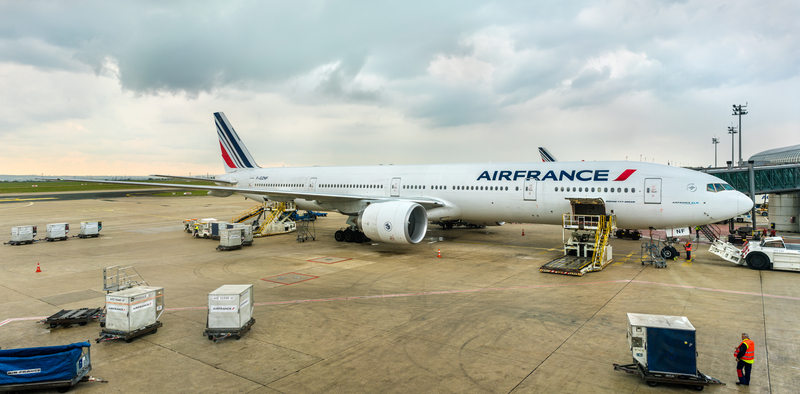
The challenge isn’t demand; it’s distance and yields. Phuket is a long, leisure-heavy route where fares tend to be relatively low. To make the economics work, Air France is deploying its most seat-dense widebody: the 472-seat Boeing 777-300ER, packed with economy seats and designed for very low seat-mile costs.
Inside Air France’s 472-Seat Boeing 777-300ER
Air France’s long-haul passenger fleet includes:
-
43 × Boeing 777-300ER
-
39 × Airbus A350-900
-
18 × Boeing 777-200ER
-
10 × Boeing 787-9
-
8 × Airbus A330-200
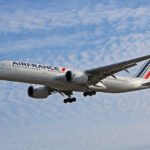
Within the 777-300ER subfleet, there are four different cabin layouts, ranging from 296 to 472 seats. The Phuket route gets the highest-capacity layout, which looks like this:
-
14 Business Class seats (1–2–1)
-
28 Premium Economy seats (2–4–2, 38″ pitch)
-
430 Economy Class seats (3–4–3, 31″ pitch)
That means about 91% of all seats on the aircraft are standard economy – a very deliberate choice for a long, leisure-focused route with modest premium demand.
Since Air France retired the Airbus A380, these 472-seat 777-300ERs are now the largest aircraft in the fleet by passenger capacity. There are 12 of them in this configuration.
They’re heavy and not cheap to operate per flight, but their real strength is extremely low cost per seat-mile, which is exactly what you want on long-haul routes where fares are relatively low but demand is high.
Paris–Phuket: Huge Demand, Thin Yields
Air France’s first CDG–Phuket flight departed Europe on November 27. The inaugural round-trip used a 328-seat Boeing 777-200ER, but nearly all subsequent rotations are planned with the 472-seat 777-300ER.
Between October 2024 and September 2025, the Paris–Phuket market saw roughly 197,000 round-trip passengers – about 540 per day. Until now, every one of them flew via a hub.
Phuket’s largest unserved European market was London (about 272,000 round-trip passengers, 745 per day), followed by Paris. With this new nonstop, Air France is targeting:
-
Strong point-to-point traffic between France and Phuket
-
One-stop itineraries from across Northern and Western Europe via CDG
Key European source markets for Phuket where CDG can now act as a convenient hub include:
-
London
-
Frankfurt
-
Copenhagen
-
Manchester
-
Munich
-
Zurich
-
Stockholm
-
Amsterdam
There are also many mid-sized markets with 20,000+ annual passengers to Phuket – places like Dublin, Gothenburg, and Birmingham – that can be fed over CDG.
The catch? Fares. Across all airlines and cabins, average one-way fares are around $562, including fuel surcharges. That’s even lower-yielding than Bangkok, and heavily driven by inbound leisure tourism. That’s exactly the environment where a high-density, low seat-cost 777-300ER makes sense.
Schedule: Paris–Phuket Winter Operation
For the winter season, Air France is running a seasonal CDG–Phuket schedule designed around overnight eastbound flying and daytime westbound returns. In December, typical timings look like:
CDG → Phuket (local times)
-
Saturdays: 15:05 – 08:50 (+1 day)
-
Mondays & Thursdays: 15:40 – 09:25 (+1 day)
Phuket → CDG (local times)
-
Sundays: 11:15 – 18:35
-
Tuesdays & Fridays: 11:55 – 19:15
Flight times are roughly 11 hours 45 minutes eastbound and around 13 hours 20 minutes westbound, depending on winds and routing.
Where Else Air France Flies The 472-Seat 777
In December, schedule data shows Air France’s 472-seat 777-300ERs averaging:
-
About six daily departures from Paris CDG
-
Around three daily departures from Paris Orly (ORY)
Unsurprisingly, the bulk of their work remains high-demand leisure and VFR routes, especially to France’s overseas territories:
-
Fort-de-France (Martinique) – daily from CDG and ORY
-
Pointe-à-Pitre (Guadeloupe) – daily from CDG and ORY
-
Saint-Denis (Réunion) – daily from CDG and ORY
Beyond these, the high-density 777s also appear on long-haul leisure and VFR routes to:
-
Dubai (DXB) – the most-served non-French market, daily in December
-
Mauritius
-
Mexico
-
Canada
-
Brazil (select December dates)
-
Peru (select December dates)
-
Thailand (Phuket)
Compared to last December, Brazil, Peru, and Thailand are new additions for this particular configuration, reflecting Air France’s strategy to use these aircraft where big volume but thinner yields demand maximum efficiency.
Bottom line
Air France has brought its densest 472-seat Boeing 777-300ER to its newest Thai route, Paris–Phuket, matching a huge, leisure-heavy market with a very low seat-cost aircraft.
Phuket sees millions of European visitors every year, but until now almost all of them have traveled via hubs in the Middle East or Asia. By launching a seasonal nonstop from CDG and feeding it with connections from across Europe, Air France is stepping into a market with strong demand but modest fares – exactly the scenario where its high-capacity 777s can shine.
For passengers, the trade-off is clear: a convenient nonstop and broad European connectivity, but on an aircraft where more than nine out of ten seats are in economy and arranged in a tight 3-4-3 layout. For Air France, if the route fills those 472 seats at sustainable fares, Phuket could become a textbook example of how to make very large aircraft work on long, sun-seeker routes.