A Dreamliner for a Commuter Hop: Qatar’s Shortest 787 Sector
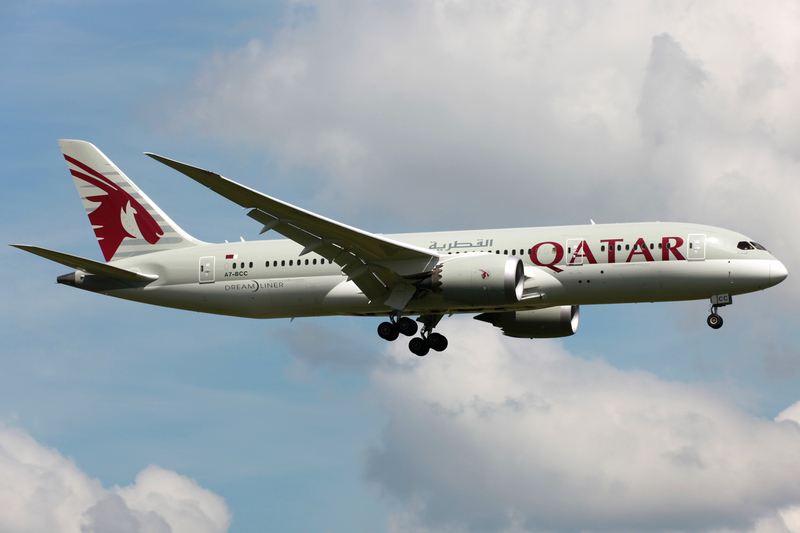
The Boeing 787 Dreamliner was built for marathon missions: long, thin routes where its composite airframe, efficient engines, and passenger-comfort tweaks can really shine. But every so often, the widebody that’s normally crossing oceans turns up doing something far more modest—like a hop so short you barely have time to settle in.
One of the most eyebrow-raising examples in Qatar Airways’ network is the shuttle between Doha Hamad International Airport (DOH) and Bahrain International Airport (BAH). It’s a sector that’s practically a “widebody cameo” in a world of A320s—yet it happens.
Doha (DOH) to Bahrain (BAH): A Dreamliner on a 91-mile sector
On a straight-line basis, DOH–BAH is roughly 91 miles (147 km). Schedules typically show block times around 50–55 minutes, but the airplane itself can spend far less time airborne; once you account for climb, a short cruise, and descent, the “in the air” portion can be startlingly brief on a good day.
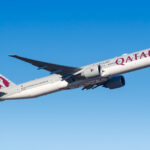
Qatar Airways normally assigns narrowbodies on the route—exactly what you’d expect for a high-frequency Gulf shuttle. The oddity is that the airline sometimes swaps in a Dreamliner (most commonly the 787-8) for specific rotations. When that happens, you’re essentially watching a long-haul asset do a commuter’s job.
So why would a carrier ever do that?
Why a widebody ends up on a short hop
Putting a 787 on a sector measured in double-digit miles looks inefficient on paper—and in many ways, it is. Takeoff and climb are the most fuel-intensive phases of flight, and widebodies also rack up expensive “cycles” (pressurization events) quickly on short sectors. But airlines don’t schedule airplanes in isolation—they schedule systems. A short-haul widebody assignment can make sense when it solves a bigger operational puzzle, such as:
-
Aircraft positioning for long-haul banks at DOH. DOH is built around tightly timed connection waves. A widebody might need to be in a specific place in the network—sometimes a short flight is simply the cleanest repositioning move.
-
Protecting premium and connecting capacity. If the day’s long-haul flows are peaking, a bigger aircraft on a regional sector can absorb misconnects, rebooked passengers, and last-minute demand without exploding the rest of the schedule.
-
Maintenance planning and fleet balancing. Airlines constantly manage aircraft utilization—hours, cycles, and planned checks. A short tag can be a convenient way to keep an aircraft on the right side of a maintenance plan, or to cover for another aircraft that’s downline.
-
Irregular operations recovery. When delays cascade, dispatchers use whatever capacity is available to “reset” the operation. A 787 covering DOH–BAH for a rotation can be a downstream consequence of an earlier disruption.
In other words: the Dreamliner isn’t on a 91-mile mission because that’s the best way to fly 91 miles. It’s there because it’s the best way to protect everything else the airline is trying to do that day.
What passengers get: long-haul hardware on a short flight
For travelers, a widebody sub-hour hop can be oddly satisfying—like being handed a flagship product for a shuttle run. On Qatar’s 787s, that usually means:
-
A true long-haul cabin with widebody galleys, larger lavatory capacity, and the general sense of space you don’t get on an A320.
-
Business Class built for distance, not just “front-cabin comfort.” Qatar’s Dreamliner Business Class is designed around long-haul expectations (seat design varies by subfleet), rather than a short-haul style recliner.
-
787 passenger-comfort features that were engineered for long segments: a quieter cabin, larger windows with electronic dimming, and the Dreamliner’s reputation for a more comfortable pressurization strategy compared with older widebodies.
Of course, on a hop like DOH–BAH, service is necessarily compressed. But the hard product—the seat, the cabin environment, the widebody boarding and deplaning flow—is the point. It’s a reminder that aircraft type changes can materially change the experience even when the route barely does.
Qatar’s short-sector widebody pattern goes beyond Bahrain
DOH sits in one of the world’s densest clusters of major airports, and Qatar Airways routinely links its hub to nearby capitals and commercial centers across the Gulf. That creates plenty of opportunities for occasional widebody substitutions on short sectors when the network needs it—whether to Saudi Arabia, the UAE, Kuwait, or beyond.
And then there are the tag-on markets, where Qatar operates multi-leg itineraries that create short standalone sectors embedded inside a longer route. A good example is southern Africa: the airline has used the 787 on services involving Lusaka (LUN) and Harare (HRE), where the inter-Africa leg is comparatively short even though the overall itinerary is intercontinental.
Bottom Line
A Boeing 787 on Doha (DOH) to Bahrain (BAH) looks like overkill—and for the passenger sitting through a widebody safety video before a very quick descent, it absolutely is. But in airline operations, “overkill” can be a feature: a widebody swap can protect connection banks, add capacity at the exact moment it’s needed, and keep a complex long-haul schedule from unraveling.
And for anyone who cares about fleet deployment, it’s a perfect micro-story: the Dreamliner, doing Dreamliner things… on a route you could almost measure in car-trip terms.