Breeze Crosses The Border: How An Airbus A220 Is Giving Smaller U.S. Airports Their First Taste Of International Flying
Breeze Airways’ international debut is classic David Neeleman: start where the majors aren’t looking, use right-sized aircraft, and sell “nonstop convenience” to passengers who’ve been driving to larger hubs for years.

On January 10, Breeze launched its first scheduled international service, linking Norfolk International Airport (ORF) with Cancun International Airport (CUN). For ORF, it’s a milestone the airport hasn’t been able to celebrate in roughly a quarter-century. For Breeze, it’s the opening move in a deliberately small, seasonal international network built around leisure demand, limited frequency, and a fleet that can make thin routes work.
A Small Airline’s International Playbook, Built For Thin Leisure Markets
Breeze’s early international map is not trying to be everything to everyone. It’s built around high-volume leisure flows to Mexico and the Caribbean—markets where a weekly nonstop can siphon meaningful demand from nearby drive-to airports, especially when fares undercut the legacies and schedules are timed around weekend travel patterns.
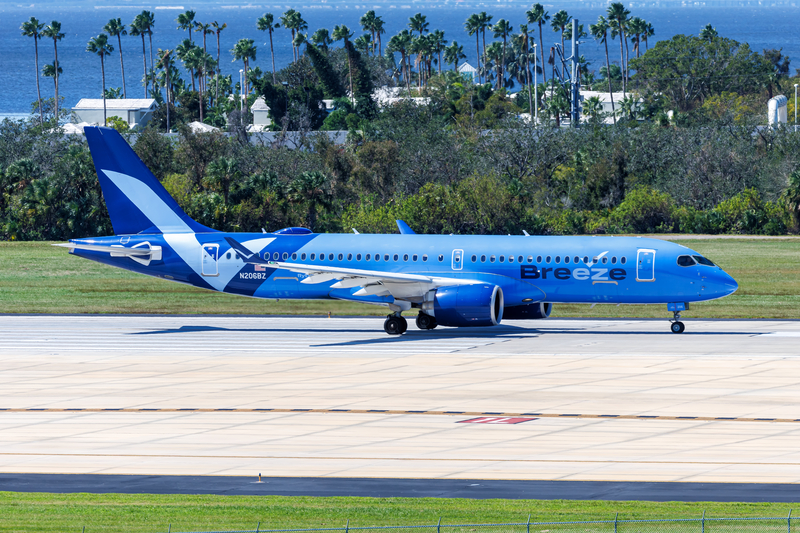
The airline’s long-haul-of-the-short-haul strategy leans heavily on the Airbus A220-300: a 2-3 configured narrowbody that’s unusually well-suited to long-ish leisure flying from secondary airports. The type’s range and economics let Breeze reach beach markets without needing to upgauge to an A320-family aircraft year-round, and without the trip-cost penalties of operating larger jets on routes that can be brutally seasonal.
For passengers, the A220’s cabin matters almost as much as the route. Wider seats than you’d expect in standard economy, larger windows, and quieter acoustics compared with older-generation narrowbodies make it a legitimate step up on flights that push into the 3–4 hour range. For operators and airport planners, it’s the aircraft that can make “first international” possible without betting the house.
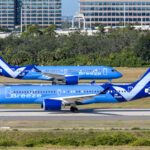
The Six Routes Breeze Has Put On The Board
Breeze’s initial rollout is anchored in Cancun (CUN) and Punta Cana (PUJ), with a sixth route—Montego Bay (MBJ)—pushed back after hurricane-related impacts in Jamaica. As filed and marketed, here’s the short list, with the airports called out the way industry people expect to see them:
-
Norfolk (ORF) – Cancun (CUN): launched January 10, initially weekly; Breeze has signaled the ability to grow frequency in peak periods.
-
Charleston (CHS) – Cancun (CUN): launching January 17, seasonal/low-frequency leisure pattern.
-
New Orleans (MSY) – Cancun (CUN): launching February 7, timed for weekend demand.
-
Providence (PVD) – Cancun (CUN): launching February 14, another “drive-to alternative” aimed at keeping New England leisure travelers out of BOS.
-
Raleigh–Durham (RDU) – Punta Cana (PUJ): launching March 4, positioned for the Research Triangle’s strong Caribbean leisure demand.
-
Tampa (TPA) – Montego Bay (MBJ): announced for early 2026 but deferred to later in 2026 after hurricane damage disrupted the near-term plan.

The pattern is consistent: low-frequency service is the trade Breeze offers for a nonstop that didn’t exist before. In airline economics terms, that’s a classic stimulation play—convert existing one-stop demand and capture new traffic from travelers who value nonstop convenience enough to accept fewer weekly choices.
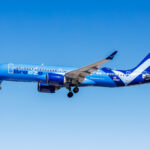
Why The Airbus A220-300 Is Doing The Heavy Lifting
If you’re trying to make international work from airports like ORF, CHS, and PVD, the aircraft choice is everything. The A220-300 sits in a sweet spot:
-
Range headroom for Mexico and the Caribbean without pushing payload limits the way older small narrowbodies can.
-
Trip-cost discipline that makes weekly flying viable—critical when you’re not trying to sustain daily service through shoulder seasons.
-
Passenger appeal that helps offset “only once a week” scheduling: when the onboard product is materially nicer than a tired legacy narrowbody, leisure customers notice.
Operationally, the A220 also keeps ground handling straightforward at smaller U.S. airports: no widebody gates, no special stand requirements, and a predictable turn profile. That matters when an airport is staffing up for CBP processing, international baggage flows, and irregular-ops contingencies that local teams may not exercise often.
Why Cancun Works From Norfolk, And What ORF Gains
From ORF, Cancun (CUN) is a smart first international market for one big reason: it’s already there in the data, even without nonstop flights. Cancun is a perennial top international destination for many mid-sized U.S. metros, and the “hidden” demand is often being served via connecting itineraries through Atlanta (ATL), Charlotte (CLT), New York (JFK/LGA/EWR), Washington (IAD/DCA), or Miami (MIA).
For ORF specifically, a nonstop to CUN does more than sell seats. It helps reposition the airport in the region’s mental map. In catchment areas where travelers default to driving to larger hubs for international service, a single nonstop can be a behavioral reset—especially when paired with competitive pricing and weekend-friendly timings.
Airports also care about what comes next: once you prove you can process an international arrival reliably—CBP staffing, baggage systems, passenger flows—you’ve lowered the barrier for additional international flying, whether that’s another airline, another destination, or expanded seasonal windows.
A Quick Reality Check: Low Frequency Is Both The Feature And The Risk
Weekly flying is a double-edged sword. It keeps utilization efficient and risk low for the airline, but it makes disruption painful. One maintenance delay or weather event can wipe out a week’s worth of customer goodwill, because there’s no “tomorrow’s flight” to re-accommodate onto without involving other carriers.
That’s why Breeze’s early international performance will be measured on more than load factor. The real test is whether the airline can hold yields high enough to justify the operational complexity of international flying—station staffing, handling contracts, CBP coordination, and higher customer-service costs when irregular operations strand leisure passengers far from home.
Bottom Line
Breeze’s first international flights aren’t about building a global network—they’re about proving that secondary U.S. airports like Norfolk (ORF) can sustain nonstop leisure service to demand-heavy markets like Cancun (CUN) when the gauge is right and the schedule is disciplined. The Airbus A220-300 is the enabler: big enough to be credible, small enough to be economical, and comfortable enough to sell the experience.
If these routes hold up through peak season and shoulder periods, expect Breeze to repeat the model across other underserved airports. If they don’t, the airline can exit cleanly—because weekly, seasonal flying is designed to be reversible.