Norse Atlantic’s U.S. Summer Reset: Fewer Flights, Same Dreamliner DNA
Norse Atlantic’s latest schedule tells you everything you need to know about the state of low-cost long-haul in 2026: the airline is slimming down its U.S. program hard, keeping only the flying it believes can consistently pay its way, and leaning even more on ACMI leasing to stabilize the business through the shoulder seasons.

Using Cirium schedule data, Norse’s U.S. capacity is down sharply year-over-year, with summer flying trimmed by roughly two-fifths. That’s a meaningful retreat for an airline built around transatlantic scale, and it’s happening even as the broader Europe–U.S. market remains crowded with widebody capacity and aggressive pricing.
What makes Norse’s move especially notable is that this isn’t a fleet problem in the traditional sense. This is a deliberate utilization problem: how to keep a small Dreamliner fleet productive, cash-generative, and resilient when transatlantic yields swing wildly by week—sometimes by day.
A Summer Map That’s Been Cut to the Structural Routes
For the peak July–September window, Norse’s remaining U.S. footprint centers on a short list of routes that fit its operational playbook: leisure-heavy demand, clear aircraft gauge discipline, and airport pairs where it can still stimulate traffic without being forced into a fare war it can’t win.
The U.S. schedule is essentially concentrated around New York JFK (JFK), Los Angeles (LAX), and Orlando (MCO), fed primarily from London Gatwick (LGW) and Rome Fiumicino (FCO), with seasonal flying from Paris Charles de Gaulle (CDG) and Athens (ATH) depending on the month and day-of-week pattern.
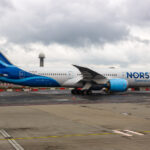
In practical terms, the summer program boils down to these city pairs:
-
Rome (FCO) – New York (JFK)
-
London Gatwick (LGW) – New York (JFK)
-
London Gatwick (LGW) – Orlando (MCO)
-
Athens (ATH) – New York (JFK)
-
London Gatwick (LGW) – Los Angeles (LAX)
-
Paris (CDG) – Los Angeles (LAX)
-
Rome (FCO) – Los Angeles (LAX)
This isn’t “growth with discipline.” It’s “survival with discipline.”
The Dreamliner Economics Behind the Decision
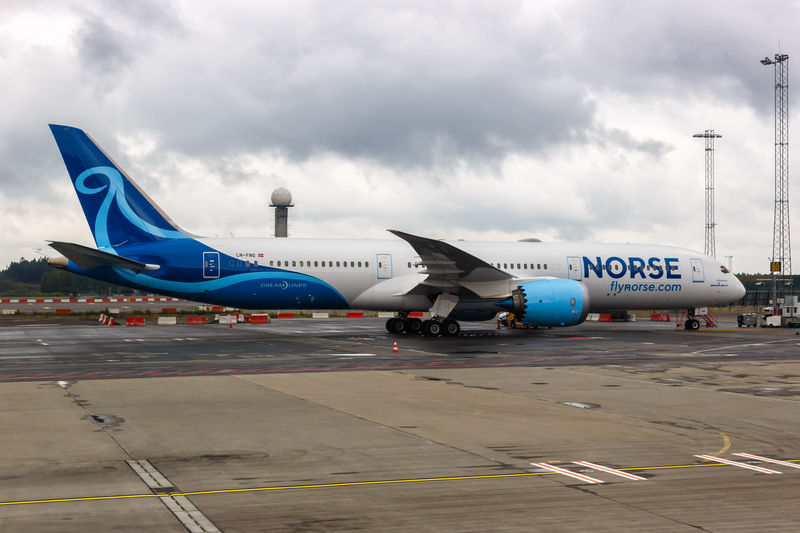
Norse is effectively a single-aircraft-type business model, and that fact shapes everything from network planning to disruption recovery.
The Boeing 787-9 is built for long stage lengths with lower fuel burn per seat than the older widebodies it replaces, and it’s quiet enough to play well at noise-sensitive airports. It’s also a high-utilization aircraft: the economics improve dramatically when you keep it flying, because ownership/lease costs, crew costs, and maintenance planning don’t care whether the airplane flies with 330 passengers or 230—your revenue does.
That’s the tension Norse is trying to resolve.
When a low-cost long-haul carrier adds too much summer capacity, it can dilute yields fast. When it keeps too much winter capacity, it bleeds cash even faster. Norse’s answer is to shrink the self-operated U.S. map to the routes most likely to hold up, and then place additional aircraft into ACMI flying where utilization and revenue are more predictable.
Why Some Routes Didn’t Make the Cut
Several U.S. routes that looked compelling on paper have proven difficult to sustain once the market moved from “post-pandemic demand spike” to “normalized competition.”
Routes such as London Gatwick (LGW) – Miami (MIA) and Paris (CDG) – New York (JFK) were always going to be exposed to intense pricing pressure, especially when legacy joint ventures can protect yields through connectivity, corporate contracts, and loyalty ecosystems. Even when load factors look “fine,” the real question is whether the fare mix can cover costs after distribution, handling, and irregular operations are accounted for.
For Norse, the schedule reset signals a preference for:
-
leisure-heavy demand where price stimulation still works (think LGW–MCO),
-
fewer head-to-head battles with multiple daily widebodies,
-
and routes where the 787-9’s range and payload profile stay comfortably inside performance margins.
ACMI Leasing: The Stability Lever Norse Needs
The most important line in Norse’s strategy isn’t a route announcement—it’s aircraft placement.
Norse has said it operates a fleet of roughly a dozen 787-9s and has confirmed an agreement to place up to six 787-9s into ACMI flying for IndiGo, with deliveries phased in through early 2026. That’s a major pivot. It effectively turns a meaningful chunk of the fleet into a revenue stabilizer: fewer seasonality shocks, fewer demand surprises, and fewer “all eggs in the transatlantic basket” quarters.
To airline professionals, the implication is straightforward: Norse is optimizing for predictable aircraft economics over brand footprint. ACMI revenue won’t make headlines the way new routes do, but it can make the difference between a sustainable utilization curve and a winter cash burn spiral.
What to Watch Next
A trimmed U.S. schedule doesn’t automatically mean weakness. In some cases, it’s the cleanest path to better margins—especially if:
-
the remaining routes concentrate around high-performing airport pairs (LGW/JFK, LGW/MCO, LGW/LAX),
-
seasonal flying to LAX from CDG and FCO is timed to peak leisure demand and tour operator patterns,
-
and ACMI utilization holds steady when the North Atlantic shoulder season arrives.
The real tell will be whether Norse continues to shorten seasons and reduce frequencies—or whether it can hold a stable summer core and let ACMI absorb the volatility elsewhere.
Bottom Line
Norse Atlantic isn’t abandoning the U.S.—it’s re-defining what “success” looks like there. By cutting summer flying materially and shrinking to a handful of routes anchored at LGW, FCO, and select seasonal points like CDG and ATH, the airline is protecting the only thing that truly matters in a small Dreamliner operation: consistent utilization that produces reliable cash flow. The 787-9 remains the engine of the business, but in 2026, Norse is increasingly choosing to monetize that engine through ACMI stability rather than chasing transatlantic scale for scale’s sake.