End of an Era at Wilmington: The Punta Cana Nonstop That Arrived and Departed Almost Overnight
Wilmington International Airport (ILM) is about to lose something it only just gained: scheduled international service.

Less than a month after Avelo Airlines launched ILM’s first-ever commercial international route—nonstop to Punta Cana, Dominican Republic (PUJ)—the ultra-low-cost carrier is preparing to pull the plug as it winds down its Wilmington operation. For a community airport, the optics are jarring: you build the capability, market the milestone, clear the first arriving passengers through a Federal Inspection Station…and then the flight disappears from the schedule.
Yet in today’s ULCC reality, “first international route” doesn’t necessarily mean “sticky international route.” It often means “seasonal trial balloon,” especially when the airline is actively resizing its fleet and pruning flying that doesn’t fit a new base strategy.
The Route That Made ILM International—In the Commercial Sense
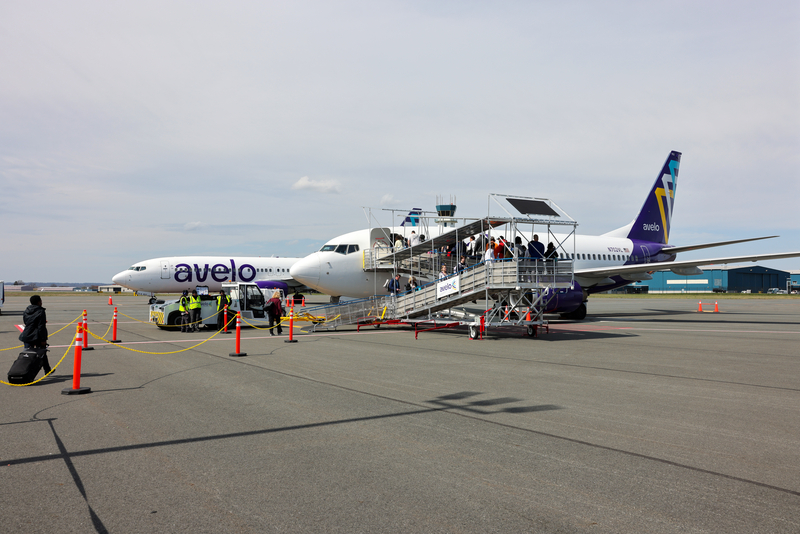
Avelo launched ILM–PUJ on December 24, 2025, operating twice weekly (Wednesdays and Saturdays). It was a clean, simple leisure play: a beach destination with strong winter appeal, packaged neatly into a schedule that keeps aircraft utilization efficient without committing to daily flying.
The published operating pattern has been:

-
XP1088: Wilmington (ILM) 10:00 → Punta Cana (PUJ) 14:05
-
XP1089: Punta Cana (PUJ) 15:35 → Wilmington (ILM) 17:53
Block times sit in the 3-hour range, which is right in the sweet spot for narrowbody Caribbean flying: long enough to generate meaningful revenue per departure, short enough to turn the aircraft and still protect the day’s rotations.
Why the Boeing 737-700 Was the Right Tool for ILM–PUJ
Avelo has been operating the ILM–PUJ service with the Boeing 737-700 (73W)—a pragmatic choice for a thin international market out of a smaller station.

From an airline planning standpoint, the -700 works here because it balances capacity and trip cost without forcing the route to “fill a bigger bus.” Avelo’s own fleet data places the 737-700 at 149 seats, powered by CFM56 engines, with a published range of 2,500 nautical miles—plenty for the roughly 3-hour sector length to the Dominican Republic. For ILM, it also means the airport can support an international operation with a common narrowbody type that fits typical gate and ramp constraints.
There’s another operational nuance that airline people will appreciate: the 737-700 is forgiving on performance margins and tends to slot well into schedules where you need flexibility around payload, alternates, and irregular operations. For a twice-weekly leisure route that depends heavily on peak-day demand, that matters.
The Bigger Story: Avelo Is Closing Its Wilmington (ILM) Base
The immediate reason ILM is losing PUJ is simple: Avelo is closing its ILM base and shrinking its footprint at the airport starting late January.
Local reporting and airport statements indicate Avelo is discontinuing service from ILM to 11 destinations, including Punta Cana (PUJ). The remaining ILM routes Avelo plans to keep are:
Everything else—spanning Florida, the Northeast, and the lone international link—falls off the board. The cut list reported locally includes, among others, Orlando (MCO), Fort Lauderdale/Miami (FLL), Fort Myers (RSW), West Palm Beach (PBI), Detroit (DTW), Rochester (ROC), Washington Dulles (IAD), and New York/Long Island (ISP), plus Wilmington, Delaware (ILG) and Punta Cana (PUJ).
That’s not a “route tweak.” That’s a station reset.
ILM Built the Capability—And That’s Not Going Away
Here’s the part that gets lost when a route vanishes quickly: ILM didn’t suddenly become capable of international arrivals in December.
ILM maintains a separate international terminal with a full Federal Inspection Station (FIS) for U.S. Customs and Border Protection processing. In other words, the infrastructure and procedures to clear international arrivals exist—commercial or otherwise.
Even more unusually, ILM has long had a niche role for general aviation customs operations. The airport itself notes that, under federal rules, it serves as a key CBP clearing point for certain GA flights arriving from south of 30°N latitude—an operational detail most travelers never see, but aviation pros will recognize as meaningful.
So while the airport may lose scheduled international service, ILM isn’t reverting to a purely “domestic-only” facility in terms of capability. What it’s losing is the scheduled airline demand needed to justify routine commercial international processing.
Why “First International Route” Can Be Fragile at Community Airports
For ILM, PUJ was always going to be a high-wire act—because small-airport international economics are unforgiving.
A few factors tend to determine whether a route like ILM–PUJ becomes durable:
Demand concentration: Leisure demand often spikes around school breaks and holidays, then softens quickly. Twice-weekly helps, but it also means limited re-accommodation options when things go wrong.
Fixed costs at both ends: Even with an existing FIS, airline station costs rise when you add international handling requirements. Coordination, staffing, and contingency planning become more complex than a typical domestic turn.
ULCC network volatility: ULCCs win by moving capacity quickly to wherever returns are strongest. That can be great for consumers, but it makes smaller markets inherently less “protected” when fleet plans shift.
In Avelo’s case, the airline’s broader restructuring is tied to fleet and base strategy—exactly the kind of corporate-level decision that can wipe out a local international route regardless of how the inaugural flight performed.
What This Means for ILM Travelers and the Region
ILM has grown sharply in recent years, and airport leadership has pointed to passenger volume rising from about 1.1 million to 1.8 million over roughly four years—strong growth by any regional-airport measure.
Even so, when a carrier closes a base, the near-term traveler experience changes immediately:
-
International travelers who were counting on nonstop PUJ will now either connect via hubs or drive to larger gateways like Raleigh–Durham (RDU) or Charlotte (CLT).
-
Domestic service becomes more concentrated, often with higher load factors on remaining routes—especially during peak season.
-
Competing airlines may absorb some demand, but replacing lost nonstop flying is rarely instantaneous, particularly on niche or leisure-heavy markets.
For the airport, the bigger question becomes: does the FIS-enabled milestone help attract another carrier to try international again—perhaps seasonally—or does the market revert to its domestic core while ILM focuses on frequency, connectivity, and reliability?
Bottom Line
ILM’s first scheduled international flight to Punta Cana (PUJ) was a milestone—and also a case study in how fast the economics can change when an ULCC reshapes its network.
Avelo’s ILM–PUJ service proved the airport can support commercial international arrivals and that the market can be stimulated quickly with the right price and schedule. But the route’s short life also highlights the harsh truth community airports know well: international service isn’t just about capability and community enthusiasm. It’s about fleet plans, base strategy, and whether a route fits the airline’s next six months—not its last press release.