Spirit’s Boston Winter Pivot: New Cancun and Santo Domingo Nonstops Join the Schedule
Spirit Airlines is in the middle of a restructuring, trimming capacity in some places while still hunting for pockets of demand it can serve profitably. The latest example is Boston Logan International Airport (BOS), where Spirit plans to add two limited-time international routes aimed squarely at winter sun traffic: Cancún International Airport (CUN) and Santo Domingo Las Américas International Airport (SDQ).

What’s notable isn’t just the destinations—it’s the strategy. Spirit is treating CUN and SDQ very differently, with a toe-in-the-water frequency to Mexico and a much more aggressive push to the Dominican Republic.
Two new BOS routes, two very different bets
Boston (BOS) – Cancún (CUN) is scheduled as a once-weekly operation, designed for the classic Saturday leisure pattern—ideal for weeklong resort stays and school-break demand. A weekly flight is also a low-risk way to test price elasticity in a market where competitors already offer plenty of seats.
Boston (BOS) – Santo Domingo (SDQ), on the other hand, is planned as a daily flight. That’s a much stronger signal: SDQ demand tends to be steadier thanks to a sizable visiting-friends-and-relatives base, and daily frequency matters more for travelers who care about day-of-week flexibility rather than perfectly matching a seven-night vacation.
Just as important: the SDQ service is structured like a utilization play. A late-night departure from BOS with an early-morning return keeps the aircraft productive without stepping on peak daytime turns, and it preserves the ability to rotate the same Airbus A320 into higher-frequency domestic flying during the day.

The aircraft choice tells you who Spirit is targeting
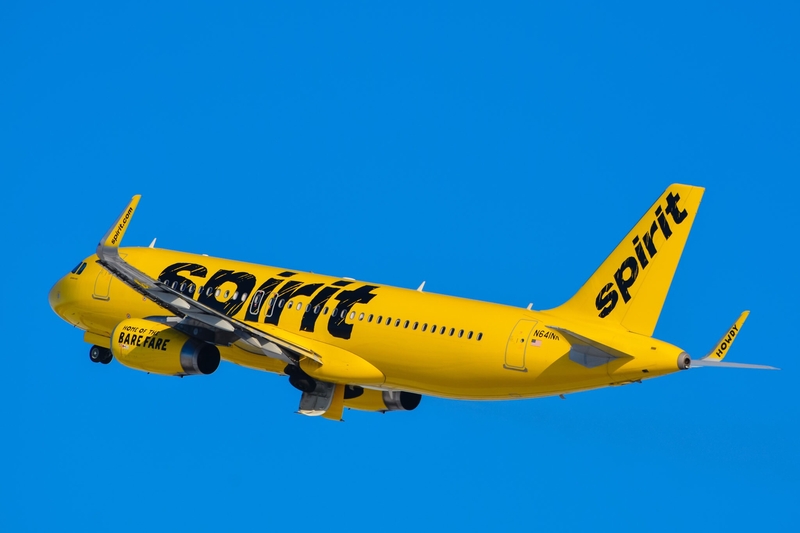
Spirit is planning to operate both BOS–CUN and BOS–SDQ with the Airbus A320 (A320-200)—a workhorse narrowbody that’s right in Spirit’s comfort zone.
For route economics, the A320 is a logical fit:
-
Stage length capability: Both CUN and SDQ are well within the A320’s typical operating envelope, even allowing for winter headwinds and alternate requirements.
-
Trip cost discipline: On leisure-heavy routes, especially where fare competition is intense, lowering trip cost is often more important than offering maximum premium volume.
-
Cabin monetization: Spirit’s model is built around unbundling—seat assignments, bags, priority boarding, and premium seating upsells. On Caribbean flying, that ancillary mix can matter as much as the base fare, particularly when customers are traveling with luggage.
Spirit’s onboard product isn’t designed to “win” on frills, but it is designed to sell choice. The A320 layout supports that well: a standard 3–3 cabin with a small forward premium section (Spirit’s Big Front Seat concept) gives the airline something higher-margin to sell without needing a true premium cabin.
Cancun vs. Santo Domingo: competitive realities from BOS
Cancún (CUN) from Boston (BOS) is one of those markets where demand is enormous—but so is capacity. That’s exactly why Spirit’s weekly approach makes sense. In a crowded CUN market, adding daily flying can quickly turn into a fare war, and ULCCs don’t want to be the last carrier standing with empty seats at low yields. A weekly flight lets Spirit participate in peak leisure demand without overcommitting aircraft time.
Santo Domingo (SDQ) is a different kind of contest. JetBlue has historically been a heavyweight in BOS Caribbean flying, and SDQ is a market where schedule matters—especially for VFR traffic that doesn’t always move neatly around weekends. If Spirit wants relevance rather than novelty, daily service is the entry price.

Also worth noting: SDQ has a broader “needs-based” demand profile than CUN. Travelers heading to SDQ are often less flexible, which can support better close-in pricing than purely discretionary resort traffic—one of the few levers airlines can pull when base fares get pressured.
Why add routes while restructuring?
Route adds during a restructuring can look counterintuitive until you remember what network planning actually is: reallocating scarce aircraft time to markets that offer the best near-term cash generation. If a carrier is reducing flying in weaker, low-performing segments, it can still redeploy into peak-season leisure routes where:
-
Load factors are easier to build quickly
-
Ancillary revenue per passenger rises (bags, seats, bundles)
-
Aircraft utilization improves through smart timing (especially red-eyes)
In other words, you can be shrinking overall and still “grow” selectively where the math works.
Bottom Line
Spirit’s planned BOS expansion to Cancún (CUN) and Santo Domingo (SDQ) looks less like a growth story and more like tactical scheduling: a low-frequency test in a heavily contested leisure market (CUN), paired with a daily, utilization-friendly play into a steadier Caribbean/VFR market (SDQ). With the Airbus A320 doing the lifting, the strategy is consistent with how ULCCs try to generate cash—high aircraft productivity, tight trip costs, and a heavy reliance on ancillary revenue—especially when every seasonal decision has to justify itself.